Best Catfish Holes on Lake Murray
It can be incredibly frustrating to hit a new lake, or even a familiar one, and feel like you're just casting blind, especially when you're after those elusive catfish. Whether you're chasing trophy blues, plentiful channels, or cunning flatheads, knowing where to drop your line on a vast lake like Murray can make all the difference. This guide will walk you through the best catfish holes on Lake Murray, giving you the insider knowledge to make your next trip a success, from specific spots to the techniques that work best there.
Understanding Lake Murray's Diverse Catfish Population
Lake Murray, nestled near Ardmore in southern Oklahoma, isn't just a pretty face; it's a fantastic fishery, particularly for catfish. What makes it so special is its clear, deep waters combined with abundant forage and structure that different catfish species absolutely love. Before we dive into the specific "holes," it’s crucial to understand a bit about the types of catfish you're likely to encounter and what they prefer. Knowing your target helps you choose the right spot and strategy.
Channel Catfish: The Everyday Angler's Delight
Channel catfish are the bread and butter for many Oklahoma anglers, and Lake Murray has them in spades. These guys are opportunistic feeders, often found in a variety of habitats, from shallow flats to deeper creek channels. They're typically identified by their forked tails and scattered spots, though larger channels can lose their spots. What makes them so appealing is their aggressive bite and delicious table fare.
On Lake Murray, you'll find channels thriving in areas with moderate depth, especially near submerged timber, brush piles, or along ledges that drop into deeper water. They love to cruise these areas looking for an easy meal. During warmer months, they might move into shallower coves in the evenings or early mornings, but they'll often retreat to deeper, cooler water as the sun climbs high. Think about areas where smaller baitfish might gather, as channels are always on the hunt.
Blue Catfish: The Lake Murray Heavyweights
If you're dreaming of a true trophy, Lake Murray's blue catfish are your target. These powerful fish can grow to impressive sizes, offering a real fight. Blue catfish are recognizable by their deeply forked tails, streamlined bodies, and a noticeable hump on their back. Unlike channels, blues tend to prefer deeper, open water, often congregating in large schools around significant underwater structure, like the main lake channel or deep humps and ledges.
Lake Murray's clear waters mean that blue catfish can be a bit more challenging to locate, as they're not always as eager to enter extremely shallow water as their channel cat cousins. They primarily feed on baitfish, so finding schools of shad is often key to finding the blues. Look for them holding close to the bottom in deeper sections, particularly where there's a strong current break or a significant depth change. Remember that Oklahoma's Catfish Fishing Rules and Limits include specific regulations for blue catfish, like the single 30-inch blue catfish rule, which you'll want to be familiar with.
Flathead Catfish: The Elusive Lunker
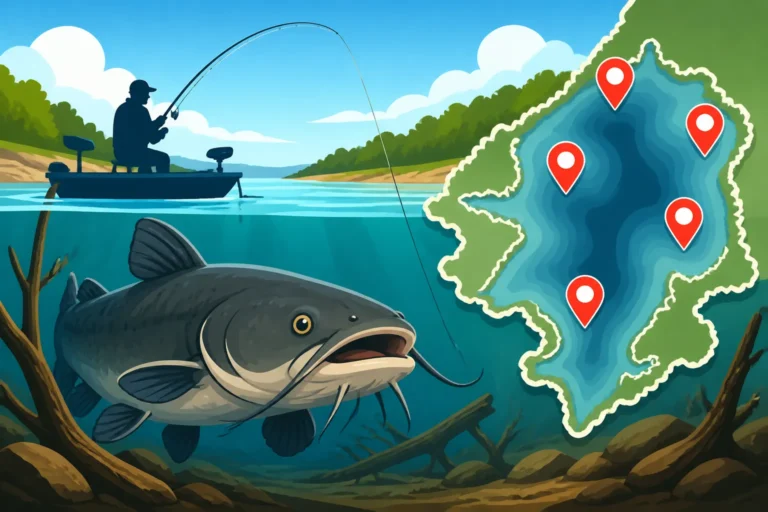
Flathead catfish are the true ambush predators of Lake Murray's catfish population. These solitary giants have flattened heads (hence the name), small eyes, and a square-shaped tail. They prefer live bait and often hide in heavy cover, waiting to ambush their prey. You won't typically find them in open water schools like blue cats or cruising flats like channels.
On Lake Murray, flatheads will gravitate towards the gnarliest cover imaginable: massive log jams, deep rock piles, or dense standing timber. They need a place to hide and ambush, and they'll rarely stray far from it. Targeting flatheads requires a different approach, often involving heavy tackle and presenting live bait right in their living room. While they might be harder to find, the reward of a massive, hard-fighting flathead is well worth the effort.
Prime Catfish Holes and Structures on Lake Murray
Lake Murray boasts diverse underwater topography, offering numerous productive spots for catfish. Understanding these key areas and what makes them attractive to different species is crucial.
The Main Lake Channel and Riverbeds
The deepest part of Lake Murray, the old river channel, is a magnet for blue catfish. This submerged channel snakes its way through the lake, providing consistent deep water and congregation points for baitfish, especially during warmer months.
- Specifics: You'll want to focus on areas where the channel makes a bend or where it intersects with a significant creek channel. These intersections create depth changes and current breaks that blue cats love. Look at topographical maps (many modern fish finders have them) to identify these bends and intersections. The stretch of the old Washita River bed that runs through the lake is particularly productive.
- Tactics: Drift fishing with cut bait (shad is king here) along the channel is incredibly effective. Use heavy sinkers to keep your bait near the bottom. You can also anchor up on a prominent hump or ledge adjacent to the channel and fan cast multiple rods. In this deep water, patience is key. The Best Bait for Catfish in Oklahoma Lakes and Rivers often includes cut shad, perch, or even chicken liver for channels.
Submerged Timber and Brush Piles
Lake Murray has a fair amount of submerged timber and intentionally placed brush piles, which are sanctuaries for channel catfish and prime ambush points for flatheads. These underwater forests offer cover, food, and cooler water in the summer heat.
- Specifics: Many coves and protected bays, particularly on the northern and eastern sides of the lake, will have standing timber or sunken brush. Some of these are naturally occurring, while others have been placed by local anglers or the Oklahoma Department of Wildlife Conservation (ODWC). Use your sonar to identify these structures. Areas near the Lake Murray State Park marinas often hold submerged cover.
- Tactics: For channel cats, cast scented baits like punch baits, stink baits, or cut shad near the edges of the timber or brush. Let your bait settle to the bottom. For flatheads, you'll need live bait – a big sunfish or perch – presented right into the densest part of the cover. This often requires heavier line and a stout rod to muscle them out before they can tangle you in the structure. Consider a Carolina Rig for Bass to avoid snags, but use a much heavier version for catfish here.
Rocky Points and Ledges
The clear, rocky shores of Lake Murray extend underwater, forming numerous points and ledges that drop into deeper water. These areas are excellent for both channel and blue catfish, depending on the depth and structure.
- Specifics: Anywhere you see a prominent rock point extending into the lake, assume there's a good chance for catfish. Ledges, which are sharp drops in depth along the bottom, are also fantastic. The western side of the lake, with its more rugged terrain, has several such areas.
- Tactics: For channels, fish the shallower ledges (10-25 feet) with traditional baits. For blues, focus on the deeper ledges (30-60+ feet) that might have schools of shad nearby. Bottom fishing is the name of the game here. You can also try vertical jigging with heavy spoons if you spot baitfish and predatory fish on your sonar. Think about where these points create natural pathways for fish moving between shallow feeding grounds and deep water safety.
Deep Humps and Underwater Islands
Lake Murray features several underwater humps and islands that don't break the surface. These isolated structures in deeper water act as natural fish attractors, concentrating baitfish and, consequently, hungry catfish.
- Specifics: These are harder to find without a good fish finder and a detailed lake map. Once you locate one, mark it on your GPS! These spots are often found in the central and southern parts of the lake, away from the immediate shoreline.
- Tactics: These humps are prime territory for blue catfish. Anchor upwind of the hump and let your cut bait drift over the top and down the sides. Alternatively, slow troll with multiple lines rigged with live or cut bait across the top and around the base of the hump. This helps you cover more ground until you locate the school. The "Deep Water Striper Fishing Techniques" article might offer some useful cross-species strategies for finding fish in similar deep structures.
Bank Fishing Hotspots
Not everyone has a boat, and Lake Murray offers some excellent bank fishing opportunities for catfish, especially for channel cats.
- Specifics: Look for public access points with rip-rap (rocky embankments), jetties, or points that drop off relatively quickly into deeper water. Areas around Catfish Bay, Elephant Rock, and the various public access points within Lake Murray State Park can be very productive. The causeways and bridges often provide good access to deeper water and structure from the bank.
- Tactics: Cast your bait (stink bait, chicken liver, cut hot dogs) as far out as you can, letting it settle to the bottom. Use a slip-sinker rig to allow the fish to take the bait without feeling resistance. Fishing at dawn, dusk, or even into the night can significantly increase your success when fishing from the bank. Night Fishing Techniques in Oklahoma can be particularly effective for catfish, as they often become more active after dark.
Here's a quick comparison of catfish preferences on Lake Murray:
| Catfish Species | Preferred Habitat | Preferred Depth | Key Bait Types | Best Times |
|---|---|---|---|---|
| Channel Catfish | Submerged timber, brush piles, ledges, coves | 10-30 feet | Cut shad, chicken liver, prepared baits, worms | Dawn, Dusk, Night |
| Blue Catfish | Main lake channel, deep humps, rocky points, ledges | 20-60+ feet | Cut shad, live perch, skipjack herring | Day and Night |
| Flathead Catfish | Heavy log jams, deep rock piles, dense standing timber | 15-40 feet | Live sunfish, live perch, live bluegill | Dusk, Night |
Essential Techniques and Baits for Lake Murray Catfish
Catching catfish on Lake Murray, regardless of the species you're targeting, often comes down to mastering a few fundamental techniques and using the right bait. These aren't complicated, but doing them well makes a huge difference.
Bottom Fishing Rigs
For almost all catfish scenarios on Lake Murray, you'll be fishing on or near the bottom. The most common and effective setups involve a weight to hold your bait down and a hook that allows the catfish to take the bait without feeling too much resistance.
- The Carolina Rig (Slip Sinker): This is arguably the most versatile rig for Lake Murray catfish. It consists of a slip sinker (egg sinker or bullet sinker) on your main line, followed by a bead (to protect your knot), a swivel, and then a leader (12-24 inches) tied to your hook. The slip sinker allows the line to slide through it when a fish bites, giving the catfish time to mouth the bait before feeling the weight of the sinker. This is crucial in the clear waters of Lake Murray where fish can be a bit more wary. It's excellent for fishing over varied bottom types, from muddy flats to rocky ledges. Learn how to Rig a Slip Sinker for Catfish for optimal presentation.
- Three-Way Swivel Rig: When you need to present your bait slightly off the bottom, or in areas with snags where you want the weight to break off if it gets stuck, a three-way swivel rig is a good option. One eye of the swivel goes to your main line, another to a short leader with a weight, and the third to a longer leader with your hook. This allows your bait to float or drift just above the bottom, keeping it visible and away from light cover. This can be effective around the edges of brush piles where channel cats might be suspended.
Bait Selection: Matching the Menu
As mentioned earlier, different catfish species have different dining preferences. Matching your bait to your target fish on Lake Murray is a critical step.
- Cut Bait: For blue catfish, fresh cut bait is king. Shad, particularly gizzard shad, are abundant in Lake Murray and are a natural food source for blues. Cut them into steaks or chunks appropriate for the size of fish you're targeting. Perch or sunfish also make excellent cut bait. The fresher, the better! You can learn more about using Best Cut Bait for Catfish Fishing in a dedicated guide.
- Live Bait: Flathead catfish are almost exclusively predatory and prefer live bait. Small sunfish, perch, or bluegill (check local regulations for baitfish size and collection) hooked through the back or lips are irresistible to a hungry flathead. Present these close to heavy cover.
- Prepared Baits: Channel catfish aren't picky. Stink baits, punch baits, and even marinated chicken livers are highly effective, especially when fishing from the bank or in areas with a high density of channel cats. These baits release strong scents that attract channels from a distance. Berkley Gulp! baits also have some excellent options for a convenient, scent-infused alternative.
Seasonal Adjustments
Catfish behavior on Lake Murray changes with the seasons, and so should your techniques.
- Spring: During the spring, as water temperatures rise, channel cats will move into shallower coves and creek arms for spawning. Blues will start to become more active, moving up and down the main lake channel. This is a great time for both species.
- Summer: Summer means warmer surface water, driving most catfish deeper during the day. Focus on the main lake channel, deep humps, and the coolest, deepest parts of the lake. Night fishing becomes incredibly productive as fish move shallower to feed under the cover of darkness. Check out Summer Night Fishing Tips for Oklahoma Reservoirs for more insight.
- Fall: As water temperatures drop in the fall, catfish will often go on a feeding frenzy to bulk up for winter. They can be found in a wider range of depths, often following schools of baitfish. This can be one of the best times for trophy blue cats.
- Winter: Don't write off winter! While slower, big blue catfish can still be caught in the deepest parts of the lake, often congregating in large schools. Locate them with your fish finder and present bait directly to them. Winter Catfishing Techniques in Oklahoma can lead to some surprisingly good catches.
Planning Your Lake Murray Catfish Adventure
A successful fishing trip to Lake Murray isn't just about knowing where the fish are; it's also about being prepared and understanding the broader environment.
Gear Up Right
Having the right gear makes a huge difference, especially when you hook into a monster blue or flathead.
- Rods and Reels: For channel cats, a medium-heavy spinning or baitcasting combo is usually sufficient. For larger blue and flathead catfish, you'll want a heavy-action rod (7-9 feet) paired with a robust baitcasting reel capable of holding at least 200 yards of 20-30 lb monofilament or 50-80 lb braided line. This is the kind of setup you'd consider for "Best Rod for Catfish Fishing From a Boat."
- Line: Monofilament is more forgiving with stretch, but braided line offers superior strength, sensitivity, and smaller diameter for its breaking strength, which can be crucial in deep water. A good quality fluorocarbon leader can offer abrasion resistance against the lake's rocky bottom.
- Hooks: Circle hooks (3/0 to 8/0, depending on bait size and target fish) are highly recommended, as they typically hook fish in the corner of the mouth, making for easier release if desired and reducing gut-hooking.
- Accessories: Don't forget essentials like a sturdy net (a big one for big cats!), a pair of pliers for hook removal, a good headlamp for night fishing, and a cooler with ice for your catch.
Local Knowledge and Resources
While this guide provides a solid foundation, local knowledge is invaluable.
- Talk to Locals: Strike up conversations at bait shops in Ardmore or Sulphur, or at the boat ramps like those found at the Best Boat Ramps on Lake Murray, Oklahoma. Local anglers are often willing to share general tips, especially if you're respectful.
- FishingBooker Guides: If you're serious about finding the biggest cats or just want to maximize your time on the water, consider hiring a local guide. Services like FishingBooker can help you connect with experienced catfish guides who know Lake Murray intimately. They have the sonar, the boat, and the specialized knowledge to put you on the fish quickly, often targeting the specific "Catfish Holes on Lake Murray" we've discussed. This can be a great way to learn advanced techniques and pinpoint exact locations for future trips.
- ODWC Reports: The Oklahoma Department of Wildlife Conservation (ODWC) often publishes fishing reports and surveys specific to Lake Murray. These can give you insights into recent stocking efforts, fish populations, and general fishing conditions.
Safety on the Water
Lake Murray is a large body of water, and safety should always be a top priority.
- Weather: Keep an eye on the weather forecast. Oklahoma storms can pop up quickly, and strong winds can make navigating Lake Murray challenging.
- Boating Safety: Ensure your boat is equipped with all necessary safety gear, including life jackets for everyone on board. Remember the "Life Jacket Rules for a 10 Year Old on an Oklahoma Boat" and that even adults should have one readily available.
- Navigation: While fishing, pay attention to navigation markers and submerged hazards, especially when exploring new areas or fishing at night.
Lake Murray truly offers a fantastic catfishing experience, from plentiful channels for a fish fry to the potential for a personal best blue or flathead. With a bit of planning, the right gear, and an understanding of these prime spots and techniques, you'll be well on your way to a memorable day on the water.
Disclaimer
Fishing regulations can change, and it is always the angler's responsibility to stay informed about the most current rules set by the Oklahoma Department of Wildlife Conservation. Please check their official website or a current fishing guide before heading out on your trip to ensure compliance with all license requirements, bag limits, and other regulations.