Trolling Motor Setup for Oklahoma Striped Bass
Striped bass fishing on Oklahoma's big reservoirs like Texoma often means covering vast amounts of water to find schools of active fish. Without the right trolling motor setup, anglers can struggle to effectively present baits, maintain consistent speed, and stay precisely on fish once they're located, leading to frustrating days and missed opportunities. This guide will walk you through everything you need to know to assemble and optimize the ideal trolling motor setup for chasing those hard-fighting Oklahoma striped bass, making your time on the water more productive and enjoyable.
Why a Trolling Motor is Essential for Oklahoma Striped Bass
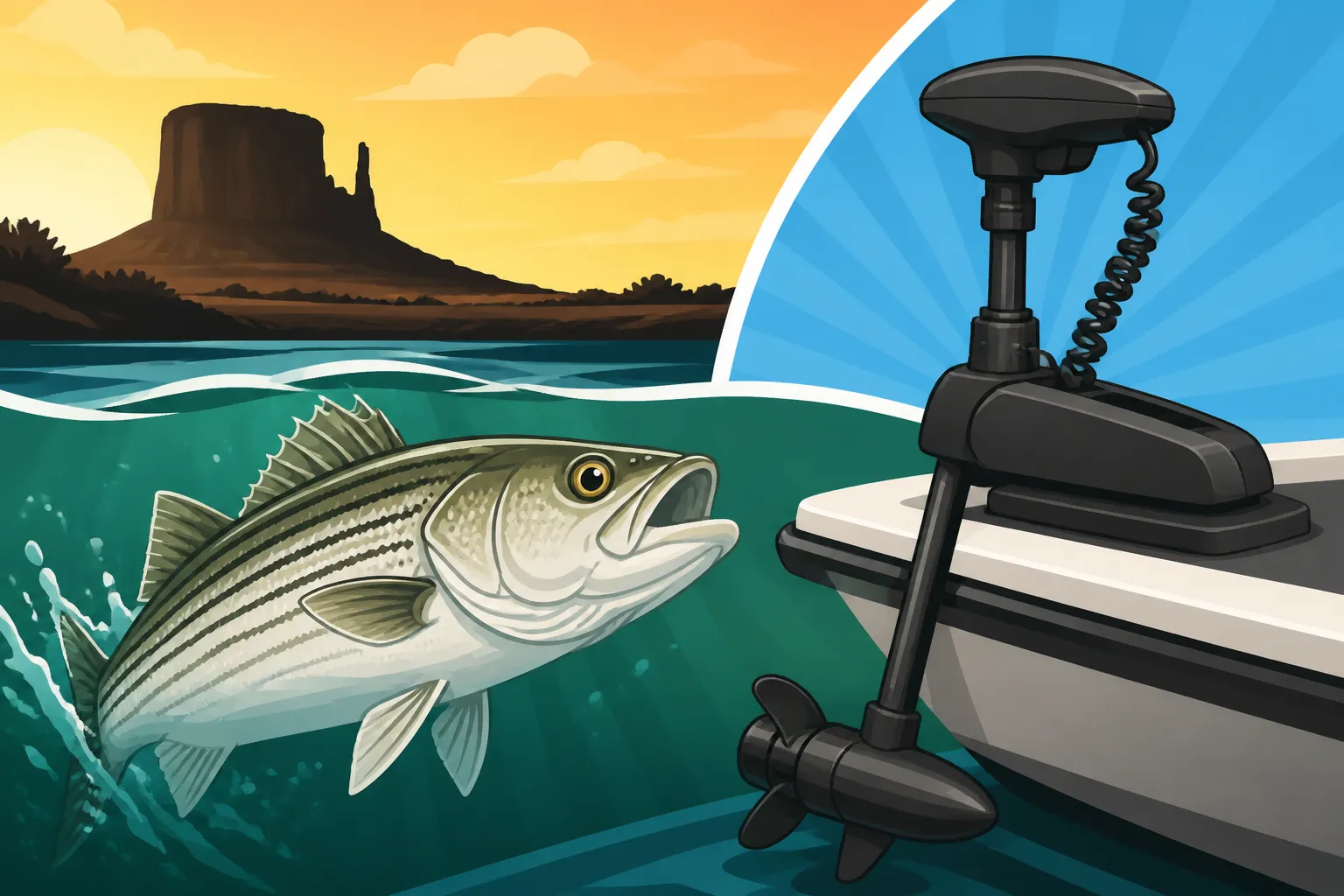
When you're out on sprawling lakes like Texoma, chasing striped bass isn't like casting for bass along a weed line. Stripers are pelagic, meaning they roam vast open water, often suspended at certain depths or following baitfish schools. Your main motor is great for getting to a general area quickly, but it's far too powerful and noisy for the finesse work required to effectively fish for stripers. This is where a dedicated trolling motor becomes not just a convenience, but an absolute necessity for serious striper anglers.
Stealth and Precision in Striper Fishing
Imagine you've marked a school of striped bass on your sonar, maybe suspended over a deep channel or near a submerged hump. If you try to hold your position with your main outboard, the prop wash and engine noise can easily spook these sensitive fish, sending them scattering before you even get a bait in the water. A trolling motor, especially an electric one, operates with minimal noise and disturbance. This allows you to slowly approach the school, maintain a discreet distance, and present your lures or live bait without alarming the fish. It’s the difference between crashing a party and subtly joining it, and when it comes to wary fish like stripers, subtlety often means success.
Beyond stealth, precision is paramount. When you're trying to troll at a specific speed, say 2-3 mph, or hold your boat directly over a small, isolated piece of structure, your main motor simply can't offer that level of control. Trolling motors allow for minute adjustments in speed and direction, enabling you to keep your boat exactly where it needs to be to intercept those fast-moving striper schools. This precision also comes in handy when navigating tight turns around structure or working a specific depth contour.
Covering Large Open Water Expanses
Oklahoma's premier striped bass lakes, like Lake Texoma, Grand Lake O' the Cherokees, and Lake Eufaula, are immense bodies of water. Covering these vast expanses efficiently to locate schools is a critical part of the game. While your main engine gets you to the general vicinity, a powerful bow-mount trolling motor with GPS capabilities transforms your boat into a highly maneuverable fishing platform. You can use it to meticulously work large areas, following subtle changes in depth, temperature breaks, or baitfish concentrations.
Think about a typical striper day: you might be cruising the main lake, marking bait on your sonar, and then suddenly you see those tell-tale arches below. A good trolling motor lets you immediately deploy and start working that area, slowly circling the school or pulling your baits directly through it. You can zig and zag, adjust for wind and current, and cover a wide swath of water without constantly starting and stopping your noisy outboard. This capability is absolutely crucial for effective Striped Bass Fishing Techniques for Oklahoma's Lake Texoma and other large reservoirs.
The Advantage of Spot-Lock Technology
For many anglers targeting Oklahoma striped bass, GPS-enabled trolling motors with "spot-lock" or "anchor" features have been a game-changer. This technology allows the trolling motor to automatically hold your boat's position, compensating for wind and current, essentially acting like a virtual anchor. Imagine you've found a thriving school of stripers, or a critical submerged point, and you want to cast to them without drifting away. Instead of constantly fiddling with the foot pedal or remote, you simply activate spot-lock.
This technology frees you up to focus entirely on fishing. You can rig new baits, assist a fellow angler, or fight a fish without worrying about your boat drifting off course. It’s especially invaluable when live-baiting for stripers, where maintaining a precise position over a marked school is key. For those long days on the water, having the boat automatically hold its position significantly reduces fatigue and boosts your fishing efficiency, making your Deep Water Striper Fishing Techniques much more effective.
Key Trolling Motor Features for Striped Bass Anglers
Choosing the right trolling motor isn't just about picking one off the shelf. For Oklahoma striped bass, you need to consider specific features that will stand up to the challenge of big water, strong currents, and hard-fighting fish. The size of your boat, the typical conditions you face, and your fishing style all play a role in making the optimal selection.
Thrust and Shaft Length Considerations
When it comes to trolling motors for striped bass, thrust is king. You need enough power to move your boat against significant wind and current, especially on large, open reservoirs. A good rule of thumb is to have at least 2 pounds of thrust for every 100 pounds of fully loaded boat weight. However, for serious striper fishing, I always recommend going higher, especially if you have a larger boat (18+ feet) or frequently fish in windy conditions. Many anglers find 80-112 pounds of thrust to be ideal for typical bass or bay boats chasing stripers. More thrust means better control, especially when trying to hold position or maintain a specific trolling speed in choppy water.
Equally important is shaft length. The shaft needs to be long enough so that the propeller remains submerged even in rough water. If your prop comes out of the water, you lose thrust and control, and it can be a jarring experience. To measure, determine the distance from where the motor will mount to the waterline, then add approximately 20 inches for bow-mount motors. For boats with high bows or that see significant waves, a 60-inch or 72-inch shaft might be necessary. It’s always better to have a slightly longer shaft than one that's too short. Nothing is more frustrating than a prop cavitating when you're trying to stay on a hot bite.
Bow-Mount vs Transom-Mount Motors
For serious Oklahoma striped bass fishing, a bow-mount trolling motor is almost universally preferred. These motors are mounted on the front of the boat, which allows you to "pull" the boat through the water rather than "pushing" it from the back. Pulling offers superior control and maneuverability, especially when trying to hold a specific course, navigate around submerged structure, or precisely follow a contour line. With a bow-mount motor, your boat reacts much more intuitively to steering inputs, making it easier to stay on fish. They also typically come with more advanced features like GPS anchoring and autopilot.
Transom-mount motors, while simpler and often less expensive, are generally only suitable for smaller boats, canoes, or kayaks, or as a secondary "kicker" motor for very light trolling. They lack the power, control, and features required for effectively chasing stripers on large reservoirs. Trying to control a larger boat in wind and waves with a transom-mount motor can quickly become a frustrating battle, compromising your ability to target these often-elusive fish.
GPS Integration and Advanced Functions
Modern trolling motors have evolved far beyond simple foot pedals and basic steering. GPS integration is arguably the most valuable advancement for striped bass anglers. Features like Spot-Lock (Minn Kota's term) or Anchor Mode (Garmin, Lowrance, MotorGuide) allow the motor to use satellite positioning to automatically hold your boat in place. This is invaluable when you've located a school of stripers and want to stay on them to cast or deploy multiple lines. It eliminates the need for a physical anchor, saves time, and dramatically increases fishing efficiency.
Beyond spot-lock, many high-end trolling motors offer:
- Autopilot: Allows the motor to steer a specific compass heading.
- Route Tracking: Record a path and have the motor automatically retrace it, perfect for Trolling Gear for Striped Bass at Oklahoma's Lake Texoma patterns.
- Cruise Control: Maintains a precise speed, critical for many striper trolling techniques.
- Integration with Fish Finders: Many systems can link directly to your marine electronics, allowing you to control the motor from your fish finder screen or even have it follow contour lines from your mapping. This kind of integration can be a massive advantage, letting you focus on watching your sonar for fish instead of constantly adjusting the motor. When buying, consider brands like Minn Kota or Garmin, which offer robust ecosystems.
| Trolling Motor Feature | Benefit for Striped Bass Anglers |
|---|---|
| High Thrust (80-112 lbs) | Power to combat wind and current, especially on large lakes like Texoma. |
| Long Shaft (60-72 inches) | Keeps propeller submerged in choppy water for consistent control. |
| Bow-Mount Design | Superior boat control, maneuverability, and responsiveness when pulling. |
| GPS Spot-Lock | Automatically holds boat position, acts as a virtual anchor over fish schools. |
| Autopilot/Route Tracking | Maintains precise course/trolling path, reduces angler fatigue. |
| Fish Finder Integration | Control motor from display, follow contours, optimize bait presentation. |
Powering Your Trolling Motor: Battery and Charging Systems
A trolling motor is only as good as the power source feeding it. For Oklahoma striped bass, you're often out on the water for extended periods, covering a lot of ground, and potentially running your motor consistently. This means your battery and charging system need to be robust and reliable. Skimping here is a common mistake that can lead to a prematurely cut short fishing trip.
Understanding Battery Types and Capacities
Most heavy-duty trolling motors (80 lbs thrust and above) will require a 24-volt or even a 36-volt system, meaning you'll need two or three 12-volt deep-cycle batteries wired in series. Deep-cycle batteries are designed for sustained power draw over long periods, unlike starting batteries that deliver a quick burst of power.
When choosing batteries, look at their amp-hour (Ah) rating, which indicates how long a battery can deliver a certain amount of current. The higher the Ah rating, the longer your trolling motor will run. For striped bass fishing, you want the largest Ah capacity you can reasonably fit and afford. Traditional lead-acid deep-cycle batteries are a common choice, offering a good balance of cost and performance. However, if your budget allows, lithium-ion batteries are rapidly gaining popularity for their significantly lighter weight, longer run times, consistent power output, and longer lifespan. They come with a higher upfront cost but often pay for themselves over time. You can find a good selection of both types at retailers like Bass Pro Shops or online through Amazon.
- Lead-Acid (Flooded/AGM): More affordable, heavier, require more maintenance (flooded). AGM (Absorbed Glass Mat) are sealed, maintenance-free, and more vibration resistant.
- Lithium-Ion (LiFePO4): Lighter, longer run times, consistent power, faster charging, much longer lifespan, but a higher initial investment.
Consider how many hours you typically spend actively using your trolling motor in a day. If you're running it for 6-8 hours, a larger capacity battery bank is crucial.
Proper Wiring and Circuit Protection
Having the right batteries is only half the battle; they need to be properly wired and protected. All connections must be clean, tight, and corrosion-free to ensure maximum power transfer and prevent electrical issues. Use marine-grade wiring that is appropriately gauged for the length of the run and the amperage of your trolling motor. Undersized wiring can lead to voltage drop, reducing your motor's performance and generating heat.
Additionally, every trolling motor system needs proper circuit protection. This comes in the form of a circuit breaker or fuse, installed close to the battery bank, that matches the maximum amperage draw of your trolling motor. This breaker protects your wiring and motor from overcurrent situations, which could otherwise lead to damage or even fire. Always follow the manufacturer's recommendations for breaker size and wiring gauge. If you're unsure about wiring, it’s always best to consult with a marine electrician or a qualified technician to ensure safety and optimal performance.
Onboard Charging Solutions for Extended Trips
To keep your trolling motor batteries topped up and ready for action, especially during multi-day fishing trips or long days on the water, an onboard marine charger is an invaluable investment. These chargers are permanently mounted in your boat, typically near your batteries, and have leads that connect directly to each battery in your bank. When you return to the dock or launch ramp, you simply plug an extension cord into the charger, and it intelligently charges and maintains your batteries.
Look for a multi-bank charger that can charge all your trolling motor batteries simultaneously and independently. "Smart" chargers are designed to optimize the charging process for each battery type (lead-acid, AGM, lithium) and prevent overcharging, extending battery life. While a basic charger might work, a high-quality onboard charger like those found on Bass Pro Shops' shelves provides convenience, efficiency, and peace of mind, ensuring your batteries are always ready when you are. A fully charged battery system is critical when you're relying on your trolling motor for hours of How to Troll for Striped Bass in Deep Water on a big lake.
Selecting the Right Propeller and Accessories
Your trolling motor is the engine, but the propeller is what actually moves your boat. Just like with a main outboard, the right prop can make a huge difference in efficiency and performance. Beyond the prop, a few key accessories can significantly enhance your trolling motor's functionality and protect your investment.
Propeller Design and Performance
The propeller on your trolling motor is crucial for transferring power to the water effectively. Most trolling motors come with a standard prop, which works fine for general use. However, there are aftermarket options designed for specific purposes. For striped bass fishing, especially if you're frequently in areas with some vegetation or need maximum thrust, you might consider a weedless prop. These propellers are designed with a specific blade geometry that helps them shed weeds and avoid getting bogged down, maintaining efficiency even in grassy areas.
Factors to consider in a prop include:
- Number of Blades: Most trolling motor props have two or three blades. Three-blade props often provide a smoother, quieter operation and better low-speed thrust, which can be beneficial for precise trolling speeds.
- Pitch and Diameter: These affect how much water the prop moves with each rotation. While you typically can't change these drastically like with an outboard, knowing their function helps understand performance.
- Material: Most are plastic or composite, designed to break or flex before damaging the motor's shaft if you hit something. Always carry a spare prop, the necessary wrench, and a shear pin (if applicable) – hitting a submerged stump is a real possibility on some Oklahoma lakes.
Regularly inspect your prop for nicks, cracks, or damage. Even minor damage can reduce efficiency and cause vibrations, which can be noticeable to fish.
Quick-Release Mounts and Stabilizers
A quick-release mount is an accessory that every bow-mount trolling motor owner should consider. This bracket allows you to easily remove your trolling motor from the boat. Why is this important?
- Security: You can take your valuable trolling motor with you after fishing, deterring theft.
- Maintenance: Makes it much easier to perform maintenance, clean the prop, or store the motor.
- Transport: Reduces wind resistance and potential damage during highway travel, especially for longer shafts.
These mounts typically consist of two plates: one permanently affixed to your boat's bow, and one attached to the trolling motor base. They lock together securely but can be released with a simple latch system.
For longer shaft trolling motors, especially those pushing 60 inches or more, a stabilizer kit or ram mount can be a lifesaver. When traveling across choppy water at high speeds, the trolling motor shaft can bounce and vibrate excessively. This not only puts stress on the mounting bracket but can also damage the motor itself over time. A stabilizer attaches to the shaft and rests on the boat's deck or a support bracket, providing crucial support and preventing excessive movement. This simple accessory significantly extends the life of your trolling motor, protecting your investment.
Integrating with Fish Finders and Sonar
Many modern trolling motors are designed to integrate seamlessly with your boat's marine electronics, particularly your fish finder. High-end trolling motors often have built-in sonar transducers in the lower unit. This means you don't need a separate transducer mounted to your trolling motor, reducing clutter and providing a clear, unobstructed view of what's directly beneath and around your prop. This is incredibly useful when you're using the trolling motor to slowly work an area and need real-time sonar feedback.
Furthermore, some systems allow your fish finder to control the trolling motor, as mentioned before. You might be able to tell your motor to follow a specific depth contour or navigate directly to a waypoint you've marked on your sonar screen. This hands-free operation is a huge advantage for striped bass anglers, as it allows you to keep your eyes on the graph for fish and bait, and your hands free to grab a rod when the action heats up. When considering a new fish finder, check its compatibility with your trolling motor brand – a fully integrated system like a Best Fish Finder for Deep Water Striped Bass on Lake Texoma can make a world of difference.
Maintenance and Troubleshooting for Longevity
Your trolling motor is an expensive and critical piece of equipment for striped bass fishing. Proper maintenance isn't just about keeping it clean; it's about extending its lifespan, ensuring reliability, and avoiding costly repairs or, worse, a ruined day on the water. Even the best gear from brands like Minn Kota or MotorGuide needs a little TLC.
Routine Care and Cleaning
Just like any other piece of marine equipment, your trolling motor is constantly exposed to the elements – water, sun, dirt, and sometimes even mud or vegetation. Regular cleaning is essential.
After each use, especially if you've been in murky water or hit any weeds, take a moment to:
- Rinse the lower unit and prop: Use fresh water to wash away any sediment, algae, or debris. Pay close attention to the area around the prop and shaft.
- Inspect the prop: Check for any fishing line wrapped around the propeller shaft. Even a small amount of line can wear down the seal and allow water to enter the motor's lower unit, leading to catastrophic failure. Use a knife or scissors to carefully cut away any line you find.
- Wipe down the shaft and head: A damp cloth can remove grime and protect the finishes.
- Check all connections: Ensure battery terminals are tight and free of corrosion. Apply a dielectric grease to help prevent future corrosion.
- Lubricate moving parts: Refer to your owner's manual for specific lubrication points, but generally, any pivot points or hinges should get a light application of marine-grade grease annually.
This quick routine can prevent many common problems and keep your motor running smoothly.
Common Issues and Quick Fixes
Even with the best care, sometimes things go wrong. Knowing how to quickly troubleshoot common issues can save your fishing trip.
- Motor Not Responding: First, check your battery connections. Are they tight? Is there corrosion? Is the circuit breaker tripped? Sometimes, simply resetting the breaker (if it's a push-button type) or wiggling connections can restore power.
- Reduced Thrust: This often points to a problem with the propeller. Check for tangled fishing line, nicks, or cracks in the prop. A bent or damaged prop can significantly reduce efficiency. If it's severely damaged, replace it with your spare. Another cause could be a low battery charge, which will directly impact thrust.
- Excessive Noise or Vibration: Again, check the prop for damage or line. If the motor itself is making unusual noises, it could indicate an internal issue, in which case it's best to take it to a qualified service center.
- GPS Glitches: Ensure you have a clear view of the sky for satellite reception. Sometimes, simply restarting the motor or your fish finder unit can resolve temporary GPS issues. Check for software updates for your unit, which can often fix bugs and improve performance.
Always keep your owner's manual handy. It's a wealth of information for specific model troubleshooting.
Winterization for Oklahoma's Off-Season
If you're like most Oklahoma anglers, you might put your boat away for a few months during the coldest parts of winter. Proper winterization of your trolling motor is crucial to protect it from damage and ensure it's ready to go when spring rolls around.
- Remove and Charge Batteries: Take your trolling motor batteries out of the boat if possible, especially if storing outdoors. Store them in a cool, dry place and keep them on a trickle charger or battery maintainer throughout the winter. Allowing lead-acid batteries to sit discharged can cause irreversible damage (sulfation). Lithium batteries can be stored at about 50-70% charge.
- Clean and Lubricate: Perform a thorough cleaning and lubrication as described above. Ensure all water is drained from the lower unit (if applicable to your model, though most are sealed).
- Inspect and Store: Check for any wear and tear that might need addressing before next season. Store the trolling motor in a dry, protected area, ideally indoors. If it remains mounted on the boat, ensure it's covered and protected from harsh winter weather, perhaps with a dedicated cover.
By taking these steps, you'll protect your investment and ensure your trolling motor is firing on all cylinders for your next pursuit of Oklahoma's hard-fighting striped bass. Investing a little time in maintenance now will save you headaches and money down the road.
Disclaimer
This article is for general informational purposes only and does not constitute professional advice. Laws, prices and regulations vary by location and change over time. Consult a qualified professional for guidance on your specific situation.