Best Fish Finder for Deep Water Striped Bass on Lake Texoma
There’s nothing quite like the thrill of chasing striped bass on a massive body of water like Lake Texoma. But let’s be real, finding those elusive deep-water stripers in a lake spanning 89,000 acres can feel like searching for a needle in a haystack, especially when they move to cooler depths in the summer months or during certain feeding patterns. This guide is dedicated to helping you cut through that frustration, focusing on how the right fish finder can transform your Texoma striper hunt from a guessing game into a precise, targeted operation.
The Unique Challenge of Deep Water Striped Bass on Lake Texoma
Lake Texoma is an absolute gem for striped bass fishing, but its sheer size and depth present a formidable challenge. These powerful fish aren't always easy to locate, especially when they go deep, chasing bait in cooler thermoclines. You can't just throw a line out and hope for the best; you need technology to give you an edge. Many anglers get out on Texoma and feel overwhelmed by the vastness, often wasting precious fishing time covering unproductive water. It’s a common frustration, feeling like you’re blindly cruising over fish you can’t see.
Understanding Striped Bass Behavior in Deep Water
Striped bass are highly migratory and schooling fish, and their behavior changes significantly with water temperature and bait availability. In the warmer months, as the surface water heats up, stripers will retreat to deeper, cooler water where oxygen levels are still good. This usually means they'll be holding along creek channels, ledges, humps, or main lake points where deep water is accessible. They're often found in massive schools, sometimes tens or even hundreds of feet below the surface, actively feeding on shad. The challenge is that these schools aren't stationary; they'll follow the bait, making a dynamic, moving target. Without the ability to "see" into the depths, you're relying purely on luck or outdated information, which simply isn't a recipe for consistent success. You need to understand How Water Temperature Affects Fish Feeding Habits and adapt your approach.
The Vastness of Lake Texoma and Why Standard Fish Finders Fall Short
Lake Texoma is one of Oklahoma's largest lakes, and its depth in certain areas can easily exceed 100 feet, especially near the dam or in old river channels. A basic, entry-level fish finder designed for shallow pond fishing simply won't have the power or the advanced sonar capabilities to effectively penetrate these depths and distinguish individual fish from structure or bait. You might see a faint blip, but you won't get the clarity needed to identify a tight school of stripers or differentiate them from a cloud of shad. This is where many anglers struggle; they have a fish finder, but it’s not equipped for the specific demands of deep-water striper fishing on a lake of Texoma's magnitude. It’s crucial to match your gear to your target and fishing environment, and for stripers on Texoma, that means stepping up your sonar game. This also ties into Lake Texoma Fishing Guide for Oklahoma Anglers, where understanding the terrain beneath you is paramount.
Key Features of a Fish Finder for Deep Water Striped Bass
When you're serious about finding deep-water striped bass on Lake Texoma, you need a fish finder that's more than just a depth sounder. You need a piece of technology that offers superior clarity, detail, and broad coverage. Think of it as your underwater eyes, giving you a distinct advantage in a huge, complex environment. Without these specialized features, you're essentially guessing, and that's no fun for any angler.
High-Frequency 2D Sonar and CHIRP Technology
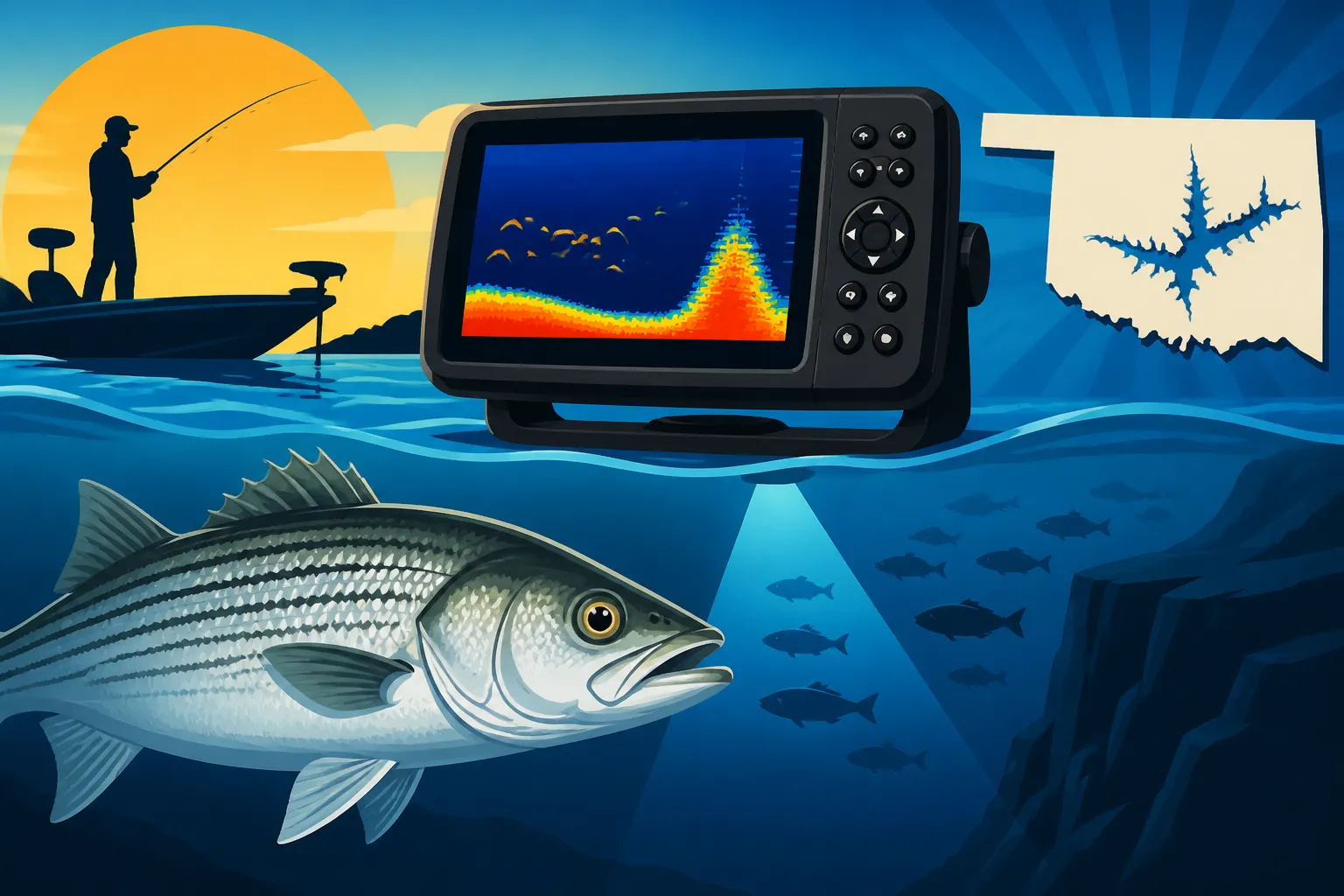
The foundation of any good deep-water fish finder is its traditional 2D sonar, but for stripers on Texoma, you want one equipped with CHIRP (Compressed High-Intensity Radiated Pulse) technology. Unlike older, single-frequency sonar units that send out one pulse at a time, CHIRP sends a continuous sweep of frequencies, from low to high. This results in much better target separation – meaning you can tell a single big striper apart from a tight school, or even distinguish a striper from a large piece of bait.
For deep water, this translates to incredible detail. You'll see crisp arches representing individual fish, clearly defined bait balls, and the subtle contours of submerged structure even at 80 or 100 feet down. Without CHIRP, those deep returns might just look like blurry blobs on your screen, leaving you wondering what you're actually seeing. When you’re trying to locate Deep Water Striper Fishing Techniques, this clarity is absolutely non-negotiable. Many of the top brands offer excellent CHIRP sonar, and you can often find good deals and comparisons on platforms like Amazon or check out the latest models at Bass Pro Shops.
Side Imaging and Down Imaging
While traditional 2D CHIRP sonar gives you an excellent view directly beneath your boat, Side Imaging and Down Imaging take your underwater reconnaissance to a whole new level. These technologies are truly game-changers for covering vast areas and pinpointing structure where stripers might be lurking.
-
Down Imaging (sometimes called DownVu or ClearVu depending on the brand) provides a photographic-like view directly below your boat. It uses a very thin, high-frequency beam to create incredibly detailed images of structure, timber, rocks, and fish. This is fantastic for seeing exactly how a school of stripers is relating to a submerged hump or the edge of a creek channel. Instead of abstract arches, you'll see more realistic representations, making it much easier to identify what’s down there.
-
Side Imaging (or SideVu) is perhaps the most revolutionary technology for finding deep-water stripers on Texoma. This sonar literally scans out to the sides of your boat, often hundreds of feet on either side, providing a wide-angle view of the bottom and everything in the water column. Imagine being able to scan a strip of water 500 feet wide as you drive, quickly identifying schools of bait or large striper schools off to your port or starboard. This saves immense amounts of time. Instead of driving directly over every piece of structure, you can cover a vast area efficiently, marking promising targets and then circling back to investigate with your 2D and Down Imaging. This is invaluable when trying to locate How to Find Striped Bass Schools with Sonar in such a huge lake.
GPS and Mapping Capabilities
Navigating a massive lake like Texoma, especially while actively searching for fish, demands robust GPS and mapping capabilities from your fish finder. This isn't just about knowing where you are; it's about building a detailed map of your fishing strategy.
A high-precision GPS receiver in your unit allows you to accurately mark waypoints for promising deep-water structure, schools of bait you've found, or even successful striper catches. You can then navigate back to these exact spots with ease. Imagine finding a massive school of stripers at 70 feet on a specific ledge using your Side Imaging, marking it, and then being able to return to it later, even if you drift or move.
Integrated mapping, often with pre-loaded Lake Texoma maps (or the ability to add detailed mapping cards), provides critical contour lines, channel markers, and navigation aids. You can see the old riverbeds, submerged humps, and sudden drop-offs that are prime striper territory. Many units also offer charting features where you can create your own custom maps, highlighting areas you’ve fished or discovered. This is critical for Trolling Gear for Striped Bass at Oklahoma's Lake Texoma and Striped Bass Fishing Techniques for Oklahoma's Lake Texoma, as precise boat control and navigation are key to presenting your baits effectively in deep water.
Choosing the Right Transducer and Mounting for Texoma
Often overlooked, the transducer is arguably the most critical component of your entire fish finder system. It’s the "ear and mouth" of your unit, sending out and receiving sonar waves. Without the right transducer, even the most expensive head unit won't perform to its potential, especially when you're targeting deep-water stripers on a lake as large and deep as Texoma. Don't skimp here; it's where the rubber meets the road, or rather, where the sonar meets the water.
Transducer Power and Cone Angles
For deep-water fishing, transducer power is paramount. The higher the wattage (RMS power), the stronger the signal the transducer can send and the deeper it can penetrate with a clear return. While low-power units might suffice in shallow coves, they simply won't give you the definition or depth penetration needed to consistently mark stripers at 60, 80, or 100+ feet. Look for transducers with at least 500 watts RMS, though 1kW (1000 watts) or more is ideal for serious deep-water work. This extra power ensures you get clear, discernible returns even in challenging conditions.
Cone angle refers to the width of the sonar beam.
- Narrow cone angles (around 20 degrees or less) are excellent for deep-water penetration and detailed target separation directly under the boat. They focus the energy, making it easier to see individual fish at greater depths.
- Wider cone angles (45 degrees or more) cover a larger area of the bottom, which is useful for searching, but they lose resolution at greater depths.
Many advanced transducers offer multiple frequencies and cone angles, allowing you to switch between them for different depths and purposes. For deep-water Texoma stripers, having strong, clear returns from a narrow beam at depth is crucial. This will help you discern fish from the bottom, which is a common challenge for new anglers using less powerful transducers.
Through-Hull vs. Transom Mount
The way your transducer is mounted significantly impacts its performance, particularly at speed and in choppy conditions common on Texoma.
-
Transom Mount Transducers: These are the most common and easiest to install, bolting to the transom of your boat. They work well for most anglers and provide excellent performance at slower speeds. However, they can be susceptible to turbulence and "blow out" (lose signal) at high speeds, especially in rough water, as air bubbles pass over the transducer face. If you do a lot of running and gunning, you might experience signal loss when you most need it – while scanning a new area. Still, for many boaters, especially those who run slower while actively fishing or use a Best Trolling Motor Setup for Oklahoma Striped Bass, a properly installed transom mount can be highly effective.
-
Through-Hull Transducers: These transducers are installed by drilling a hole through the hull of your boat, with the transducer element protruding below the hull's surface. This placement ensures a clean, uninterrupted water flow over the transducer face, providing superior performance at all speeds, even in rough water. They are generally more expensive and complex to install, often requiring professional help, but they offer the best possible sonar returns, especially for deep-water applications where maintaining a consistent signal is critical. For dedicated striper anglers on Texoma who want the absolute best performance, a through-hull transducer is often the preferred choice. There are also "in-hull" (shoot-through) transducers that glue to the inside of the hull and shoot through fiberglass, avoiding holes, but these can lose a bit of power and detail compared to true through-hull models, depending on hull thickness and material.
Here's a quick comparison of transducer types:
| Transducer Type | Installation Ease | Performance (Deep Water) | High-Speed Performance | Cost | Ideal Use Case |
|---|---|---|---|---|---|
| Transom Mount | Easy | Good | Fair to Good (can lose signal) | Moderate | General fishing, slower trolling, easy DIY |
| Through-Hull | Complex (pro install recommended) | Excellent | Excellent | Higher | Dedicated deep-water, high-speed scanning, best clarity |
| In-Hull (Shoot-Through) | Moderate (no holes) | Good (slight power loss) | Good | Moderate | Fiberglass hulls, avoiding holes, good compromise |
Optimizing Your Fish Finder Settings for Striped Bass
Having a top-of-the-line fish finder is only half the battle; knowing how to properly set it up and interpret what you see on the screen is the other, equally important half. Many anglers get frustrated because their expensive unit isn't showing them what they expect, when often, it's just a matter of adjusting a few key settings. Getting the most out of your gear requires a bit of experimentation and understanding, but the rewards are well worth it when you start consistently finding those deep-water stripers.
Adjusting Sensitivity, Gain, and Ping Speed
These three settings are your primary tools for fine-tuning the sonar signal and getting the clearest picture possible in deep water.
-
Sensitivity/Gain: This controls how much detail your unit displays. Too low, and you'll miss fainter returns from deep fish or small bait balls. Too high, and your screen will be cluttered with noise, making it hard to distinguish actual targets from clutter. For deep water, you generally want to run your sensitivity as high as possible without introducing excessive clutter. Start by increasing it until you see too much noise, then back it off slightly. This is an ongoing adjustment; factors like water clarity, depth, and bottom composition will require tweaking. You want to see crisp, well-defined arches for fish and clear representations of bait.
-
Ping Speed (or Scroll Speed): This dictates how quickly the sonar pings are sent and how fast the image scrolls across your screen. A faster ping speed sends out more pulses per second, resulting in a more detailed and real-time view of what's beneath your boat. This is crucial when actively trolling or drifting over schools of moving stripers. You'll see their movements more dynamically. For deep water, a faster ping speed helps capture those quick movements. However, if your boat is stationary or moving very slowly, you might not need the fastest setting. Experiment to find what gives you the best balance of detail and smooth scrolling for your fishing style.
Interpreting the Screen: Distinguishing Bait Balls, Stripers, and Thermoclines
Learning to read your fish finder screen is an art that develops with experience, but there are some key indicators for deep-water stripers on Texoma:
-
Bait Balls: These typically appear as dense, often spherical or oval clouds on your screen. Shad, which stripers feed on, will often form these tight schools. When you see bait balls, especially larger ones, you're in the right neighborhood. Stripers will almost always be associated with bait, so finding the bait is often the first step to finding the predators. You might see larger arches (stripers) either inside, below, or around the edges of these bait balls.
-
Stripers: On 2D sonar, individual stripers usually appear as strong, elongated arches, especially if you're moving at a consistent speed. In deep water, these arches will be clearer with good CHIRP sonar. Look for multiple arches clustered together, indicating a school. On Down Imaging, they might look like distinct, bright marks, sometimes resembling small torpedoes or streaks, depending on their orientation. The key is to look for these strong, bright returns that are separate from the bottom and often in close proximity to bait. Best Time to Catch Walleye in Oklahoma also emphasizes the importance of understanding target separation and how different fish species appear.
-
Thermoclines: These are layers of water where the temperature changes rapidly. In deep lakes like Texoma, especially in summer, thermoclines are crucial. They often appear as a distinct, hazy line or a fuzzy band across your screen, usually at a specific depth. Stripers will often suspend just above, within, or just below the thermocline, as this is where the cooler, oxygenated water and baitfish are concentrated. Identifying the thermocline allows you to narrow down the depth range where stripers are most likely to be holding, making your fishing much more efficient. Don't forget to consider Water Temperature and Oklahoma Fishing Timing as a critical factor in your fishing strategy.
By mastering these settings and interpretations, your fish finder will become an indispensable tool for successfully targeting deep-water striped bass on Lake Texoma.
Disclaimer
This article is for general informational purposes only and does not constitute professional advice. Laws, prices and regulations vary by location and change over time. Consult a qualified professional for guidance on your specific situation.