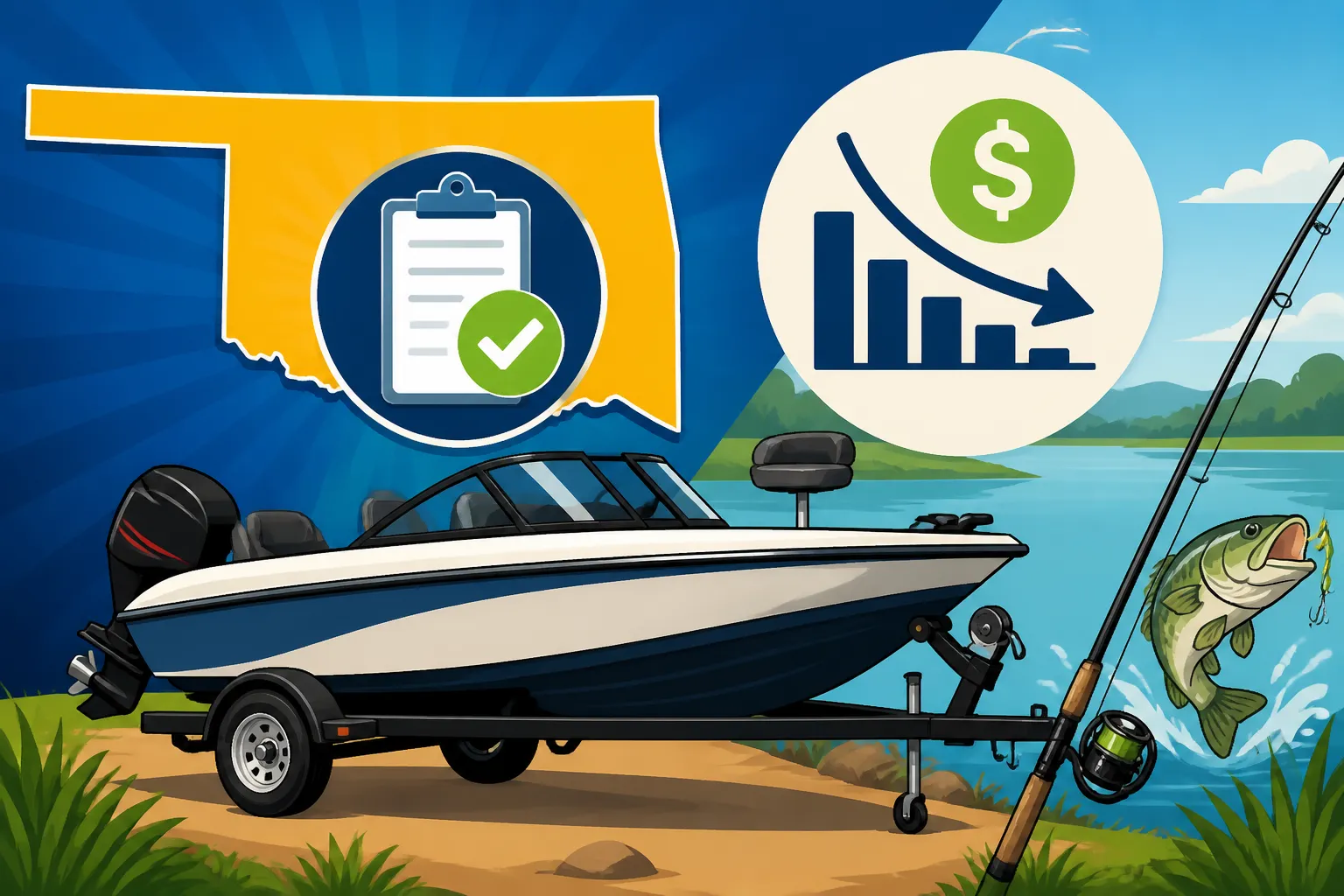
Used Boat Registration Fee After One Year of Depreciation in Oklahoma
There’s nothing quite like the thrill of finding that perfect used boat – maybe it’s a lightly seasoned bass boat or a comfortable pontoon that’s only seen one season. You’re ready to hit the water, but then you hit a snag: figuring out the registration fees. Many anglers assume a used boat is automatically cheaper to register, and while that's generally true, understanding how the fee changes after just one year of depreciation in Oklahoma can be a bit of a mystery. This guide will unravel the specifics of how a boat's age, particularly its first year, impacts what you'll pay to get it legally registered on our beautiful Oklahoma waters.
Decoding Oklahoma's Boat Registration System
Before we dive into depreciation, let's get a handle on the fundamentals of boat registration here in the Sooner State. It's a system designed to ensure all vessels are properly accounted for, contributing to waterway safety and resource management. When you purchase a boat, whether it's fresh off the showroom floor or a beloved pre-owned gem, getting it registered with the Oklahoma Tax Commission (OTC) is a non-negotiable step.
Why Registration Matters for Every Angler
Beyond being a legal requirement, registering your boat serves several important purposes. First and foremost, it identifies your vessel, which is crucial in case of theft or an accident. Imagine enjoying a peaceful morning on Lake Eufaula when an unexpected storm rolls in; having your boat properly identified can be a lifesaver if you ever need assistance. Secondly, the fees collected from registration go towards funding various state programs, including those that improve our boat ramps, maintain our lakes, and support wildlife conservation efforts – all things that directly benefit us, the anglers. It's a way for us to contribute to the health of the very fisheries we love to explore. If you're curious about the general process, our guide on Oklahoma Boat Registration and Titling Rules Explained covers all the initial steps.
The Standard Calculation: MSRP as the Starting Point
Oklahoma bases its boat registration fees on the manufacturer's suggested retail price (MSRP) of the vessel when it was new. Yes, even for a used boat, the original MSRP is the benchmark. This can sometimes throw people off, especially if they bought a used boat for a steal. The state wants to assess a fair value based on what the boat could have sold for initially, rather than whatever deal you managed to snag. It’s a way to standardize the assessment and prevent huge discrepancies based on individual sale prices. This initial MSRP figure is a critical piece of information you’ll need to provide when you head to the tag agency.
How Depreciation Factors into Your Used Boat Fee
Now for the meat of the matter: how does the age of your boat, specifically after one year, affect that registration fee? Oklahoma's system is pretty straightforward in principle: the registration fee is calculated as a percentage of the original MSRP, and that percentage decreases each year. This depreciation schedule is what makes buying a used boat more appealing from a registration standpoint.
The First Year's Impact on Registration Costs
That first year of depreciation is often the most significant in terms of percentage reduction. Think about it like a new car: it loses a chunk of its value the moment it’s driven off the lot. Boats are similar. While the state doesn't give you a break on the actual purchase price, it does acknowledge that a one-year-old boat isn't "brand new" anymore for registration purposes. So, when you're registering a boat that's been on the water for one full year, you're no longer paying the "new boat" percentage. Instead, you'll be subject to a slightly reduced rate that reflects that initial year of wear and tear, however minimal. This immediately puts some money back in your pocket compared to registering a brand-new vessel, which is certainly a welcome relief for any angler. It's important to remember that this is a fixed schedule the state uses, not an appraisal based on the current market value of your specific boat. Our article How Oklahoma Calculates the Registration Fee for a New Boat goes into more detail about the initial fee for brand-new vessels.
The Principle of Declining Percentage Over Time
The crucial thing to grasp is that this isn't a flat dollar amount reduction, but a sliding scale based on a percentage. The state applies a certain percentage to the original MSRP, and that percentage steadily drops each year the boat ages. For instance, if a new boat might be assessed at 'X'% of its MSRP, a one-year-old boat might be at 'Y%' (where Y is less than X), a two-year-old boat at 'Z%', and so on. This continues until the boat reaches a certain age where the fee caps out at a minimum amount, ensuring even very old boats still contribute something. This structured approach provides predictability, allowing you to estimate your costs.
Calculating the First Year's Depreciation for Registration
So, how do you actually figure out what you'll owe for that one-year-old boat? While I can't give you the exact current percentages (those can shift, and you'll always want to check with the OTC or your local tag agency for the most up-to-date figures), I can explain the mechanics.
Locating the Original Manufacturer's Suggested Retail Price (MSRP)
Your first task is to find the original MSRP. If you bought the boat from a dealer, they should have this information readily available. For private sales, it might be on the original bill of sale, the boat's title history, or even through online resources that track boat values by model year. Sometimes, a quick call to a reputable boat dealer (perhaps even checking with a national retailer like Bass Pro Shops for comparable models) can help you pinpoint this figure if you're really stuck. Without the MSRP, you won't be able to calculate the fee accurately. Keep in mind, this is the price before any add-ons or special packages you might have acquired.
Applying the Depreciation Schedule
Once you have the MSRP, the state then applies its specific depreciation rate for a one-year-old vessel. Let's imagine, purely hypothetically, that the state charges 3.25% of the MSRP for a brand new boat, and that rate drops slightly for each subsequent year. For a boat that is one year old, the rate would be a bit lower than the initial 3.25%. This might not seem like a huge drop on a smaller boat, but on a higher-end vessel, even a fractional reduction can shave off a noticeable amount from your registration bill.
Here’s a conceptual look at how depreciation reduces the percentage applied to the MSRP over time:
| Boat Age | Conceptual Percentage of Original MSRP Applied | Notes |
|---|---|---|
| New (Year 0) | Highest percentage | Full initial assessment |
| 1 Year Old | Slightly Reduced Percentage | First year of depreciation reflects here |
| 2 Years Old | Further Reduced Percentage | Continues to decrease |
| 3-4 Years Old | Even Lower Percentage | Continued steady decline |
| 5+ Years Old | Significantly Lower Percentage / Near Minimum | Reaching the lower end of the fee scale |
Remember: This table uses conceptual percentages to illustrate the principle. Always verify current rates with the Oklahoma Tax Commission or a licensed tag agency.
This means that while the core cost is still tied to the boat's original value, you're directly benefiting from the fact that it's no longer considered brand spanking new. It's a welcome acknowledgement from the state that used boats have a different value proposition.
Example Scenario: A One-Year-Old Bass Boat
Let's imagine you found a fantastic deal on a one-year-old bass boat, say a popular model that had an original MSRP of around $40,000. If that boat were brand new, you'd pay the highest percentage of that $40,000. But since it's already one year old, Oklahoma's depreciation schedule kicks in. Instead of, for example, the 3.25% rate applied to new boats, the rate for a one-year-old boat might be slightly less, perhaps 2.9% or 2.8%. While a small percentage difference, this can translate to real savings. You'd calculate the fee by multiplying that original $40,000 by the one-year-old depreciation percentage. This is precisely why it pays to understand the system, as every dollar saved on registration can go towards new lures or a fresh fishing rod! You might even find some great deals on those fishing essentials on Amazon once you're officially on the water.
Beyond the First Year: Long-Term Registration Costs
While our focus here is on that crucial first year of depreciation, it's helpful to understand that the savings don't stop there. The registration fees continue to decline as your boat ages, eventually reaching a minimum threshold.
Continued Fee Reduction Over Time
The depreciation schedule continues year after year, meaning a two-year-old boat will cost less to register than a one-year-old, and a five-year-old boat even less. This is great news for anglers who prefer to buy older, well-maintained vessels. The state recognizes that a boat that has provided many years of enjoyment has significantly depreciated from its original value, and the registration fees reflect that. This makes long-term boat ownership in Oklahoma more budget-friendly. For a deeper dive into how fees change over a longer period, check out our guide on Used Boat Registration Fee After Five Years of Depreciation in Oklahoma.
The Oklahoma Registration Fee Cap
It’s important to note that Oklahoma also has a maximum annual registration fee. This cap prevents owners of extremely high-value boats from paying exorbitant amounts each year. While it primarily affects brand new, very expensive vessels, it’s a good detail to be aware of within the overall registration structure. Conversely, there's also a minimum fee, ensuring that even the oldest, most depreciated boats contribute a small amount annually. This helps keep the system fair and ensures all boat owners are participating. You can learn more about this limit in Oklahoma's $151 Boat Registration Fee Cap.
Other Fees to Consider: Titling and Transfers
Don't forget that registration isn't the only fee involved. When you buy a used boat, you'll also need to get it titled in your name. There's a separate fee for boat titling, and this is a one-time cost associated with establishing legal ownership. The titling fee isn't subject to the same depreciation schedule as the annual registration fee. Think of it like buying a car: you pay sales tax and title fees upfront, then annual registration. Boats follow a similar pattern. Understanding both the annual registration and the initial titling costs will give you a complete picture of your financial commitment. Our article on Oklahoma Boat Titling Fee and Application Cost breaks down these expenses.
Ultimately, buying a boat that's already one year old in Oklahoma means you'll benefit from the state's depreciation schedule, reducing your annual registration cost right out of the gate. It's a small but significant detail that helps make boat ownership a little more accessible for everyone who loves to fish our incredible lakes and rivers. So, go ahead and enjoy that "new-to-you" boat; just make sure you've got all your registration ducks in a row!
Disclaimer
This article is for general informational purposes only and does not constitute professional advice. Laws, prices and regulations vary by location and change over time. Consult a qualified professional for guidance on your specific situation.