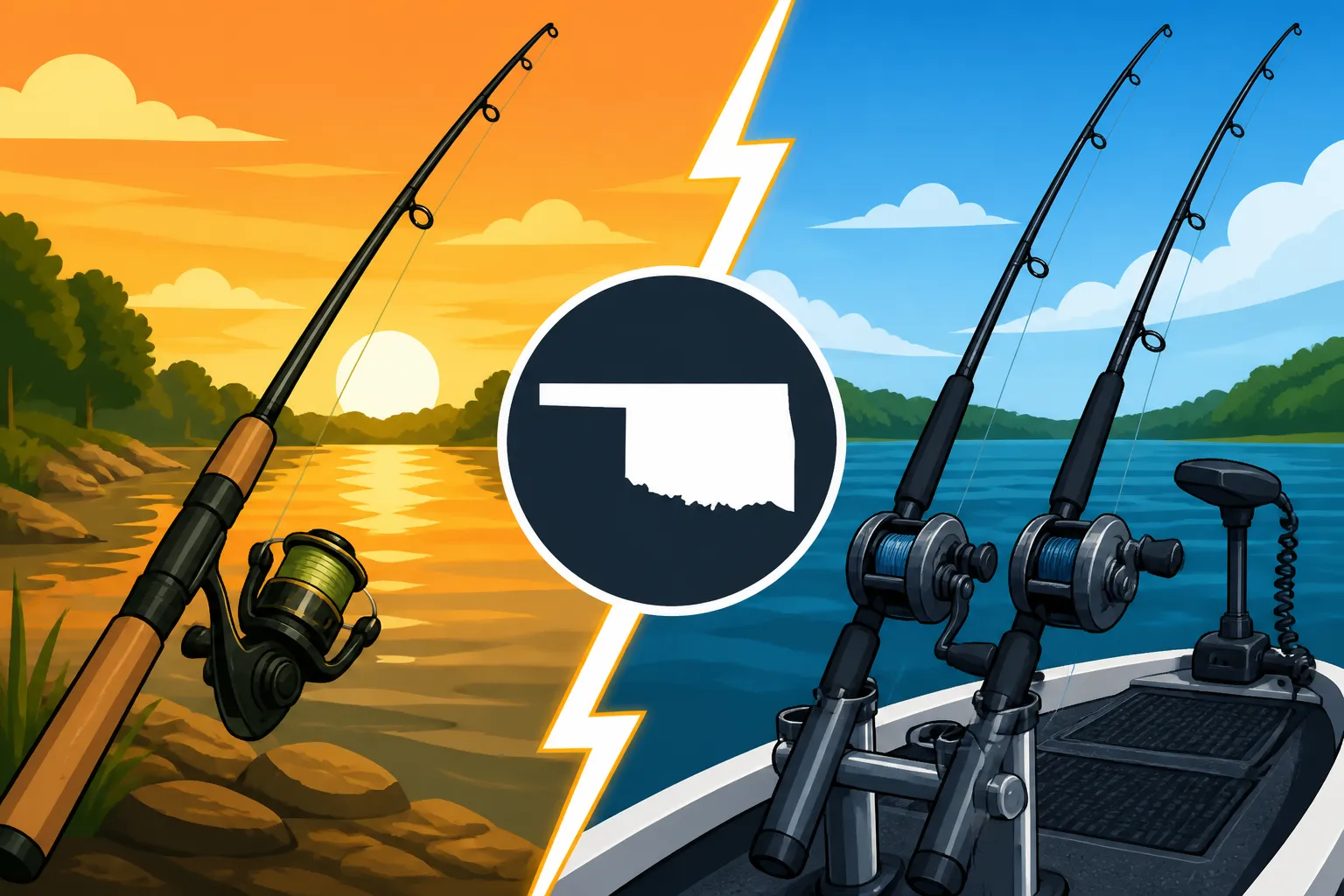
Bank Fishing Rod Setup vs Boat Fishing Rod Setup
Many Oklahoma anglers find themselves at a crossroads, wondering if the rod and reel they use for casting from the shore will really cut it when they finally get out on a boat, or vice-versa. It’s a common frustration: you’ve got a go-to setup that feels perfect for one scenario, but then you feel under-gunned or over-equipped in another. This guide will walk you through the distinct considerations for bank fishing versus boat fishing rod setups in Oklahoma, helping you understand why some gear excels in one environment and how to choose the right tools for your specific angling adventure, whether you're casting from a quiet bank or trolling across a vast reservoir.
Understanding the Core Differences: Bank vs. Boat Fishing Dynamics
The fundamental difference between bank and boat fishing isn't just about where your feet are planted; it's about how you approach the water, the space you have, and the fish you're trying to reach. These dynamics profoundly influence the ideal rod and reel setup.
Mobility and Casting Needs
When you're bank fishing, your mobility is inherently limited by the shoreline itself. You're often fixed in one spot, or perhaps you can walk a short stretch. This means your casting reach becomes paramount. You need to be able to get your bait out to where the fish are holding, whether that's a distant weed line, a submerged structure, or the middle of a creek channel. This typically favors longer rods that can generate more leverage and distance in a cast. Think about trying to reach a brush pile 50 yards out from the shore at Lake Hefner – a short 6-foot rod simply isn't going to cut it. You'd be lucky to hit 30 yards. You need that extra length to load up and launch your lure, generating the necessary velocity to send your bait flying across the water. This also helps immensely when trying to cast against the wind or when dealing with overhanging trees behind you that restrict your backcast.
Boat fishing, on the other hand, grants you unparalleled mobility. You can motor right up to that brush pile, hover over a submerged creek channel, or follow a schooling pattern in open water. Your casting needs shift dramatically. Instead of needing maximum distance, you often require precision, control, and the ability to fight a fish in close quarters or around obstacles like boat anchors or trolling motors. You might be vertical jigging right under the boat, flipping baits into tight cover, or making short, accurate pitches to visible targets. The boat itself acts as your mobile platform, bringing you directly to the fish, which changes the game entirely for your rod choice. You're not trying to cast a mile; you're trying to drop a lure on a dinner plate, often within a short distance of the boat. This demands a more compact, maneuverable rod.
Target Species and Water Depth
The types of fish you're targeting and the depths they inhabit also play a huge role. From the bank, you're often limited to shallower waters, especially those within casting distance of the shore. This means you might be primarily pursuing species that frequent these areas: smaller bass, panfish like bluegill and crappie, or channel catfish cruising the banks. The rods for these species tend to be lighter, with a more forgiving action to handle smaller fish and lighter lines. You're not usually trying to pull a 50-pound blue catfish out of a 40-foot deep channel when bank fishing, as reaching those depths and handling such a fish from shore presents significant challenges in terms of casting weight, line capacity, and fighting power. The fish you're catching will likely be smaller to medium-sized, and your gear should reflect that.
Conversely, from a boat, the entire water column opens up. You can venture into deeper sections of Lake Eufaula to target monster blue catfish, chase schooling striped bass in the main lake body of Lake Texoma, or probe deep structure for suspended crappie. This access to deeper water and larger, more aggressive species demands different rod characteristics. You might need heavier power rods to handle larger fish, specific actions for different techniques (like fast action for jigging or moderate action for crankbaits), and more robust reels to manage stronger runs and heavier line. Imagine the difference between landing a 1-pound crappie from a dock versus trying to subdue a 20-pound striper that just took off on a blistering run in the middle of Lake Texoma – totally different battles, totally different gear requirements. A trophy catfish found in the deep holes of the Red River arm of Lake Texoma, for example, demands a completely different approach and a much stronger rod than what you'd use for a panfish from the bank.
Gear Portability and Storage
Let's be realistic: when you're bank fishing, you're either walking to your spot, carrying everything in a backpack, or perhaps you've got a wagon. Every piece of gear needs to be relatively compact, lightweight, and easy to transport. A massive 8-foot heavy action catfish rod might be great for fighting big blues, but lugging it along with a cooler, tackle box, and chair to a remote stretch of the Illinois River is a real pain. You're often limited to one or two rods you can comfortably carry and manage, which means versatility in those chosen rods is key. Many anglers opt for two-piece rods that break down for easier transport in a car trunk or across uneven terrain. Space is a premium, and every ounce counts when you're hiking to that perfect hidden fishing spot.
On a boat, the rules change completely. You have dedicated rod lockers, vast storage compartments, and the ability to bring multiple rods rigged for different techniques and species. Want to switch from casting crankbaits for bass to vertical jigging for crappie? No problem, just grab another rod from the locker. This freedom from portability constraints allows for much more specialized setups. You can have a heavy casting rod for big swimbaits, a light spinning rod for finesse presentations, and a medium-heavy trolling rod, all within arm's reach. The boat becomes your mobile tackle shop, eliminating the need for compromise in your rod choices based on transport. You can find excellent boat storage solutions from retailers like Bass Pro Shops, making it easy to organize a diverse rod collection without sacrificing space or convenience. You can literally have a rod for every imaginable scenario.
Essential Rod Setup for Bank Anglers in Oklahoma
When you're sticking to the shore, your rod setup needs to prioritize casting distance, versatility, and ease of transport. You're making the most of what's within reach, often fishing a wider range of conditions and species with limited gear.
Rod Length and Action for Shore Casting
For bank fishing in Oklahoma, a longer rod is almost always your friend. We're talking anywhere from 7 to 9 feet, and sometimes even longer if you're targeting specific species like catfish or trying to really bomb a bait out into a large reservoir. The extra length provides several advantages:
- Increased Casting Distance: This is the big one. A longer rod allows for a longer pendulum swing, which translates to greater lure speed and more distance on your cast. This is crucial for reaching submerged structure, drop-offs, or schooling fish that are out of range with a shorter rod. It allows you to cover more water without having to constantly move your position, which can be difficult on uneven or overgrown banks.
- Better Line Control: Once your lure is out there, a longer rod helps you keep more line off the water, reducing drag from wind and current, and allowing for better lure presentation and sensitivity. It also helps manage line around shoreline obstacles like rocks or brush that might snag your retrieve.
- Enhanced Fish Fighting Leverage: While a longer rod might seem less powerful, it actually gives you more leverage over a fish, especially when you're fighting it from a fixed position. It helps steer the fish away from snags and keep its head up, crucial when you don't have the mobility of a boat to follow a strong run. It can also help lift a fish over a slight bank edge, reducing the risk of line breakage.
When it comes to action, a medium to medium-heavy power rod with a moderate-fast to fast action is often ideal for bank fishing.
- Medium Power: This allows you to cast a good range of lure weights, from lighter jigs and worms for bass and crappie to heavier bottom rigs for catfish. It provides enough backbone to handle most common bank-caught fish without feeling overly stiff for smaller catches.
- Moderate-Fast Action: This means the rod bends mostly in the top half or third. It offers a good balance of sensitivity for detecting subtle bites and enough backbone to set the hook and fight larger fish. It also helps with casting distance by distributing the load more smoothly throughout the cast, acting like a spring.
A great example would be an 8-foot medium-heavy spinning rod. This setup can handle a decent range of line weights and lure sizes, making it a versatile choice for everything from casting spinnerbaits for largemouth bass to a basic bobber and worm rig for sunfish. It also gives you the reach needed for many Oklahoma bank fishing scenarios. If you're specifically targeting bigger channel or blue catfish, you might even step up to a 9-10 foot heavy power rod to truly launch those heavy sinker rigs and absorb powerful runs.
Reel Choice for Bank Fishing
For bank fishing, the spinning reel is king. It's incredibly user-friendly, excels at casting lighter lures, and is less prone to backlashing than a baitcasting reel, which is a major plus when you're trying to make long, accurate casts from a potentially awkward position on the bank. They are generally more forgiving for less experienced casters.
- Ease of Use: Spinning reels are easy to learn and operate, making them perfect for anglers of all skill levels. The open-face design simplifies line management.
- Versatility: They handle a wide range of line types and lure weights. From ultra-light monofilament for panfish to heavier braided line for catfish, a good spinning reel can do it all. You can easily switch between different baits and techniques.
- Casting Performance: The open-faced design allows line to peel off freely, resulting in smooth, long casts, especially with lighter baits that wouldn't load a baitcaster effectively.
Look for a reel size that balances well with your chosen rod length and power. For an 8-foot medium-heavy rod, a 3000- or 4000-series spinning reel would be a fantastic match, offering enough line capacity and drag power for most bank-caught fish in Oklahoma. You can find reliable and affordable spinning reels for bank fishing on Amazon, often with helpful customer reviews to guide your choice. For heavier catfish setups, a larger 6000 or 8000 series spinning reel might be needed to hold enough heavy line.
Line and Terminal Tackle Considerations
Given the need for versatility and often longer casts, your line choice for bank fishing should reflect that.
- Monofilament (Mono): A great all-around choice. It’s affordable, has good stretch (which can be forgiving when a fish makes a strong run from a fixed position, especially without the boat's ability to chase), and is easy to tie knots with. A 8-12 lb test mono is a solid choice for general bank fishing, offering a balance of strength and castability.
- Braided Line: For maximum casting distance, strength, and sensitivity, braided line is excellent. Its thin diameter for its breaking strength means less wind resistance on casts and more line capacity. However, it has no stretch, so it can be less forgiving during sudden surges. If using braid, consider adding a fluorocarbon leader for abrasion resistance (braid can fray easily on rocks) and invisibility, especially in clearer waters like those found around Broken Bow Lake. Braid also helps when fishing in windy conditions, as it cuts through the air better.
Terminal tackle will largely depend on your target species, but a versatile bank fishing kit should include:
- Assorted Hooks: J-hooks, circle hooks (great for catfish and reducing gut hooks), and wide-gap worm hooks for soft plastics. Keep a range of sizes to match different bait and fish.
- Sinkers/Weights: Split shots, egg sinkers, bullet weights for various rigs (Carolina rig, Texas rig, bottom fishing). Different weights will help you adapt to current and depth.
- Bobbers: Slip bobbers and fixed bobbers for suspending baits at various depths. These are essential for presenting baits to panfish or crappie, especially in shallower areas.
- Swivels and Snaps: To prevent line twist, especially with spinning lures, and to quickly change lures or rigs without retying.
Having a good selection allows you to quickly adapt to different conditions or target different species without having to hike back to your car for more gear. The compact nature of these items makes them ideal for a small tackle box or backpack. Bank Fishing Tips for Beginners
Optimizing Your Rod Setup for Boat Fishing in Oklahoma
Boat fishing opens up a whole new world of techniques and opportunities, and your rod setup should reflect that increased access and specialization. The boat is your platform, allowing for more aggressive and precise tactics.
Rod Length and Power for Boat Maneuvering
When fishing from a boat, shorter rods often become more practical and efficient. Think 6 to 7.5 feet. The reasons are numerous:
- Maneuverability in Confined Spaces: Boats, even large ones, have confined cockpits. A shorter rod is much easier to cast, pitch, and flip without hitting boat consoles, other anglers, or the trolling motor. It also makes for more comfortable handling when fighting a fish around the boat, allowing you to quickly adjust angles.
- Precision and Accuracy: You're often making shorter, more accurate casts to specific targets that the boat can position you next to. A shorter rod offers more control for these precise presentations, whether you're flipping a jig into a dock corner or casting a crankbait along a bluff wall.
- Vertical Presentations: When jigging directly under the boat for crappie or bass, or working spoons in deep water, a shorter rod is more comfortable and allows for more direct control over the lure. You’re not trying to cast; you’re dropping straight down, and a long rod would just get in the way.
- Specialized Power: Boat fishing often demands more specialized power in rods. You might have a light action rod for ultra-finesse baits (e.g., small jigs for crappie), a medium-heavy rod for pitching jigs into heavy cover (e.g., bass fishing thick brush), or a heavy action rod for muscling big fish out of thick brush (e.g., trophy catfish). The power choice is dictated by the specific technique and target, rather than needing a general-purpose casting distance machine.
For instance, a 6'6" medium-heavy baitcasting rod is a staple for bass anglers fishing from a boat. It's perfect for throwing spinnerbaits, jigs, and Texas-rigged worms into shoreline cover. If you're targeting big stripers on Lake Texoma, you might opt for a 7-foot medium-heavy to heavy power rod that can handle the sheer force of these powerful fish and the heavy lures often used. Best Boat for Fishing Lake Texoma's Open Water For very light finesse applications like drop-shotting, a 6'8" to 7'2" medium-light spinning rod with an extra-fast tip provides the sensitivity needed.
Reel Types for Boat Fishing
While spinning reels still have a place on a boat for certain finesse techniques, boat fishing often sees a greater reliance on baitcasting reels and, for specialized applications, even trolling reels.
- Baitcasting Reels: These are favored by many serious boat anglers, especially for bass and larger predatory fish. They offer superior accuracy, power, and torque for fighting big fish. They also excel with heavier lines and lures, making them ideal for heavy cover or strong fish. Once you master a baitcaster, you'll appreciate the control it gives you over your lure presentation and hook sets. They are particularly effective for repeated, accurate casts.
- Trolling Reels: For specific techniques like trolling for striped bass or walleye on large bodies of water like Lake Texoma or Lake Keystone, dedicated trolling reels (often baitcaster-style, but with line counters) are invaluable. They are built for brute strength, handling heavy line, and deploying lures at specific depths over long periods. The line counter feature ensures your lure is precisely where you want it in the water column.
- Spinning Reels (Specialized): Don't count spinning reels out entirely. For light line finesse techniques, drop-shotting, skipping baits under docks, or panfish angling, a smaller spinning reel paired with a lighter rod is often the best choice, offering unparalleled sensitivity and the ability to cast very light lures that a baitcaster struggles with. They remain a crucial part of a well-rounded boat angler's arsenal.
The key is having a selection of reels, each optimized for a particular technique or species. This is where the storage capacity of a boat truly shines, allowing you to carry multiple combos for every scenario you might encounter.
Specialized Rigging and Electronics Integration
One of the biggest advantages of boat fishing is the ability to integrate advanced electronics and specialized rigging. Your rod setup can directly benefit from this.
- Fish Finders and Sonar: Modern fish finders with side imaging, down imaging, and 2D sonar help you locate structure, baitfish, and game fish. This directly influences your rod choice. If your sonar shows bass holding tight to a submerged brush pile, you'll grab your pitching rod with a heavy jig. If it shows crappie suspended 20 feet down over a creek channel, you'll pick up your light jigging rod. Best Fish Finder Under $500 for Reservoir Fishing These electronics tell you exactly what you're fishing, allowing for precise gear selection.
- Trolling Motors with GPS and Spot-Lock: A GPS-enabled trolling motor allows you to hold your boat precisely over a productive spot, making vertical presentations incredibly effective. This means you can use shorter, more sensitive rods designed specifically for jigging or drop-shotting, knowing your boat will stay put even in wind or current. This frees up your hands to focus purely on fishing.
- Rod Holders: Boat fishing allows for the use of multiple rod holders, which is essential for trolling or when jug fishing for catfish. You can have several rods deployed at once, each rigged with different baits or lures at varying depths, increasing your chances of finding fish. This also keeps your rods safe and organized while moving between spots.
- Livewells: While not directly part of the rod setup, a boat's livewell allows anglers to keep fish alive, particularly important for catch-and-release tournaments or for transporting fish home safely. This means you can focus on landing fish efficiently with your chosen rod, knowing you have a safe place for them.
The ability to leverage these tools means your rod setup can be much more precise and technique-specific. You're not just casting blindly; you're often targeting individual fish or small schools identified by your electronics. For example, if you're marking individual crappie on your graph in deep water, you might use a very sensitive, light-power rod with a tiny jig, something you'd rarely consider for general bank fishing.
Hybrid Approaches and Versatile Setups
While specialization is great, not every angler can or needs to own a dozen different rod and reel combos. There are definitely ways to get good mileage out of fewer setups, especially if you blend your fishing experiences between bank and boat. It’s all about making smart choices for your individual needs.
When One Setup Can Serve Both
It’s true that some setups can bridge the gap between bank and boat fishing, especially if you're mostly targeting smaller to medium-sized fish or aren't delving into highly specialized techniques. A prime example is a good quality 7-foot medium-heavy spinning rod paired with a 3000-series reel.
- For Bank Fishing: The 7-foot length offers a decent compromise for casting distance without being unwieldy for transport. It can still launch lures a respectable distance for most bank scenarios. The medium-heavy power can handle a good variety of lures and fish sizes, from average bass to decent channel catfish.
- For Boat Fishing: While not ideal for every niche technique, it's perfectly capable of casting jigs, crankbaits, or soft plastics around cover from a boat. It's also manageable in boat spaces and offers enough backbone for typical catches. You can still effectively work a variety of presentations.
This kind of versatile combo is an excellent starting point for new anglers or those who only fish occasionally. It won't excel at everything, but it will allow you to catch fish from both the bank and a boat in many Oklahoma waters. For instance, a 7-foot spinning rod is fine for general crappie fishing from a dock or from a boat on Lake Arbuckle, which has stricter crappie limits. Arbuckle Lake Crappie Rules in Oklahoma You might not be able to pitch into the tightest cover or make the longest casts, but you'll be able to fish effectively.
Investing in a Diverse Arsenal
As you become more dedicated to fishing, or if you find yourself frequently switching between bank and boat, you'll naturally start to build a more diverse arsenal of rods and reels. Instead of buying one "do-it-all" combo, think about adding specialized tools over time as your skills and interests grow.
- Start with Versatility: Begin with that 7-foot medium-heavy spinning combo. It's your workhorse, capable of handling most general fishing situations.
- Add a Bank-Specific Rod: Your next purchase might be a longer, perhaps 8-9 foot medium-heavy rod specifically for increasing casting distance from the shore, especially if you're after catfish or fishing larger waters. This could be another spinning rod, or a heavy-duty conventional reel setup for bottom fishing. Oklahoma Forked-Tail Catfish Bag Limit This will significantly improve your reach from the bank.
- Introduce a Boat-Specific Combo: As you get more time on the water in a boat, you might invest in a 6'6" medium-heavy baitcasting combo for more accurate presentations around boat structures or heavy cover. This opens up techniques like flipping and pitching that are harder with spinning gear, giving you more control and power.
- Consider Species-Specific: If you develop a passion for a particular species, like trophy bass or striped bass, you might then get a dedicated rod and reel for those pursuits. For example, a heavy-action rod for large swimbaits or a trolling setup for stripers. These highly specialized tools are designed to maximize your success for a very specific type of fishing.
Building your collection this way ensures you always have a functional setup, and you gradually acquire the specialized tools that genuinely enhance your fishing experience. You can browse a huge selection of specialized rods and reels at retailers like Bass Pro Shops or compare prices and features online via platforms like Amazon to build your ideal collection. Don't feel pressured to buy everything at once! Angling is a journey, and your gear collection will evolve with you, adapting to new challenges and discoveries on the water.
Comparing Rod Setups: Bank vs. Boat Fishing
To give you a clearer picture, here's a table summarizing the general differences in rod and reel setups for bank versus boat fishing. Remember, these are guidelines, and personal preference always plays a role!
| Feature | Bank Fishing Rod Setup | Boat Fishing Rod Setup |
|---|---|---|
| Typical Rod Length | Longer (7-9+ feet) for casting distance | Shorter (6-7.5 feet) for maneuverability & precision |
| Rod Power | Medium to Medium-Heavy (versatility) | Variable (Light to Heavy, highly specialized) |
| Rod Action | Moderate-Fast to Fast (casting & sensitivity) | Fast to Extra-Fast (sensitivity & hook set) or Moderate (crankbaits) |
| Primary Reel Type | Spinning (easy casting, versatility) | Baitcasting (power, accuracy), Spinning (finesse), Trolling (specialized) |
| Line Focus | Monofilament or Braid with fluoro leader (distance, strength) | Braid with fluoro leader (sensitivity, strength), Mono (specific techniques) |
| Portability | High importance (lightweight, often 2-piece) | Low importance (boat storage available, multiple setups) |
| Casting Priority | Maximize distance to reach fish | Maximize accuracy to hit specific targets |
| Target Depths | Shallower, accessible areas from shore | Entire water column, deep structure, open water |
| Typical Species | Panfish, smaller bass, channel catfish | All species, including trophy bass, striped bass, deepwater catfish |
| Cost Implications | Often more budget-friendly general purpose | Can involve higher investment in specialized gear |
When planning your next fishing trip, whether it's a quiet morning on the bank of a local pond or a full day exploring the expansive waters of Grand Lake, knowing how your gear aligns with your fishing environment is key to a successful and enjoyable experience. Grand Lake O' the Cherokees Bass Fishing Guide Don't be afraid to experiment and find what works best for your style and the specific Oklahoma waters you're fishing. Having the right tools for the job really does make all the difference, making your time on the water more productive and much more fun.
Disclaimer
This article is for general informational purposes only and does not constitute professional advice. Laws, prices and regulations vary by location and change over time. Consult a qualified professional for guidance on your specific situation.