Best Trolling Motor for Striped Bass at Lake Texoma
Trying to find the perfect trolling motor for chasing those hard-fighting striped bass on Lake Texoma can feel like navigating a maze of specs and features. It's a huge lake with diverse conditions, and a subpar trolling motor can easily ruin a day of fishing, leaving you drifting when you should be holding steady over a school of fish. This guide is here to cut through the confusion and help you understand exactly what to look for in a trolling motor that will stand up to the challenge of striper fishing on Oklahoma's premier striped bass destination.
Why the Right Trolling Motor is Crucial for Lake Texoma Striped Bass
Fishing for striped bass on Lake Texoma isn't like lazily drifting for panfish in a calm pond. Texoma is vast, often windy, and the stripers themselves are powerful, fast-moving fish that demand a robust approach. Your trolling motor isn't just for getting from point A to point B; it's a critical tool for boat control, especially when you're trying to stay on top of a school, hold against current, or navigate challenging conditions.
Imagine you've located a prime school of stripers on your Fish Finder Features That Matter Most on Oklahoma Reservoirs, but the wind picks up, or a subtle current starts pushing your boat away. Without enough thrust or precise control, you're constantly fighting the elements instead of focusing on the fish. You'll spend more time adjusting your position manually, potentially spooking the school or missing key bites. A powerful, reliable trolling motor allows you to silently sneak up on fish, maintain your position with pinpoint accuracy, and fight a fish without worrying about drifting into hazards or off the hot spot. It’s an investment that directly impacts your success rate and overall enjoyment on the water.
Understanding Lake Texoma's Unique Demands
Lake Texoma is one of the largest lakes in Oklahoma, sprawling across the Oklahoma-Texas border. Its sheer size means you'll encounter a wide range of conditions, often within a single day. You might start in calm coves, but by midday, you could be battling significant chop and strong winds on the main lake. This isn't a lake for underpowered equipment.
Striped bass are pelagic, meaning they often suspend in open water, or follow baitfish schools across vast areas. This requires anglers to cover a lot of water efficiently, often at varying speeds to match the baitfish or the striper's mood. A good trolling motor needs to be able to propel your boat smoothly and quietly for extended periods. Furthermore, the Red River arm of Texoma can have substantial current, especially after heavy rains or when water is being released from dams, adding another layer of challenge. Your trolling motor must be able to hold your boat against these forces, which demands serious thrust and reliable performance. Lake Texoma Fishing Guide for Oklahoma Anglers details more about fishing this fantastic lake.
The Role of Boat Control in Striped Bass Success
When you're actively fishing for striped bass, especially with techniques like trolling, jigging, or live baiting, precise boat control is paramount. If you're trolling, maintaining a consistent speed and direction is key to presenting your lures naturally. If you're jigging over a specific structure or a baitball you see on your sonar, you need to be able to hold your boat perfectly still or make micro-adjustments to stay in the strike zone.
Consider a scenario where you're watching your Best Fish Finder for Deep Water Striped Bass on Lake Texoma screen, seeing stripers suspended at 30 feet. With a powerful GPS-enabled trolling motor, you can hit a button, and your boat will automatically hold that position, leaving you free to manage your rods, tie knots, or land a fish without constantly steering. This frees up your hands and mind, allowing you to be a more effective angler. Without this precise control, you're constantly distracted, and the window of opportunity to catch those elusive stripers can quickly close.
Key Features for a Striped Bass Trolling Motor
When it comes to outfitting your boat for Lake Texoma stripers, certain trolling motor features move from "nice-to-have" to "must-have." These aren't just about raw power, but also about intelligence, durability, and convenience that make a real difference on the water.
Thrust and Voltage: Powering Through Texoma's Conditions
Thrust is arguably the most critical factor for any trolling motor, and for Lake Texoma, you'll want to lean towards the higher end of the spectrum. Thrust is measured in pounds, and it dictates how much power your motor can exert to move or hold your boat.
For average bass boats, bay boats, or even smaller center consoles used for striper fishing on Texoma, a minimum of 80 lbs of thrust is generally recommended, but 100-112 lbs or even 120 lbs is often preferred, especially if your boat is 18 feet or longer, or heavily loaded with gear and multiple anglers. A good rule of thumb is to aim for at least 2 lbs of thrust for every 100 lbs of fully loaded boat weight. On a windy day on Texoma, you'll be thankful for every extra pound of thrust you have.
This level of thrust typically requires higher voltage systems. Most powerful trolling motors operate on either 24-volt (requiring two 12V batteries) or 36-volt (requiring three 12V batteries) systems. While a 12V system might suffice for very small boats in calm conditions, it simply won't cut it for sustained use on Texoma, especially for stripers. A 24V or 36V system provides the necessary power and, crucially, extends your run time on the water, letting you stay out longer without worrying about losing juice.
Shaft Length: Reaching the Water in Waves
Shaft length is often overlooked but is absolutely vital, especially on a lake known for chop like Texoma. If your shaft is too short, your propeller will come out of the water in waves, causing cavitation, noise, and loss of control. This isn't just annoying; it can actively spook fish and prevent you from staying on course.
To determine the ideal shaft length, measure the distance from where the trolling motor will be mounted on your boat's bow to the waterline. Then, add at least 10-15 inches to that measurement to ensure the prop stays submerged even in rough conditions. For larger boats fishing Lake Texoma, especially those with higher bows, you'll likely need a shaft length of 60 inches or more. Many anglers find 60-72 inch shafts provide the best performance and peace of mind when encountering Texoma's notorious rollers. Don't skimp here; a slightly longer shaft is always better than one that's too short.
GPS Anchoring and Spot-Lock Technology: Holding Your Position
This is where modern trolling motors truly shine for striper fishing. Features like Minn Kota's Spot-Lock or Garmin's Anchor Lock use GPS technology to automatically hold your boat in a precise location, even against wind and current. This capability is a game-changer for striped bass anglers.
Imagine you're casting to a submerged humps or following a school of stripers on your sonar. With GPS anchoring, you can simply press a button, and the trolling motor will deploy and adjust itself to keep your boat exactly where you want it. This frees you up to fish, tie on a new lure, or land a big striper without constantly having to adjust your boat's position with a foot pedal. It's incredibly valuable for working a specific area where fish are holding, or for keeping your boat positioned perfectly for Trolling Speed for Striped Bass on Oklahoma Reservoirs. Many leading brands offer this technology, and it's worth the investment for the sheer convenience and effectiveness it provides for Texoma. When shopping at a place like Bass Pro Shops or even online at Amazon, look for specific mentions of "GPS anchoring" or "virtual anchor" capabilities.
Remote Control and Integration: Ease of Use
Beyond sheer power, how you control your trolling motor impacts your fishing experience. Many high-end trolling motors offer wireless remote controls (often wrist-mounted or handheld fobs) that allow you to steer, adjust speed, and engage GPS anchoring from anywhere on the boat. This is particularly useful when you're fighting a fish from the back of the boat or need to make quick adjustments while working a specific area.
Furthermore, some trolling motors integrate seamlessly with your boat's other electronics, such as your Best Fish Finder for Deep Water Striped Bass on Lake Texoma. This integration might allow you to steer your boat along a contour line on your chartplotter, or automatically follow a specific depth. For serious striper anglers who spend long hours on the water, these features add significant comfort and efficiency, allowing you to maximize your fishing time.
Types of Trolling Motors for Striped Bass
When you start looking at actual trolling motor models, you'll notice they generally fall into a few categories based on their mounting style and intended use. Knowing the pros and cons of each can help you make an informed decision for your Texoma striped bass adventures.
Bow-Mount Trolling Motors
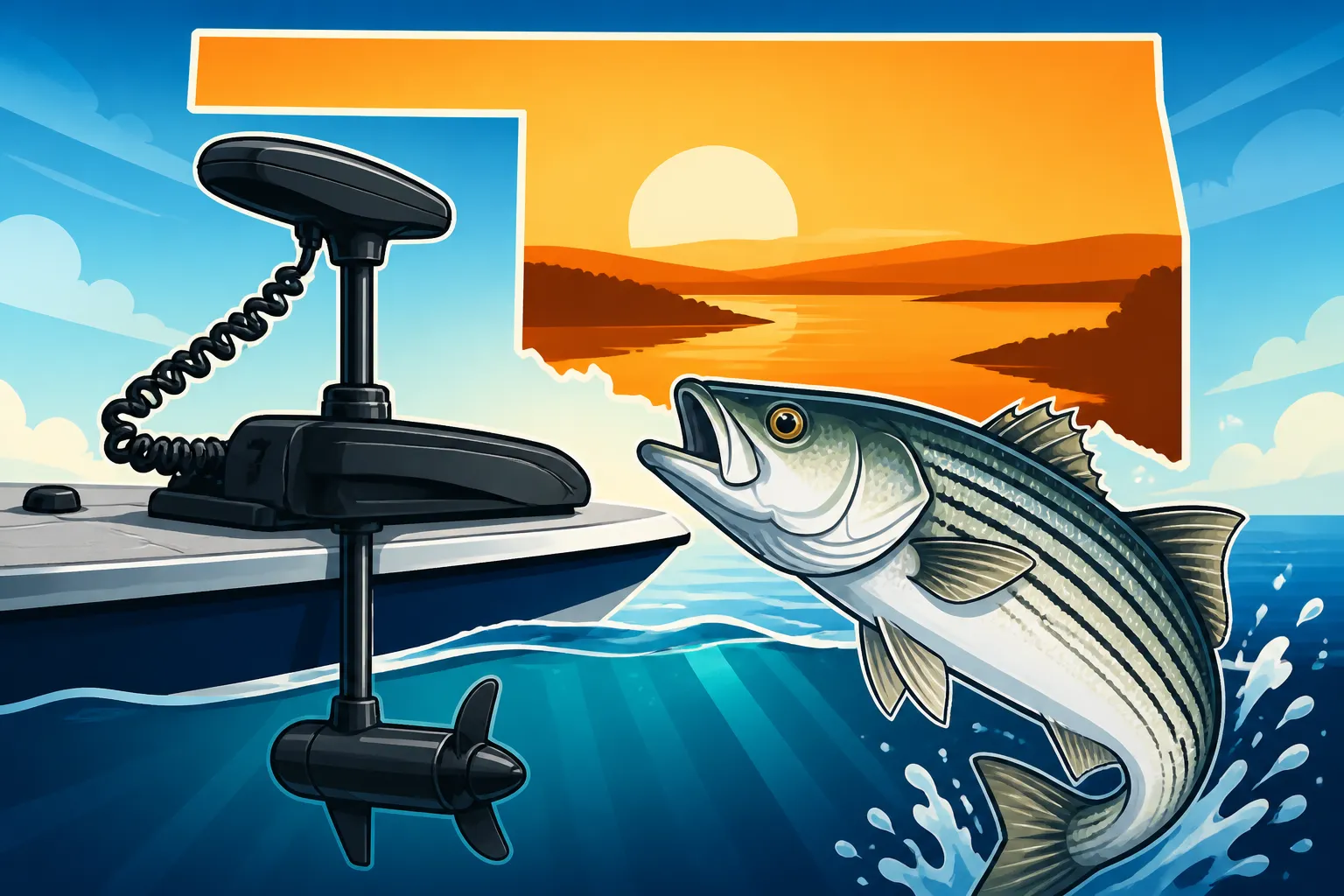
This is the most common and generally preferred type of trolling motor for serious freshwater and near-shore saltwater fishing, including striped bass on Lake Texoma. Bow-mount motors attach to the front of your boat, pulling it rather than pushing it. This "pulling" action offers superior control, especially in wind and waves, making it much easier to steer precisely and hold a course.
Pros:
- Superior Control: Pulling the boat from the bow allows for much more accurate steering and positioning.
- GPS Anchoring: Almost all modern bow-mount motors come with or can be upgraded with GPS anchoring features, which are invaluable for striper fishing.
- Powerful Thrust: These motors are designed for high thrust ratings, capable of handling larger boats and challenging conditions like those on Texoma.
- Foot Pedal & Remote Options: Most offer both foot pedal control for hands-free operation and wireless remotes for flexibility.
Cons:
- Installation: Installation can be more involved, often requiring drilling into the boat's bow and running dedicated wiring to batteries.
- Cost: Generally the most expensive type of trolling motor, especially for models with advanced features.
- Obstruction: When stowed, the motor head can sometimes obstruct the view from the bow, though modern designs aim to minimize this.
For anyone serious about targeting striped bass on Lake Texoma, a bow-mount trolling motor with GPS anchoring is overwhelmingly the top recommendation. Brands like Minn Kota and MotorGuide dominate this space, offering robust models built for demanding conditions. You'll find a huge selection of these motors at retailers like Bass Pro Shops or specialized marine electronics stores.
Transom-Mount Trolling Motors
Transom-mount trolling motors attach to the stern (back) of your boat, typically with a clamp-on bracket. They are often simpler in design and more affordable than bow-mount units.
Pros:
- Easy Installation: Simple clamp-on design means quick attachment and removal.
- Affordable: Generally the most budget-friendly option.
- Portability: Easy to move between different boats or remove for storage.
Cons:
- Limited Control: Pushing the boat from the stern offers less precise control, especially in windy conditions or when trying to hold a specific heading.
- Less Powerful: Often come with lower thrust ratings, making them less suitable for larger boats or the strong currents and waves of Lake Texoma.
- No GPS Anchoring: Most transom-mount motors lack advanced GPS features.
- Interference: Can interfere with outboard motor operation or prop wash.
While a transom-mount motor might work for smaller boats in very calm, protected coves on Texoma, it's generally not recommended as the primary trolling motor for dedicated striped bass fishing. The lack of thrust, precise control, and GPS anchoring would severely limit your effectiveness and comfort on the main lake.
Engine-Mount Trolling Motors
These are specialized trolling motors that attach directly to the cavitation plate of your outboard motor. They are designed to supplement your main engine, often used for subtle speed adjustments during slow trolling.
Pros:
- Stealthy: Extremely quiet operation.
- Hidden: Doesn't take up deck space.
- Simple Operation: Often integrates with your main steering.
Cons:
- Low Thrust: Typically offer much lower thrust than bow-mount motors, making them ineffective for holding position against strong winds or current.
- No GPS Anchoring: Lack advanced navigation features.
- Limited Maneuverability: Dependent on the steering of your main outboard.
- Not a Primary Trolling Solution: These are best as auxiliary motors, not as your main boat control device for active fishing.
For striped bass on Lake Texoma, an engine-mount trolling motor might serve as a backup or for very specific, subtle trolling presentations, but it should not be considered a replacement for a powerful bow-mount system. You need the robust thrust and precise control that only a dedicated bow-mount unit can provide.
Here's a quick comparison of general trolling motor types:
| Feature | Bow-Mount Motor | Transom-Mount Motor | Engine-Mount Motor |
|---|---|---|---|
| Control & Precision | Excellent (Pulls boat) | Fair (Pushes boat) | Fair (Steers with main) |
| Thrust Range | High (80-120+ lbs) | Low to Medium (30-55 lbs) | Low (25-45 lbs) |
| GPS Anchoring | Yes (Common) | No (Rare) | No |
| Shaft Length Needs | Long (60-72+ inches) | Shorter (36-48 inches) | N/A |
| Best For Lake Texoma Stripers | Highly Recommended | Not Recommended (Primary) | Auxiliary Use Only |
| Installation | Complex | Simple (Clamp-on) | Moderate |
| Cost | High | Low | Medium |
Selecting and Maintaining Your Texoma Trolling Motor
Choosing the right trolling motor is an investment, and like any good piece of fishing gear, it deserves proper selection and care. For your Lake Texoma striped bass adventures, going cheap here can cost you dearly in frustration and missed opportunities.
Making the Final Decision
When you're ready to make your purchase, here's a checklist to help solidify your choice:
- Boat Size and Weight: Be honest about your boat's length, width, and how much gear and how many people you typically have on board. This directly impacts the thrust you need. A 21-foot bass boat loaded for a tournament will need significantly more power than a 17-foot aluminum jon boat.
- Water Conditions: You're fishing Lake Texoma. Expect wind, waves, and current. Opt for higher thrust and longer shaft length than you think you might need. You won't regret having extra power when the weather turns.
- Battery Capacity: Don't forget the batteries! A powerful 36V trolling motor is useless without three strong 12V deep-cycle marine batteries and a reliable charger. Plan for enough amp-hours to last you a full day of heavy use. Investing in quality batteries is just as important as the motor itself.
- Features vs. Budget: Decide which features are non-negotiable for your fishing style. For stripers on Texoma, GPS anchoring is almost certainly a top priority. While you might find entry-level models, consider how much the advanced features will improve your experience and success. Sometimes, spending a bit more upfront saves you headaches down the line. You can often compare models and their features side-by-side on websites like Amazon, or by talking to the knowledgeable staff at a specialty store like Bass Pro Shops. Best Trolling Motor for Striped Bass at Lake Texoma will generally be a bow-mount unit with high thrust and advanced GPS features.
Trolling Motor Maintenance for Longevity
Your trolling motor is going to work hard for you on Lake Texoma, so proper maintenance is key to ensuring its longevity and reliability.
- Rinse After Use: Always rinse your trolling motor thoroughly with fresh water after each trip. This is especially important for parts that have been submerged, as lake water can contain sediment and other elements that can build up.
- Check Propeller: Regularly inspect your propeller for fishing line, weeds, or any damage. Even a small piece of fishing line wrapped around the prop shaft can cause seals to leak and lead to costly repairs down the road. Keep a spare prop and the necessary wrench in your boat.
- Battery Care: Your batteries are the heart of your trolling motor system. Keep them clean, ensure terminals are tight and free of corrosion, and always charge them fully after each use. Store them in a cool, dry place if your boat is put up for an extended period. Consider a smart charger that can maintain battery health.
- Cable and Connection Inspection: Periodically check all electrical cables for cuts, chafing, or corrosion, especially at the connections to the batteries and the motor itself. Loose or corroded connections can lead to poor performance and even damage to your motor.
- Shaft and Mount Lubrication: Some components of your motor's mount and shaft may benefit from occasional lubrication as recommended by the manufacturer. This helps ensure smooth deployment and stowage.
- Annual Service: Just like your main outboard, consider an annual inspection by a qualified marine technician. They can check for internal wear, update software, and ensure all systems are operating optimally.
By giving your trolling motor the attention it deserves, you'll ensure it's ready to perform whenever you hit the water, helping you pursue those trophy striped bass across Lake Texoma for many seasons to come. You'll find that taking care of your gear, like understanding Oklahoma Boat Registration and Titling Rules Explained or knowing Oklahoma Life Jacket and PFD Rules for Boaters, is just part of being a responsible angler and boater.
Disclaimer
This article is for general informational purposes only and does not constitute professional advice. Laws, prices and regulations vary by location and change over time. Consult a qualified professional for guidance on your specific situation.