How Deep to Troll for Striped Bass on Lake Texoma
One of the biggest head-scratchers for any angler hitting the expansive waters of Lake Texoma is figuring out just how deep those elusive striped bass are holding. You're out there, trolling along, feeling the hum of the boat, but if your lures aren't at the right depth, you might as well be dragging a stick. It can be incredibly frustrating to spend hours on the water, burning fuel, only to come back empty-handed because you couldn't crack the code of striper depth. This guide is here to unravel that mystery, giving you the knowledge and strategies to consistently put your bait in front of Texoma's famous stripers.
Decoding Striped Bass Behavior and Depth Preferences on Lake Texoma
Understanding where striped bass prefer to hang out isn't just about throwing a line in the water; it's about getting inside their "heads" and anticipating their movements. These powerful fish are highly influenced by environmental factors, especially in a dynamic reservoir like Lake Texoma. If you want to consistently catch them, you need to understand the nuances of their seasonal migration, preferred habitats, and how light affects their positioning.
Seasonal Movements and Water Temperature
Striped bass are constantly on the move, and their depth preferences shift dramatically with the seasons. Water temperature is arguably the single most important factor driving these changes.
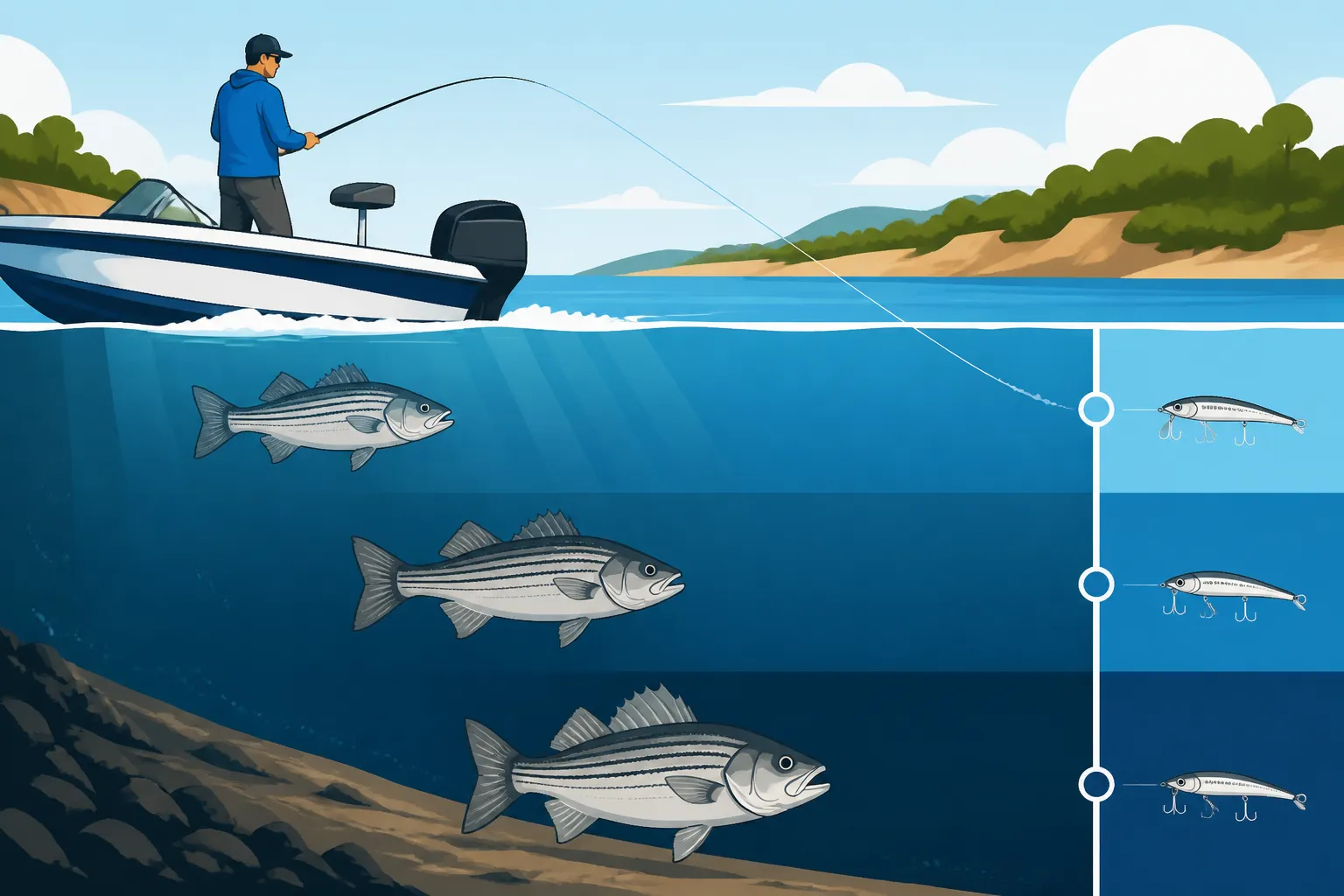
During the warmer months, typically from late spring through summer, Lake Texoma's waters heat up, and a distinct thermocline often forms. This is a layer where the water temperature rapidly changes, creating a comfortable zone for stripers and their baitfish. Above the thermocline, the water might be too warm and have lower oxygen levels, pushing the fish deeper. Below it, the water can become anoxic (lacking oxygen), also forcing fish to stay above that boundary. So, in summer, you'll often find stripers congregating right along or just above the thermocline, seeking that sweet spot of cooler, oxygenated water. This could mean they are holding anywhere from 25 to 60 feet deep, depending on the specific conditions of the lake that year. Knowing how to read your electronics to identify the thermocline is absolutely crucial.
Conversely, as fall brings cooler temperatures, the lake begins to "turn over," and the thermocline breaks down. This allows stripers to spread out more horizontally and vertically throughout the water column. In the fall and winter, you might find them shallower, chasing baitfish closer to the surface, especially during feeding frenzies, or still holding in deeper channels and creek beds but without the strict adherence to a thermocline. In the coldest parts of winter, they might hold in very deep, stable water, but still be willing to come up for a bait. This flexibility means your trolling depth could range from 15 feet to 80 feet or more, truly making it a day-to-day adjustment based on current conditions. For more on how these changes affect fishing, check out How Water Temperature Affects Fishing Timing in Oklahoma.
Forage and Structure
Striped bass are predators, plain and simple. Their lives revolve around finding and eating baitfish, primarily gizzard shad and threadfin shad in Lake Texoma. Therefore, where the bait goes, the stripers often follow. This means your trolling depth should always be informed by where you're marking schools of baitfish on your fish finder. If you see huge clouds of shad at 30 feet, that's likely where the stripers will be lurking, ready to ambush them.
Beyond the bait, stripers also relate heavily to underwater structure. Lake Texoma, being a large reservoir, has an abundance of submerged features: old river channels, creek beds, ledges, humps, points, and even standing timber. These structures provide ambush points, shade, and sometimes slightly cooler water, making them prime real estate for stripers. For instance, if you're trolling over a deep river channel that drops from 40 feet to 80 feet, the stripers might be holding on the edges of that channel or suspended just above the deepest part. Trolling your lures to run parallel to these depth contours is a highly effective strategy. Focusing your efforts on these key underwater features can significantly increase your chances of success, and a good topographical map combined with an advanced fish finder is your best friend here. Consider how different techniques are used when looking at Deep Water Striper Fishing Techniques.
Time of Day and Light Conditions
The amount of light penetrating the water also plays a significant role in how deep striped bass will hold. Like many predatory fish, stripers tend to be more active and willing to come shallower during low-light conditions, such as dawn, dusk, or on heavily overcast days. During these times, they feel less exposed and can use their superior eyesight to hunt baitfish more effectively. You might find them in the upper 10-20 feet of the water column, especially if baitfish are present there.
However, as the sun climbs higher in the sky and penetrates deeper into the water, stripers often retreat to deeper, darker water. This is partly for comfort and partly because their eyes are very sensitive to bright light. On a clear, sunny midday, even in cooler water, stripers will often be much deeper, sometimes holding 40-70 feet down, suspending over open water or relating tightly to deep structure. This is why many experienced Texoma anglers will tell you that the early morning and late evening hours are often the most productive for shallow-to-mid depth striper action, while midday requires a commitment to deep-water trolling. Knowing how to adjust your trolling depth based on the sun's position is a critical skill for consistent catches.
Essential Gear for Effective Deep Trolling on Texoma
Trolling for striped bass on Lake Texoma, especially when targeting those deeper fish, isn't something you can do effectively with just any old rod and reel. It requires a specialized setup designed to handle the forces of heavy weights, deep-diving lures, and powerful fish. Having the right tools for the job makes all the difference between a productive day and a frustrating one.
Rods, Reels, and Line
When it comes to rods for deep trolling for stripers, you'll want something stout and durable. Medium-heavy to heavy power rods, typically 6 to 7.5 feet in length, are ideal. Look for rods with a moderate to fast action that can absorb the shock of a big striper strike while still having enough backbone to winch a fish up from deep water. Fiberglass or composite rods often fit this bill well, offering excellent durability and a forgiving bend.
For reels, conventional (baitcasting) reels are the workhorses of striper trolling. They offer superior line capacity, which is crucial for letting out long lengths of line or deploying lead core. A smooth, powerful drag system is non-negotiable, as Texoma stripers can make blistering runs. Look for reels with a high-quality level-wind system to ensure even line lay, preventing tangles and ensuring smooth deployment. Brands like Penn, Shimano, or Abu Garcia offer reliable options that can stand up to the abuse of striper fishing. You can often find great deals on these at Amazon or local shops.
Line choice is also critical. Many anglers opt for 20-30 pound monofilament or fluorocarbon as a main line, particularly when using diving planners or downriggers, due to its stretch and abrasion resistance. However, some prefer braid (30-50 pound test) for its sensitivity and zero stretch, especially if they are going to use lead core line. When using braid or sometimes even mono, a fluorocarbon leader of 30-50 pounds test is a must. This leader provides an invisible connection to your lure, crucial in the clear waters of Texoma, and offers excellent abrasion resistance against the striper's rough mouth or any underwater obstacles.
Trolling Devices and Weights
This is where we really get into the "how deep" question. Simply tying a lure to your line and casting it out isn't going to get you 40-60 feet down. You need specialized devices to achieve and maintain those depths.
- Downriggers: These are perhaps the most precise method for controlling trolling depth. A downrigger uses a heavy ball (often 8-12 pounds) on a cable to pull your main fishing line down to a desired depth. Your fishing line is then clipped to the downrigger release, which holds it until a fish strikes, at which point it releases. This allows you to fish with lighter line and directly present lures at precise depths, making it incredibly effective when stripers are holding tight to a specific contour or thermocline.
- Lead Core Line: This is a specialized fishing line with a lead filament woven into its core, making it heavy and causing it to sink. Lead core is color-coded, with each color segment (typically 10 yards) sinking a certain amount at a given trolling speed. For example, at 2-3 mph, you might estimate 5 feet of depth per color. This method doesn't require extra weight on your line, but it does mean using a different type of line on your reel and learning its sink rate. It's often spooled onto larger conventional reels.
- Diving Planers (Dipsy Divers, Jet Divers): These are disc-shaped or finned devices that attach to your main line ahead of your leader and lure. As you troll, the water pressure forces them to dive, pulling your lure down to a specified depth. Many models are adjustable, allowing you to fine-tune the diving angle and thus the depth. They come in various sizes, with larger ones capable of reaching greater depths. They're a great alternative if you don't have downriggers.
- Snap Weights and Trolling Weights: These are simply heavy weights that you "snap" onto your main line, usually a certain distance ahead of your lure. While effective for getting some depth, they are less precise than downriggers or diving planers and can be a bit more cumbersome when fighting a fish or reeling in. They are often used when you need just a bit more depth than your lure can achieve on its own.
Lures and Bait
The choice of lure or bait is just as important as the depth. For deep trolling for stripers on Texoma, you'll want baits that mimic the natural forage.
- Deep-Diving Crankbaits: These are hard-bodied lures with large bills that cause them to dive when retrieved or trolled. Some models can reach depths of 20-30 feet on their own, and when combined with lead core or diving planers, they can easily get down to where the stripers are. Look for colors that mimic shad, like chrome, white, or blues.
- Umbrella Rigs: A Texoma favorite! These rigs consist of a central wire with multiple arms, each trailing a swimbait or grub. They mimic a school of baitfish, making them incredibly attractive to stripers. Umbrella rigs often require additional weight or a downrigger to reach deeper fish, but their effectiveness is undeniable. You can find a good selection of these at a well-stocked Bass Pro Shops.
- Spoons: Heavy metal jigging spoons or flutter spoons can be incredibly effective when dropped to depth and then trolled, allowing them to flutter and flash like a distressed baitfish.
- Live Bait: While less common for trolling, live shad or even large shiners can be incredibly effective when drifted or slow-trolled with the current, especially when weighted to reach target depths. This often falls more into controlled drifting than active trolling, but it's worth noting.
Practical Trolling Strategies for Lake Texoma's Stripers
Once you have your gear sorted, it's time to put it to use on the vast waters of Lake Texoma. This reservoir is legendary for its striped bass, but finding them can sometimes feel like searching for a needle in a haystack. Strategic planning and a willingness to adapt are crucial. For more overall advice, be sure to check out Lake Texoma Fishing Guide for Oklahoma Anglers.
Locating Deep Water Hotspots
Success often begins before you even launch the boat. Start by studying maps of Lake Texoma, focusing on areas with significant depth changes, old river channels (like the Red and Washita rivers), creek beds, and prominent underwater humps or ledges. These are the highways and hangouts for stripers. Identify areas where these deep structures intersect or where deep water is close to shallower points – these are classic ambush zones.
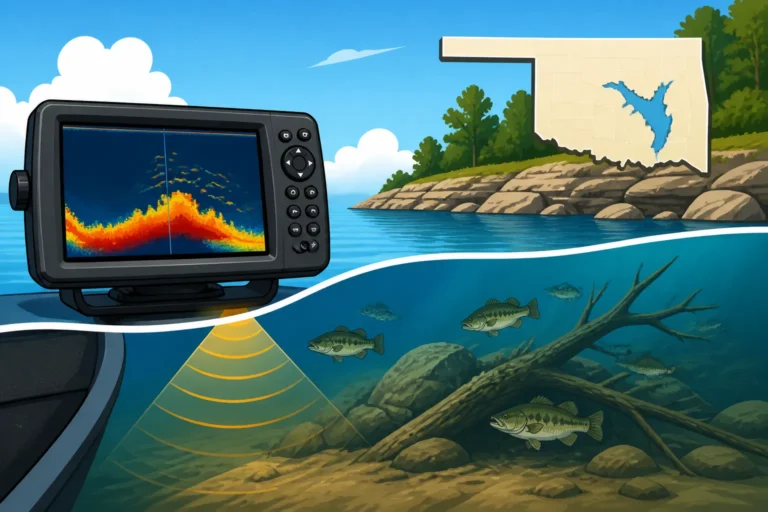
Once on the water, your fish finder or sonar becomes your most valuable tool. Don't just motor around aimlessly. Look for schools of baitfish, often appearing as large clouds or scattered dots on your screen. If you find bait, stripers are usually not far behind, appearing as distinct arches or lines, often below or just on the edge of the bait. Fish Finder Features That Matter Most on Oklahoma Reservoirs provides excellent insights into optimizing your electronics. Pay attention to any thermocline you might see during the warmer months, as stripers will often be suspended right around that depth. Mark these spots on your GPS so you can return to them later or troll through them repeatedly. Also, observe other successful anglers – not to crowd them, but to get an idea of the general depth and areas where fish are being caught. Local knowledge, whether from bait shops or fellow anglers, is priceless.
Adjusting Depth Based on Conditions
This is where the art of deep trolling truly comes into play. There's no magic number that works every single day. You have to be a detective, constantly adjusting and experimenting. Start by deploying your lures at a depth where you're marking bait or fish. If your fish finder shows bait at 40 feet, try running your lures at 35, 40, and 45 feet across multiple lines to see what they prefer.
Vary your trolling speed. A slower speed (1.5-2.5 mph) often allows lures to run deeper and can be more effective for lethargic fish, especially in cooler water. Faster speeds (2.5-4 mph) can draw reaction strikes and cause lures to run shallower. Speed also affects how lead core line sinks or how diving planers perform, so keep meticulous notes. Don't be afraid to make small, incremental changes. Move your downrigger ball up or down 5 feet. Let out an extra "color" of lead core. Change the setting on your diving planer. It's often these subtle adjustments that unlock the bite. If you're not getting hits, don't be stubborn; change something. This might mean trying a completely different depth, or even a different lure or color. Understanding Striped Bass Fishing Techniques for Oklahoma's Lake Texoma will further enhance your approach.
Reading Your Electronics
Modern fish finders are incredibly powerful tools, but they're only as good as your ability to interpret what they're telling you. Learn to distinguish between baitfish (often appearing as fuzzy clouds or dense schools) and individual game fish (usually distinct arches or solid lines). Pay attention to the depth at which these targets appear. If you're consistently seeing bait at 30 feet and stripers just below them, that's your target depth range.
Also, look for structure. Your fish finder can reveal submerged humps, drops, and channels that you might not even know are there. Trolling along the edges of these features, rather than directly over them, can often be more productive as stripers use these edges for ambush points. During warmer months, identify the thermocline if it's present – it will often appear as a distinct horizontal line where the sonar signal changes density. This line is a prime depth for stripers. Remember, your electronics are giving you a real-time snapshot of the underwater world; learn to trust what you see and adjust your strategy accordingly.
Here's a quick reference table for common trolling devices and their general depth ranges:
| Trolling Device | Approximate Depth Range (at typical trolling speed) | Advantages | Considerations |
|---|---|---|---|
| Downrigger | 10 – 100+ feet (variable with weight and cable) | Most precise depth control, lighter main line use | Requires dedicated equipment, slower to deploy/retrieve |
| Lead Core Line | 5 – 10 feet per "color" (10-yard segment) | No additional weights on line, effective for covering depths | Requires special reel setup, less precise than downrigger |
| Diving Planer | 15 – 50 feet (varies by size/model/settings) | No heavy weights on line, relatively easy to use | Less precise than downrigger, can add drag to line |
| Snap Weights | 10 – 40 feet (varies by weight and distance) | Simple, inexpensive, flexible in placement | Less precise, can be cumbersome when reeling in fish |
Common Mistakes and Advanced Tips for Deep Trolling
Even seasoned anglers can fall into traps when deep trolling, and for beginners, the learning curve can feel steep. But with a few pointers and a willingness to experiment, you'll be well on your way to mastering Texoma's striped bass.
Trolling Too Fast or Too Slow
One of the most common mistakes I see out on the lake is anglers either zooming across the water or barely creeping along, without understanding how trolling speed impacts their presentation. Trolling speed directly affects how deep your lures run and how they behave in the water. As a general rule, a faster troll will make crankbaits dive shallower and swim with more action, while a slower troll will allow them to get deeper and have a more subtle wiggle. For lead core, faster speeds will lift the line and make it run shallower, while slower speeds let it sink deeper.
The "right" speed isn't a fixed number; it depends on the lure you're using, the device you're employing (downrigger, lead core, planer), and the mood of the fish. Often, a good starting point is between 2.0 and 3.5 mph. However, if fish are lethargic, slowing down to 1.5 mph can be the ticket, making your lure appear more like an easy meal. If they're actively chasing, bumping it up to 4.0 mph might trigger a reaction strike. Pay attention to how your lures are performing at different speeds, and don't be afraid to play with your boat's throttle. Your Trolling Motor Setup for Oklahoma Striped Bass can play a crucial role in maintaining precise speeds.
Ignoring the Bait
It might sound obvious, but many anglers focus solely on finding "fish" on their sonar and forget to pay attention to the baitfish. Striped bass are almost always associated with their food source. If you're marking a lot of arches at 50 feet but see absolutely no bait in the vicinity, those might be carp or another species not interested in your striper baits. Conversely, if you see dense clouds of shad at 35 feet, even if you don't immediately see stripers, you can bet they're likely somewhere nearby, perhaps lurking just below the school or on its edges.
Make it a priority to locate baitfish schools. Once you find them, adjust your trolling depth to present your lures right on the edge of, through, or just below those bait balls. Sometimes, stripers will be directly inside the bait school, attacking from within. Other times, they'll be beneath it, waiting for injured bait to fall. By focusing on the bait, you're fishing where the food is, which dramatically increases your odds of encountering hungry stripers. The best fishing spot for stripers often changes, so knowledge of Lake Texoma's Striped Bass Fishery in Oklahoma is helpful.
Experimentation is Key
Perhaps the most important advanced tip for deep trolling for striped bass on Lake Texoma is this: never stop experimenting. The lake is a living, breathing entity, and conditions change daily, sometimes hourly. What worked yesterday might not work today. The fish might move deeper or shallower due to weather fronts, changes in current, boat traffic, or simply their own inscrutable whims.
Don't get stuck in a rut using the same depth, same lure, or same speed if it's not producing. Start with your best guess based on previous success and current conditions, but then be prepared to adjust. Try different lure colors, sizes, and types. Use different trolling devices on different lines to cover multiple depths simultaneously. Vary your speed throughout your trolling passes. Keep detailed notes (mental or physical) about what works, when, and where. The anglers who consistently catch fish on Texoma are the ones who are constantly learning, adapting, and experimenting with their approach, turning every trip into a valuable lesson. If you're looking for different gear to try, a quick browse on Amazon will show you countless options.
Disclaimer
This article is for general informational purposes only and does not constitute professional advice. Laws, prices and regulations vary by location and change over time. Consult a qualified professional for guidance on your specific situation.