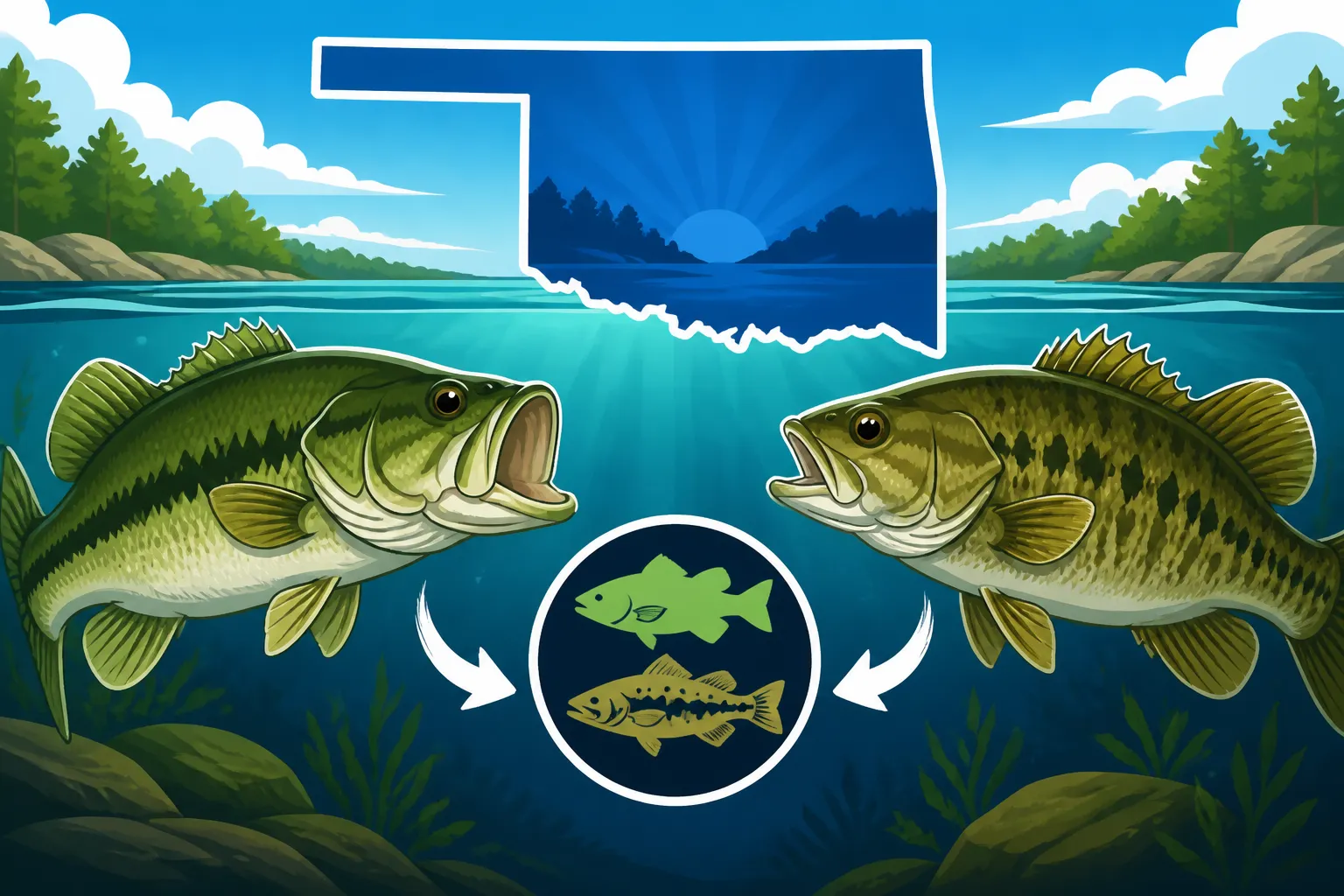
Do Largemouth Bass and Spotted Bass Live in the Same Oklahoma Lakes?
It can be incredibly confusing when you’re out on the water in Oklahoma, reeling in a beautiful bass, and you’re just not quite sure if it’s a largemouth or a spotted bass. Many anglers, even seasoned ones, find themselves wondering if these two distinct species actually share the same watery homes, and how to tell them apart when they do. This guide is here to untangle that mystery, offering clarity on where these bass species live and how you can identify them with confidence.
Understanding Oklahoma's Black Bass Family
Oklahoma is truly a bass angler's paradise, offering a variety of these exciting game fish. When we talk about "black bass," we're generally referring to largemouth, smallmouth, and spotted bass. While smallmouth often prefer cooler, clearer, rocky streams and reservoirs, largemouth and spotted bass have a more complicated relationship, often thriving in the same lake systems across our state. It's not just a matter of identification; understanding their habits and habitats can drastically improve your fishing success.
The Ubiquitous Largemouth Bass
Ah, the largemouth bass! This is likely the fish that comes to mind for most people when they think of bass fishing in Oklahoma. They are, without a doubt, the most popular game fish in our state and across the country. You'll find them in almost every lake, pond, and larger river system, making them incredibly accessible for anglers of all skill levels. Their adaptability is truly remarkable.
Largemouth bass are typically ambush predators, preferring to hide in dense cover. Think about those areas where submerged timber, thick weed lines, lily pads, or even boat docks and brush piles offer plenty of shade and structure. They love to lie in wait, perfectly camouflaged, ready to explode on unsuspecting prey. This is why you often find them cruising the shallow margins, especially during lower light conditions or cooler parts of the day.
Visually, largemouth are characterized by their prominent jaw – the rear of their upper jaw extends beyond the back of their eye when their mouth is closed. They generally have a more solid, often dark green to olive green lateral line that may be somewhat broken or patchy. When hooked, a largemouth often puts on an aerial show, jumping and thrashing its head to throw the hook. It's that classic bass fight that gets the adrenaline pumping and keeps us coming back for more.
The More Elusive Spotted Bass
Now, let's talk about the spotted bass, sometimes affectionately called "spots" or "Kentucky spotted bass" by those who fish for them regularly. While perhaps not as universally recognized as the largemouth, the spotted bass is a growing presence and a formidable opponent in many Oklahoma lakes, particularly in the eastern and southeastern parts of the state. They might be a bit more elusive simply because they often prefer different types of habitat.
Spotted bass tend to favor clearer, rockier waters with deeper structure. While a largemouth might be buried in a thick mat of hydrilla, a spotted bass is more likely to be hugging a bluff wall, hanging out around a deep rocky point, or cruising over a submerged hump. They don't mind current as much as largemouth, so you'll often find them near dam spillways or river channels within a reservoir. Their preference for these deeper, hard-bottomed areas means anglers sometimes have to adjust their tactics to find them.
In terms of appearance, spotted bass have a smaller mouth than their largemouth cousins; the upper jaw typically does not extend past the middle of the eye. Their most distinguishing feature, however, is the rows of dark spots below the lateral line, giving them a "spotted" belly appearance (hence the name!). They also often have a rough patch of teeth on their tongue, which is a key identifier. When you hook a spotted bass, be ready for a fight that's often described as a bulldog-like pull. They tend to stay deep, pulling hard and constantly, rather than jumping. This deep-diving, relentless fight is truly something to experience.
The Overlap: When and Where They Coexist
The short answer to the question "Do Largemouth Bass and Spotted Bass live in the same Oklahoma lakes?" is a resounding yes! It's not just possible; it's quite common. However, their coexistence isn't always a free-for-all. They often manage to share the same body of water by partitioning the available habitat, essentially carving out their own niches. This means that while you might catch both in the same lake, you're more likely to find them in different types of cover or at different depths.
Shared Waters: Reservoirs with Diverse Habitats
Many of Oklahoma's larger reservoirs are perfect examples of lakes that can successfully support healthy populations of both largemouth and spotted bass. Lakes like Lake Eufaula: Oklahoma's Gentle Giant for Bass and Crappie, Grand Lake O' the Cherokees Bass Fishing Guide, and even parts of Lake Texoma, offer such a wide array of habitats that both species can thrive without directly competing for the exact same resources. These lakes often have extensive shallow, weedy flats alongside deep, rocky bluffs and submerged timber, providing homes for both types of bass.
Imagine a large reservoir where one arm flows into a shallower, more timber-filled area with lots of standing trees and brush piles, and another arm boasts clearer water with steep rock walls and deep drop-offs. The largemouth will gravitate towards that brushy, timbered, shallower end, while the spotted bass will often patrol those rocky, deeper sections. It’s like they have an unspoken agreement to stay in their preferred "neighborhoods," even though they technically live in the same "city." This habitat partitioning is crucial for maintaining healthy populations of both species in a single system.
For example, on Grand Lake O' the Cherokees, you might target largemouth in the dense willow trees and flooded timber found in the upper reaches of the lake or around man-made structures further south. Meanwhile, spotted bass will be holding tight to the rocky points and bluff ends in the lower, clearer sections of the lake. An angler who understands this distinction can effectively target both species on the same outing simply by moving between different types of structure. This allows for a much more versatile and often more productive fishing trip.
Habitat Segregation: How They Avoid Direct Competition
While they might share the same lake, largemouth and spotted bass generally stick to what they know best, minimizing direct competition for food and prime real estate. This natural segregation is fascinating to observe as an angler. You'll rarely find a largemouth and a spotted bass schooling together, though they might be caught in close proximity if a specific piece of structure offers varied habitat.
Largemouth bass, with their larger mouths, are perfectly adapted to ambushing bigger prey from dense cover. They thrive in environments where they can hide and surprise their meal. So, when you're fishing a lake that holds both, look for largemouth along the edges of vegetation, under overhanging limbs, or near boat docks. These are their comfort zones, and they'll rarely stray far from such secure hiding spots. They are generally less tolerant of strong currents and prefer more stagnant or slowly moving water.
Spotted bass, on the other hand, often feed on smaller prey, including shad and crayfish, and prefer to hunt in more open, deeper water or along vertical structures. Their body shape and fighting style are geared for battling in current and staying down. Thus, if you’re fishing a deep, clear Oklahoma lake with a lot of rock and vertical drops, chances are you’ll encounter more spots. They are also quite active, often chasing baitfish in open water, which is a behavior less commonly associated with largemouth. Recognizing these distinct preferences is key to understanding their coexistence and, more importantly, catching them!
Identifying Largemouth vs. Spotted Bass on the Water
Even in lakes where both species are present, knowing what you've just hooked can be a fun challenge. Sometimes it's obvious, but other times, especially with smaller fish or hybrids, it can be a real head-scratcher. The good news is that with a few key identifiers, you can usually tell them apart without too much trouble. It takes a keen eye and a bit of practice, but soon you'll be calling them out instantly.
Key Visual Differences
The most reliable way to distinguish between a largemouth and a spotted bass usually comes down to a few critical anatomical features. Don't worry, you don't need a magnifying glass, just a good look at your catch.
First, and often the easiest, is the mouth size. For a largemouth, when its mouth is closed, the corner of its jaw (maxillary) extends distinctly past the rear edge of its eye. If you draw an imaginary vertical line down from the back of the eye, the largemouth's jaw goes past it. For a spotted bass, that jaw typically aligns with the middle of the eye or just slightly behind it, but rarely past the back edge.
Next, look at the lateral line and body spots. Largemouth bass usually have a prominent, often continuous dark lateral line (the stripe down its side), and generally lack distinct rows of spots on their belly scales below that line. Spotted bass, however, will have more broken or patchy lateral line markings, and most importantly, distinct rows of dark spots on their lower flanks and belly. It's like they have a polka-dot shirt on their underside.
Finally, check the tongue. This is often the clincher for the more ambiguous catches. Gently open the bass's mouth and feel for a rough patch on the middle of its tongue. Spotted bass almost always have a noticeable patch of small, coarse teeth on their tongue. Largemouth bass very rarely have this, and if they do, it's usually very faint.
Here's a quick comparison table to help you in the field:
| Feature | Largemouth Bass | Spotted Bass |
|---|---|---|
| Upper Jaw | Extends past the back edge of the eye | Ends at or before the back edge of the eye |
| Lateral Line | Often a solid, distinct dark stripe | More broken or patchy, sometimes less defined |
| Belly Spots | Generally absent or very faint | Distinct rows of dark spots below lateral line |
| Tongue Patch | Absent or very faint/rough | Almost always present and noticeable |
| Body Shape | More elongated, somewhat rounder | More compact, sometimes appears chunkier |
The Fight: How They Feel Different on the Line
Beyond the visual cues, experienced anglers can often tell the difference between a largemouth and a spotted bass just by how they fight. While every fish is different, and size plays a huge role, there are some general tendencies.
A largemouth bass is famous for its acrobatic displays. When you hook a largemouth, especially in open water, get ready for jumps! They love to break the surface, shaking their head violently in an attempt to dislodge the hook. It's an exciting, splashy fight that often has periods of intense action followed by moments of relative calm. You might feel a heavy head shake more than a constant pull.
Spotted bass, on the other hand, are often described as "miniature smallmouths" in their fighting style. They tend to stay deep, pulling hard and making continuous, strong runs. Instead of jumping, they often dive repeatedly, putting a constant, relentless pressure on your line. You'll feel a steady, bulldog-like pull and less of the violent head-shaking at the surface. They are incredibly tough for their size and can truly test your tackle.
Understanding these fight differences can help you anticipate their moves and adjust your retrieve or drag accordingly. It's part of the fun of fishing in Oklahoma's diverse waters, where you never quite know what kind of fight you're going to get until it's on the end of your line.
Fishing Strategies for Coexisting Bass Populations
Knowing that both species might be lurking in the same lake opens up some exciting possibilities for anglers. It also means you might need to adjust your approach if you have a preference for one over the other. The key is to understand their preferred habitats and tailor your lure selection and presentation accordingly. Whether you're a fan of the explosive jumps of a largemouth or the deep, powerful runs of a spotted bass, Oklahoma has plenty of opportunities.
Targeting Largemouth in Mixed Waters
If your heart is set on catching largemouth bass in a lake that also holds spots, you'll want to focus your efforts on those classic largemouth haunts. Think shallow, dense cover. This includes thick vegetation like hydrilla or lily pad fields, laydowns, stump fields, brush piles, boat docks, and even shaded creek channels. Largemouth bass are ambush predators, so they want places where they can hide and surprise their prey.
Your lure selection should reflect this. Spinnerbaits, chatterbaits, plastic worms (especially Texas-rigged or Carolina-rigged), jigs, and topwater lures like frogs or poppers are all excellent choices for enticing largemouth out of their cover. Heavy cover often calls for heavier line and stout rods, which you can easily find on platforms like Amazon if you're looking to upgrade your gear. Remember, presentation is key – get your lure right into their living room! For more in-depth advice, check out Largemouth Bass Fishing in Oklahoma: The Complete Guide.
Imagine you're on Lake Eufaula, known for its extensive timber. You'd be casting a weedless jig or a Texas-rigged worm right into the heart of those submerged trees, feeling for that subtle tap. Or maybe you're pitching a frog over matted vegetation. These are classic largemouth strategies. You might still catch a spotted bass occasionally, especially if the cover is near a drop-off, but your focus will be on the densest cover available.
Targeting Spotted Bass in Mixed Waters
For those who appreciate the relentless fight of a spotted bass, you'll need to shift your focus to different parts of the lake. Spotted bass prefer clearer water and hard structure, often holding deeper than largemouth. Look for rocky points, bluff walls, deep humps, main lake points, and areas with submerged rock or gravel beds. They also tend to be more comfortable with current, so fishing near dam outflows or along river channels within a reservoir can be highly productive.
Finesse techniques often shine when targeting spotted bass. Smaller crankbaits, finesse jigs, shaky head worms, drop-shot rigs, and small swimbaits are incredibly effective. Spotted bass often feed on shad and crayfish, so lures that imitate these prey items will do well. They are less prone to smashing a big, noisy topwater lure and more likely to respond to a subtle, natural presentation. If you're looking for specific lures or a new Best Rod for Largemouth Bass Fishing for finesse presentations, many specialized options are available online.
Consider fishing Grand Lake, where you have clear, deep sections with abundant rock. Here, you'd be throwing a shaky head worm or a small crankbait along a steep rock wall, letting it bounce down the ledges. Or you might be dropping a drop-shot rig over a deep, submerged hump where spotted bass are schooling on baitfish. These tactics, while different from traditional largemouth fishing, are incredibly rewarding and will lead you to those hard-fighting spots. For more specific lure ideas, consult Best Lures for Spotted Bass.
So, while both bass species certainly share many of Oklahoma's fantastic fishing waters, understanding their individual preferences and adapting your fishing strategy will significantly increase your chances of success. It's all about knowing your fish and knowing your water. And remember to always be mindful of Oklahoma Statewide Bass Bag Limit Explained and How Many Bass You Can Keep in Oklahoma before you head out. Happy fishing!
Disclaimer
This article is for general informational purposes only and does not constitute professional advice. Laws, prices and regulations vary by location and change over time. Consult a qualified professional for guidance on your specific situation.