Largemouth vs Smallmouth vs Spotted Bass: How to Tell Oklahoma’s Bass Apart
It can be incredibly frustrating to reel in a beautiful bass, only to stare at it wondering, "Is this a largemouth? A smallmouth? Or one of those tricky spotted bass?" Many Oklahoma anglers grapple with this exact question, especially since identifying the subtle differences between these three common species can be a real challenge. This comprehensive guide is here to unravel that mystery, providing clear, practical tips and visual cues so you can confidently identify each bass species thriving in Oklahoma's diverse waters.
The Bass Family in Oklahoma: A Quick Overview
Oklahoma is truly a bass angler's paradise, boasting healthy populations of largemouth, smallmouth, and spotted bass. Each of these species offers a unique fishing experience, from the explosive topwater strikes of a largemouth to the hard-fighting acrobatics of a smallmouth in current. But before you can appreciate their individual merits on the line, you've got to know who you're dealing with. It’s not just about bragging rights; accurate identification plays a crucial role in responsible angling, especially when specific bag limits or length restrictions vary by species or even by water body.
Why Identification Matters for Oklahoma Anglers
You might think, "A bass is a bass, right?" and while they all belong to the Micropterus genus, there are vital distinctions. For instance, the statewide bag limit for black bass (which includes largemouth, smallmouth, and spotted bass) is generally a combined six fish. However, some lakes and rivers have very specific rules that might protect one species more than another. Imagine getting a hefty fine because you accidentally kept a smallmouth bass that was under the length limit for rivers, thinking it was a largemouth. It happens! Knowing the nuances can save you a headache and ensure you're fishing legally and sustainably.
Beyond the regulations, proper identification helps you understand the fish's behavior, preferred habitat, and what kind of bait or lure might tempt them. A smallmouth in a rocky riverbed is going to react differently than a largemouth lurking in heavy cover. Understanding these subtle differences is a huge step in becoming a more successful and knowledgeable angler. It's about connecting with the resource on a deeper level.
The Importance of Knowing Your Local Waters
Oklahoma's waters are incredibly varied, from sprawling reservoirs like Lake Texoma and Lake Eufaula to crystal-clear streams in the southeastern part of the state. While largemouth bass are ubiquitous, smallmouth and spotted bass tend to have more specific habitat preferences. Smallmouth, for example, thrive in cooler, clearer waters with rocky bottoms and good current, which is why you'll often find them in rivers or the deep, rocky sections of certain lakes. Spotted bass, on the other hand, can be found in a wider range of habitats, sometimes overlapping with both largemouth and smallmouth, making their identification even trickier.
Knowing the typical species composition of the lake or river you're fishing can give you a head start. If you're on a clear, rocky stream, you might be more likely to encounter smallmouth. If you're in a heavily vegetated pond, largemouth are probably the dominant species. However, many of Oklahoma's larger reservoirs offer a mixed bag, which is where those visual identification skills truly come into play. Always consult the latest Oklahoma's Bass Fishing Rules and Limits for the specific body of water you're targeting.
Largemouth Bass: The Classic Oklahoma Fighter
The largemouth bass (Micropterus salmoides) is arguably the most iconic freshwater game fish in North America, and Oklahoma is no exception. It's the fish that many of us grew up chasing, known for its aggressive strikes and powerful fights. If you've fished a farm pond, a state park lake, or one of Oklahoma's major reservoirs, chances are you've tangled with a largemouth. They are widespread and resilient, making them a favorite target for anglers of all skill levels.
Visual Cues and Distinctive Features
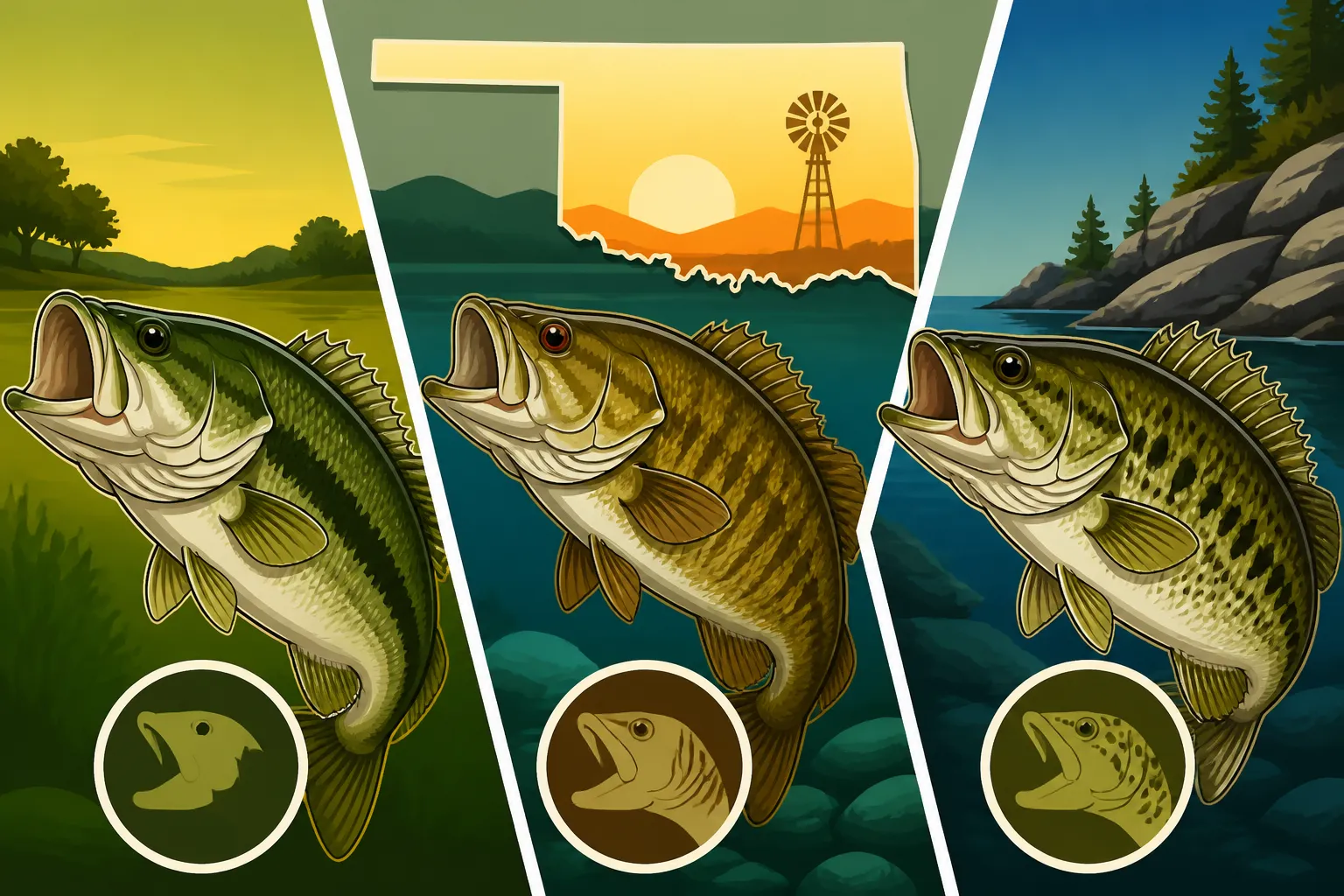
When you pull a largemouth out of the water, the first thing you'll notice, true to its name, is that enormous mouth. The jawline extends well past the back of the eye when the mouth is closed. This is perhaps the most reliable identifier. They also typically have a prominent, dark, horizontal stripe or series of blotches along their sides, which can sometimes appear as a broken or smudged line depending on water clarity and the individual fish. Their coloration can vary wildly, from dark green to olive green, often with a white or yellowish belly.
Another key feature is the dorsal fin. On a largemouth, the spiny front dorsal fin is deeply separated from the soft-rayed rear dorsal fin, almost looking like two distinct fins. Run your finger along it gently, and you'll feel that clear separation. Their body is generally robust and stocky, built for ambushing prey in dense cover. The scales on a largemouth are relatively large. For more detailed insights, check out our Largemouth Bass Fishing in Oklahoma: The Complete Guide.
Typical Habitat and Behavior
Largemouth bass are masters of cover. They love structure: submerged timber, brush piles, lily pads, hydrilla mats, boat docks, and even old tires. If it provides an ambush point, a largemouth will likely be there. They prefer warmer, shallower water compared to their smallmouth cousins and are often found in the fertile, stained, or clearer waters of Oklahoma's ponds, smaller lakes, and the coves and bays of larger reservoirs. Think quiet, protected areas where they can hide and dart out to snatch unsuspecting prey.
Their diet is diverse, including baitfish, crawfish, frogs, insects, and even small birds or rodents that fall into the water. This opportunistic feeding habit makes them receptive to a wide range of lures. They are often less tolerant of strong currents, preferring the slack water behind obstacles. During the warmer months, they might move to deeper water, but they'll always be associated with some form of cover.
Fishing for Largemouth: Techniques and Gear
Due to their ambush predator nature, targeting largemouth often involves casting lures into or around heavy cover. Flipping and pitching jigs or soft plastics into dense vegetation is a classic technique. Topwater lures like poppers, frogs, and buzzbaits are incredibly exciting when largemouth are actively feeding, especially during dawn and dusk. Crankbaits, spinnerbaits, and various soft plastic rigs (like Texas rigs or Carolina rigs) are also highly effective.
For gear, most largemouth anglers opt for baitcasting setups with medium-heavy to heavy power rods, allowing them to muscle fish out of thick cover and cast heavier lures accurately. Monofilament or fluorocarbon lines in the 12-20 pound test range are common, with braid often used for heavy cover applications. A good selection of lures can be found on platforms like Amazon, from basic soft plastics to more elaborate crankbaits. If you're looking to upgrade your setup, consider checking out some Best Rods for Oklahoma Largemouth Bass.
Smallmouth Bass: The River and Rock Dweller
The smallmouth bass (Micropterus dolomieu) is a beloved game fish, revered for its tenacious fight and acrobatic leaps. While not as widespread in Oklahoma as the largemouth, where they are found, they are cherished. These bronze beauties thrive in specific environments, offering a different kind of challenge and reward to the angler who seeks them out. You'll find them primarily in certain rivers and the rocky, cooler sections of some of our deeper reservoirs.
Key Identification Markers
The name "smallmouth" offers a clue, but it's not always as straightforward as it sounds, especially when comparing them to spotted bass. The most reliable visual cue for a smallmouth is that its jawline does not extend past the back of its eye when its mouth is closed. Their body shape is typically more torpedo-like and streamlined than a largemouth, designed for navigating current. Coloration is usually a beautiful bronze, golden brown, or olive green, often with dark vertical bars or blotches along their sides, rather than a continuous horizontal stripe.
Look closely at the dorsal fin: unlike the largemouth, the spiny and soft-rayed parts of the smallmouth's dorsal fin are connected, forming a continuous, though slightly notched, fin. The scales are generally smaller than those on a largemouth. You might also notice a subtle red tint in their eye, especially in clearer waters. For a deeper dive into their characteristics, read Smallmouth Bass in Oklahoma: What Anglers Should Know.
Preferred Environments and Habits
Smallmouth bass are quintessential residents of clear, cool, flowing water with rocky or gravel bottoms. Think rivers, creeks, and the deep, rocky main lake points, bluffs, and humps of large reservoirs. They prefer areas with current that brings food to them and helps keep the water oxygenated. Structures like boulders, rock piles, ledges, and submerged logs in current breaks are prime smallmouth real estate. They are less fond of dense aquatic vegetation or muddy, warm waters.
Their diet consists heavily of crawfish, baitfish (like shad or minnows), and aquatic insects. They are ambush predators but also actively hunt, often patrolling rocky banks or suspended over deeper structure. Smallmouth are known for their strong, sustained fights, often making powerful runs and incredible aerial displays when hooked.
Targeting Smallmouth: Approaches and Equipment
Fishing for smallmouth often involves techniques that mimic their preferred prey in rocky, current-rich environments. Small crankbaits, jerkbaits, spinnerbaits, and tube jigs are excellent choices. Soft plastic swimbaits and grub baits fished on jig heads are also highly effective, especially when hopped or dragged along the bottom. Topwater lures can be explosive when smallmouth are actively feeding in low light.
Many smallmouth anglers prefer spinning tackle, which offers excellent sensitivity for detecting subtle bites and allows for precise casting of lighter lures. Medium-light to medium power rods with fast actions are common, paired with spinning reels spooled with 6-10 pound fluorocarbon or braid with a fluorocarbon leader. When fishing rivers, portable tackle bags or vests, easily found on Amazon, are often preferred over large tackle boxes for mobility. Remember, if you're targeting them in rivers, specific regulations like The 14-Inch Minimum for River and Stream Bass might apply.
Spotted Bass: The Often-Confused Cousin
The spotted bass (Micropterus punctulatus) is often the culprit behind angler confusion, as it shares characteristics with both largemouth and smallmouth. Also known as "Kentucky bass" in some regions, these fish are abundant in many Oklahoma waters and can offer excellent fishing opportunities once you learn to identify them correctly. They are often found in similar habitats to largemouth but can tolerate a bit more current and deeper water.
How to Pinpoint a Spotted Bass
Here's where it gets tricky, but there are definitive markers. The jawline of a spotted bass, when closed, will extend to or just slightly past the back of the eye, but generally not as far as a largemouth. This is a subtle but critical difference. Their body shape is typically more slender and compressed than a largemouth, but not as streamlined as a smallmouth. Coloration is usually olive green to brownish green, with a dark, broken horizontal stripe that can resemble a largemouth.
The real "aha!" moment for spotted bass often comes from two key features:
- Tongue Patch: Gently open the fish's mouth and feel for a small, rough patch of teeth on its tongue. This is almost always present on a spotted bass and absent on largemouth and smallmouth.
- Scale Pattern Below Lateral Line: Below the lateral line, a spotted bass will typically have distinct rows of dark spots, forming a "spotted" pattern. This is why they're called spotted bass! Largemouth might have some irregular blotches, but not these distinct rows of spots.
Like the smallmouth, the spiny and soft-rayed dorsal fins of a spotted bass are connected, though the notch can be more pronounced than on a smallmouth. Get a good look at your catch, perhaps even taking a photo for later comparison. Our Spotted Bass Fishing in Oklahoma: A Complete Guide offers more detailed photos and descriptions.
Where You'll Find Them in Oklahoma
Spotted bass are adaptable and can be found in a variety of habitats throughout Oklahoma. They often occupy a niche between largemouth and smallmouth, tolerating more current and deeper water than largemouth, but not requiring the consistently cool, clear, rocky environments favored by smallmouth. You'll find them in reservoirs like Lake Eufaula, Fort Gibson, and Grand Lake O' the Cherokees, often congregating around main lake points, humps, creek channels, and bluff ends.
They can also be found in rivers, often in sections with moderate current and rocky or gravel bottoms, but also near submerged timber and brush. They tend to school up more readily than largemouth, especially in open water, which can lead to exciting multiple hook-ups once you find a school.
Effective Spotted Bass Fishing Strategies
Because of their overlapping habitats and feeding patterns, many techniques effective for largemouth and smallmouth will also work for spotted bass. However, since they often school and are found in slightly deeper, more open water, techniques that allow you to cover water and fish vertically can be particularly effective. Drop-shotting, jigging spoons, shaky heads, and small crankbaits or swimbaits that imitate shad are excellent choices. They are also notoriously aggressive and will hit topwater lures with gusto.
Spotted bass often respond well to finesse techniques when conditions are tough, but they can be just as eager to chase down a fast-moving crankbait. Light to medium-light spinning gear can provide the sensitivity needed for these techniques, especially when fishing deeper structure. Look for them on ledges and humps using your fish finder. Many anglers swear by specific colors of soft plastics, often found in multi-packs on Amazon, when targeting these feisty fish.
Side-by-Side Comparison: Spotting the Differences
Alright, let's bring it all together. When you've got a bass in hand, and you're trying to figure out if it's a largemouth, smallmouth, or spotted, here's a direct comparison of the most telling features. This table summarizes the key physical distinctions, making it easier to quickly classify your catch.
| Feature | Largemouth Bass | Smallmouth Bass | Spotted Bass |
|---|---|---|---|
| Mouth/Jawline | Extends well past the back of the eye | Does not extend past the back of the eye | Extends to or slightly past the back of the eye |
| Dorsal Fin | Deeply separated into two distinct fins | Connected, but with a slight notch | Connected, with a distinct notch |
| Lateral Stripe/Spots | Prominent dark horizontal stripe/blotches | Vertical bars or dark blotches | Broken horizontal stripe with distinct spots below lateral line |
| Tongue Patch | Absent (smooth tongue) | Absent (smooth tongue) | Present (rough patch of teeth on tongue) |
| Body Shape | Stocky, robust, generally thicker | Streamlined, torpedo-shaped, less deep | More slender than largemouth, deeper than smallmouth |
| General Color | Dark green to olive, white/yellow belly | Bronze, golden brown, olive green, lighter belly | Olive green to brownish green, white belly |
| Eye Color | Typically brown or gold | Often reddish tint in clear water | Typically brown or gold |
Mouth, Jawline, and Dorsal Fin Details
The mouth is your first, best indicator. If that jaw extends significantly beyond the back of the eye, you're almost certainly holding a largemouth. If it barely reaches the back of the eye, or falls short, it's either a smallmouth or a spotted bass. Then, look at the dorsal fin. Run your finger from the front (spiny) part to the back (soft-rayed) part. If there's a clear, deep gap, it's a largemouth. If it's connected, even with a notch, you've narrowed it down to a smallmouth or spotted bass. These two features alone can eliminate one or two species quickly.
Lateral Line and Scale Patterns
Next, examine the lateral line and the scales below it. Largemouth will have a clear, often jagged, horizontal band. Smallmouth will typically have vertical barring or irregular blotches, giving them a "tiger" like appearance. The spotted bass is the one with the distinct rows of dark spots below its lateral line. This is a consistent and very reliable feature for spotted bass. Also, notice the relative size of the scales: largemouth generally have larger scales compared to the smaller, finer scales of smallmouth and spotted bass.
Size, Shape, and Habitat Tendencies
While size isn't a definitive identification tool (young fish of all species can look similar), mature smallmouth and spotted bass rarely reach the trophy sizes that largemouth can achieve in Oklahoma. Largemouth tend to be chunkier and deeper-bodied, while smallmouth are more muscular and streamlined. Spotted bass fall somewhere in between, often looking like a cross between the two. Think about where you caught the fish: shallow, weedy cove? Probably a largemouth. Clear, rocky river current? Likely a smallmouth. Deep, rocky point on a reservoir? Could be any of them, but often a spotted bass. These environmental cues are helpful secondary clues. Remember, specific rules like Oklahoma Statewide Bass Bag Limit Explained apply to all three.
Practical Tips for Anglers: Beyond Just Looking
Successfully identifying bass species often comes down to a keen eye and a bit of practice. Don't feel discouraged if it's tough at first; even seasoned anglers can get stumped. The key is to pay attention to multiple characteristics rather than relying on just one. The more you examine fish, the better you'll become at recognizing the subtle differences that set each species apart.
Using a Fish ID Guide or App
One of the best tools an angler can have, especially when learning, is a good fish identification guide. You can find excellent waterproof field guides specific to Oklahoma or North American freshwater fish on Amazon. Many state wildlife departments also offer free printable guides online. Even better, there are numerous excellent fishing apps available for smartphones that allow you to quickly look up species, often with detailed photos and descriptions. Some even have community features where you can upload a photo of your catch and get help with identification from other anglers. Having a quick reference on hand can be invaluable when you're on the water.
Respecting Regulations and Limits
Once you're confident in your identification skills, it's crucial to apply them to comply with fishing regulations. Oklahoma has specific bag and length limits for bass, and these can sometimes vary by species or by the particular body of water. For example, some rivers have a Black Bass Rules for Oklahoma Rivers and Streams or stricter length limits for smallmouth bass. Always double-check the current regulations issued by the Oklahoma Department of Wildlife Conservation (ODWC) before you head out. Ignorance of the law is not an excuse for violations, and fishing without a license or keeping illegal fish can lead to significant penalties. Make sure you understand How Many Bass You Can Keep in Oklahoma before your trip.
Photographing Your Catch for Better Identification
In today's digital age, your smartphone is more than just a communication device—it's a powerful fishing tool. If you're unsure about a bass's identity, quickly snap a few clear photos before releasing it. Get shots of the entire fish, focusing on the jawline (mouth closed), the dorsal fin, and the lateral line. These photos can then be used later to consult a guide, an app, or even share with more experienced anglers online or at your local bait shop for confirmation. This practice not only helps you learn but also promotes catch-and-release, especially for fish you're not planning to keep, minimizing stress on the fish. Remember to wet your hands before handling fish and support their body weight horizontally to prevent injury.
Disclaimer
This article is for general informational purposes only and does not constitute professional advice. Laws, prices and regulations vary by location and change over time. Consult a qualified professional for guidance on your specific situation.