Rainbow Trout vs Brown Trout: How to Tell Them Apart
It's a common scene on the waters of Oklahoma: you've just landed a beautiful trout, and as it glistens in the sun, you find yourself staring, wondering, "Is this a rainbow or a brown?" For many anglers, especially those just starting out or visiting our state's fantastic trout streams and tailwaters, these two magnificent fish can look surprisingly similar at first glance. But knowing the difference isn't just about bragging rights; it can sometimes be crucial for adhering to local regulations, and it certainly deepens your appreciation for the unique characteristics of each species. This guide is here to unravel the subtle yet distinctive features that will help you confidently identify whether you've caught a vibrant rainbow or a stealthy brown trout in Oklahoma's cool waters.
Understanding the Trout Species in Oklahoma
Before we dive into the nitty-gritty of identification, let's set the stage for why these two trout are so prominent in Oklahoma. Unlike some native fish, both rainbow and brown trout are primarily here thanks to dedicated stocking programs by the Oklahoma Department of Wildlife Conservation (ODWC). This means they thrive in specific, managed tailwater fisheries and cool-water streams that can sustain them, offering anglers fantastic opportunities they might not otherwise have in our generally warm-water state. Recognizing these fish is part of being a responsible and knowledgeable angler, ensuring you understand any size or creel limits specific to each species where you're fishing. You can learn more about where these fish are found by reading Trout Fishing in Oklahoma: Rainbow and Brown Trout.
The Importance of Correct Identification
Why does it truly matter if you can tell a rainbow from a brown? Beyond satisfying your curiosity, there are practical reasons. Sometimes, regulations can differ. While generally, trout regulations in Oklahoma's designated trout areas are straightforward, specific length limits or creel limits could theoretically vary for certain species in certain areas, though less common for these two. More importantly, understanding the species helps you appreciate their individual behaviors, feeding preferences, and fight on the line. A rainbow might leap and make fast runs, while a brown is often known for its powerful, dogged fight and tendency to dive deep. Knowing what you've hooked allows you to adjust your technique, understand their habits, and ultimately become a more effective angler. It also makes you feel like a seasoned pro when you can confidently name your catch!
Oklahoma's Stocking Programs
Oklahoma's trout fisheries are a testament to careful management. The ODWC actively stocks both rainbow and brown trout in various locations throughout the year, especially in designated trout areas like the Mountain Fork River below Broken Bow Lake, the Lower Illinois River below Tenkiller Ferry Lake, and the Blue River Public Fishing and Hunting Area. These stocking efforts ensure a healthy and vibrant fishery, providing year-round opportunities for anglers to chase these cold-water beauties. The success of these programs relies on anglers understanding the fish they're pursuing, contributing to data, and respecting the environment. The continuous stocking efforts make it possible to consistently encounter both species, bringing the "rainbow vs. brown" question to the forefront for many of us.
Decoding the Rainbow Trout
The rainbow trout (Oncorhynchus mykiss) is arguably the most recognized trout species, famed for its brilliant coloration and energetic fight. When you pull one of these beauties out of an Oklahoma stream, its namesake often becomes immediately apparent.
Distinctive Body Coloration and Markings
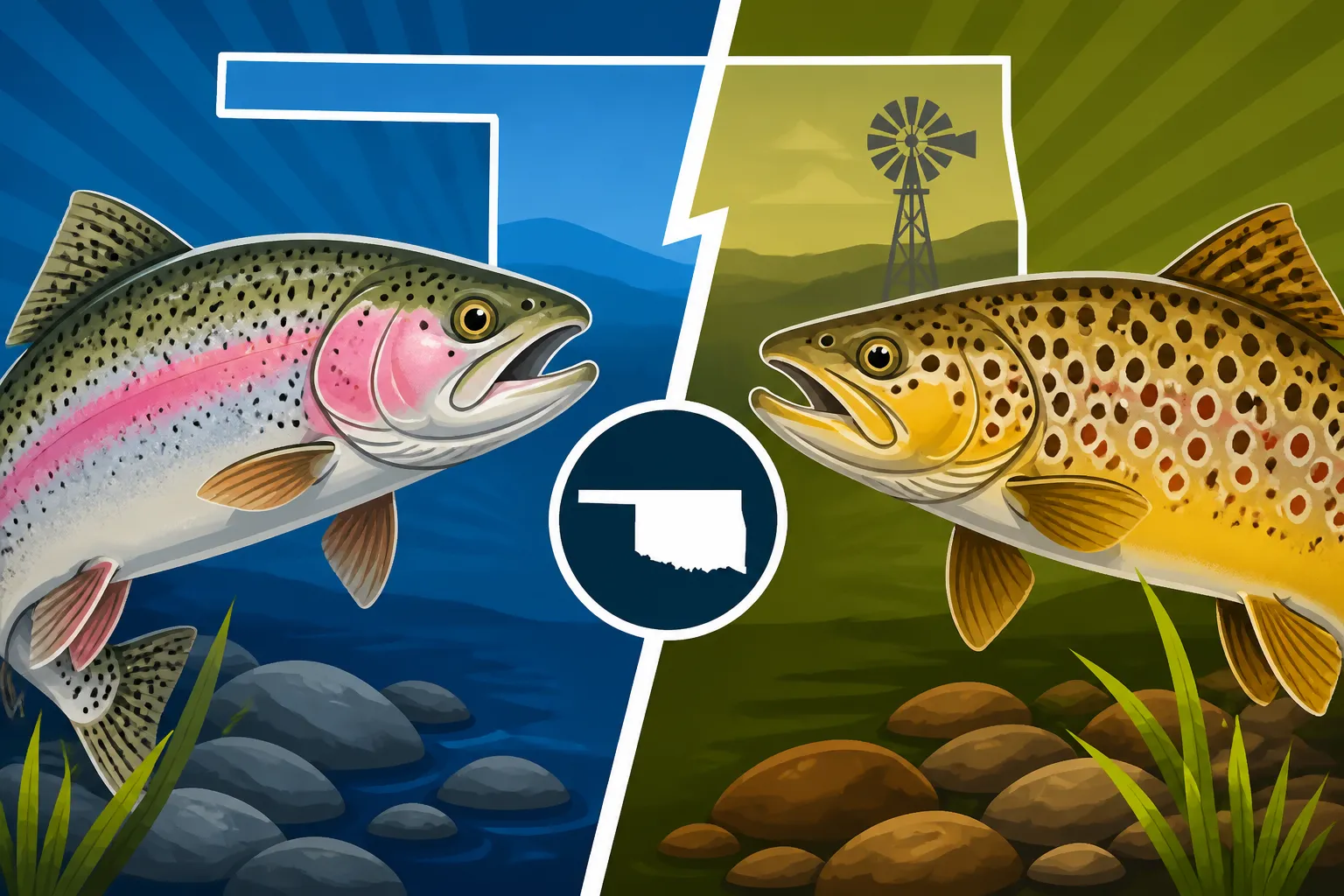
The most striking feature of a rainbow trout is, well, its rainbow! These fish typically have a vibrant, iridescent pink or red stripe running horizontally along their sides, from gill plate to tail. This stripe can be very pronounced, especially on males during spawning season, or more subtle, almost a pale rose color, depending on the fish's diet, age, and environment. Their overall body color tends to be a silvery-green or brassy yellow-green on the back, fading to silvery sides and a white belly. But the true giveaway, even if the stripe isn't vivid, is the abundance of small, dark spots. These spots are usually concentrated on the back, sides, and especially on the dorsal fin and tail. They are typically irregular in shape and evenly distributed.
A good way to remember this is to imagine the fish has been lightly dusted with black pepper from head to tail, including the fins. The intensity of this spotting can vary; some rainbows will be absolutely covered, while others might have fewer, larger spots. But the presence of spots on the tail fin is a particularly strong indicator for rainbows. When you see that broad, fan-like tail, often with a faint fork but usually squared, check for those tell-tale spots radiating outward. This pattern is a key differentiator from brown trout, which typically have unspotted or very sparsely spotted tail fins.
Fin Structure and Adipose Fin Details
Let's talk fins! The fins of a rainbow trout are generally proportional to its body, robust and well-formed for fighting currents and making those famous leaps. The dorsal fin (the main fin on its back) and the caudal fin (tail fin) are almost always heavily spotted, as mentioned. Their pectoral fins (paired fins near the gills) and pelvic fins (paired fins on the belly) tend to be clear or lightly pigmented, without the same heavy spotting as the dorsal and caudal.
The adipose fin is a small, fleshy fin located between the dorsal fin and the tail fin. It's a key feature for all salmonids, including trout. For rainbow trout, this small fin is usually unspotted or might have just a couple of very faint spots, and it will generally be the same color as the surrounding skin or slightly darker. It doesn't have the same vivid coloration or spotting that you'll sometimes see on other trout species. Paying close attention to the size and spotting of the adipose fin can be a subtle but definitive clue in identification.
Mouth and Jaw Characteristics
When you get a close look at a rainbow trout's head, you'll notice a few things about its mouth. They generally have a relatively small mouth, and when closed, the upper jaw (maxillary) typically extends back to about the middle of the eye, or sometimes just slightly past it. It doesn't extend dramatically beyond the eye. Their teeth are small and sharp, designed for grasping insects, small crustaceans, and baitfish. The snout is usually somewhat blunt and rounded.
If you gently open the mouth, you'll see a dark or grayish lining inside. This dark lining is another excellent identifier for rainbow trout and other Pacific salmon species to which they are related. While not always obvious in every fish, a consistently dark mouth lining is a strong characteristic of a rainbow trout. When combined with the pink stripe and spotted tail, these features paint a clear picture. For anglers looking to select specific lures for these fish, having knowledge of their mouth structure might influence your choices for hooks or lure sizes, which you can often find a wide variety of on Amazon.
Unmasking the Brown Trout
The brown trout (Salmo trutta) is another highly sought-after game fish in Oklahoma, known for its elusive nature and impressive size potential. These fish can be a bit more challenging to catch than rainbows, often preferring to hold in deeper, more secluded areas.
Distinctive Body Coloration and Markings
Brown trout typically display a more subdued, earthy coloration compared to the flashy rainbow. Their backs are usually an olive-brown to dark brown, often fading to yellowish-brown or golden-bronze sides and a creamy white or pale yellow belly. What truly sets them apart are their spots. Brown trout have prominent dark spots, often ringed with a lighter halo, scattered across their back and sides. Interspersed among these dark spots, you'll also find distinct red or orange spots, sometimes with a pale halo, which are a hallmark of the species. These red spots are almost never found on rainbow trout.
Crucially, unlike the rainbow, the spots on a brown trout's tail fin are usually minimal or completely absent. Their caudal fin is generally unspotted or might have a very few, faint, scattered spots, making it a clear contrast to the heavily spotted tail of a rainbow. The dark spots on a brown trout tend to be larger and more irregular than a rainbow's, and they might extend onto the gill plates. Think of a brown trout as having fewer, bolder, and more colorful spots than the "peppered" look of a rainbow. This difference is often the quickest way to tell them apart on the stream.
Fin Structure and Adipose Fin Details
The fins of a brown trout are robust, much like a rainbow's, but the spotting patterns differ significantly. The dorsal fin will have dark spots, but often fewer and less uniform than a rainbow's. The caudal fin, as emphasized, is usually devoid of spots or has only a sparse few. The pectoral and pelvic fins might have a yellowish or orange tint, especially near the base, and are generally unspotted.
Now, let's revisit that adipose fin. For a brown trout, the adipose fin is typically distinctly orange or reddish, often with a dark margin. This colorful adipose fin is a key visual cue that often gives away a brown trout even before you get a full view of its body. It stands out against the muted browns and golds of its body, acting like a little beacon. This detail, combined with the presence of red/orange spots on its body and the unspotted tail, forms a powerful set of identification markers. Knowing these subtle differences is particularly helpful when fishing in areas like the Blue River, where both species are present. More details about fishing for them can be found in Brown Trout Fishing in Oklahoma.
Mouth and Jaw Characteristics
Brown trout are known for having a larger mouth than rainbow trout. When the mouth is closed, the upper jaw (maxillary) of a brown trout extends noticeably beyond the back of the eye, often reaching well past it. This gives them a more predatory appearance, befitting their diet which often includes larger baitfish as they grow. Their teeth are larger and more numerous, reflecting their preference for a varied diet that can include other fish. The snout can appear more pointed than a rainbow's.
Inside the mouth, a brown trout will typically have a pale or whitish lining, a stark contrast to the dark mouth lining of a rainbow. This internal mouth color is one of the most reliable features for distinguishing between the two when you have a good look. A combination of a large mouth extending past the eye, red/orange spots on the body, a mostly unspotted tail, and a pale mouth lining points directly to a brown trout. When selecting flies or lures for brown trout, their larger mouth and predatory nature means you might opt for slightly larger, more aggressive presentations, which are widely available.
Side-by-Side Comparison: Visual Cues at a Glance
Sometimes, the best way to grasp the differences is to see them laid out directly. While each fish is an individual and some variations can occur due to genetics or environment, these general guidelines hold true for most rainbow and brown trout you'll encounter in Oklahoma.
| Feature | Rainbow Trout (Oncorhynchus mykiss) | Brown Trout (Salmo trutta) |
|---|---|---|
| Body Color | Silvery-green to brassy, white belly | Olive-brown to dark brown, yellowish/golden sides |
| Lateral Stripe | Distinct pink/red stripe (often vibrant) | Absent or very faint |
| Dark Spots | Numerous small, irregular, black spots, "peppered" | Fewer, larger, bold dark spots, often with light halo |
| Red/Orange Spots | Generally absent | Present, often with pale halos |
| Tail Fin (Caudal) | Heavily spotted, often radiating outward | Usually unspotted or very sparsely spotted |
| Adipose Fin | Unspotted or faint spots, same color as skin | Distinctly orange/red, often with dark margin |
| Mouth Size | Relatively small, upper jaw to middle of eye | Larger, upper jaw extends past the eye |
| Mouth Lining | Dark or grayish | Pale or whitish |
| Body Shape | More streamlined, somewhat football-shaped | More robust, deeper body |
This table provides a quick reference for when you're on the water. It's a handy checklist to run through when that trout is in your net. Remember, while catching a fish can be exciting, it's always best to handle them minimally and carefully, especially if you plan to release them.
Real-World Scenarios and Nuances
It's important to remember that fish, like people, can have individual variations. A rainbow trout caught from a deep, clear pool might look slightly different from one caught in a shallower, faster-moving stretch. Environmental factors, diet, and age can all influence a fish's coloration and intensity of markings. For example, a "holdover" rainbow (one that has survived in the river for an extended period rather than being recently stocked) might develop darker, more vibrant colors, making its pink stripe even more prominent. Similarly, a brown trout in very clear water might display more vivid red spots.
Sometimes, hybridisation can occur, though it's much rarer between these two distinct species in Oklahoma's managed fisheries. The key is to look at a combination of features rather than relying on just one. If you see a fish with a strong pink stripe and a heavily spotted tail, even if its other spots are a bit faded, it's almost certainly a rainbow. If you see those distinct red/orange spots and a mostly unspotted tail, coupled with a large mouth, you've got a brown. Practice makes perfect, and the more trout you catch, the easier these distinctions will become. Don't be afraid to take a quick, respectful photo to compare later if you're unsure. You can often find a good waterproof camera for this purpose on Amazon.
Habitat and Behavior Differences in Oklahoma
Beyond their physical appearance, rainbow and brown trout often exhibit different preferences for habitat and behavior, which can also help with identification (or at least give you a clue about which species you might be targeting).
Preferred Water Conditions and Structure
In Oklahoma, both rainbow and brown trout thrive in cold, oxygen-rich waters. However, there are subtle differences in their preferences. Rainbow trout are often more tolerant of slightly warmer water temperatures (though still requiring cold water to survive) and can be found throughout the designated trout zones. They are often more active feeders and might be found in faster-moving runs, riffles, and near the head of pools where oxygen levels are high. They're usually less wary and can be caught more consistently by a variety of methods, including bait, spinners, and flies.
Brown trout, on the other hand, are generally more elusive and prefer cooler, more stable water temperatures. They are often found holding in deeper pools, undercuts, log jams, and around heavy structure. They're more nocturnal and wary, making them a more challenging catch, especially for larger specimens. They prefer areas where they can ambush prey and quickly retreat to cover. Knowing these tendencies can help you guess what you've hooked before you even see it. If you're consistently catching fish out of shallow, fast water, chances are you're hitting rainbows. If you're pulling a fish from deep under a log, it might just be a big brown. This nuanced understanding comes with experience and spending time on the water, something every Oklahoma angler cherishes.
Feeding Habits and Activity Patterns
Their preferred habitats tie directly into their feeding habits. Rainbow trout are often opportunistic feeders, willing to strike at a wide range of offerings throughout the day. They'll readily take insects, worms, small crustaceans, and even artificial baits. This makes them a great target for anglers using various techniques. They are often active from dawn through dusk, especially in overcast conditions or during insect hatches. You might find great success targeting them with specific lures and flies designed for active feeders, which are often grouped by species in fishing shops and on online retailers like Amazon.
Brown trout, conversely, tend to be more predatory and often feed more actively during low light conditions – dawn, dusk, and even at night, especially as they grow larger. They are particularly fond of baitfish, crayfish, and larger insects. This is why you often hear of anglers targeting trophy brown trout with large streamer flies or plugs during the evening hours. Their cautious nature and preference for ambush points mean you might need to present your bait or lure more subtly and persistently. This also explains why those large brown trout are often harder to find; they're masters of concealment and selective feeding. Understanding these behavioral traits can not only help you identify your catch but also refine your fishing strategy for future trips. Don't forget to review Oklahoma's Senior Fishing License Guide if you are planning to fish with a senior family member as the rules can differ for them.
Conclusion: Becoming a Savvy Oklahoma Trout Angler
Distinguishing between rainbow trout and brown trout in Oklahoma is a skill that comes with practice and keen observation. While they share many similarities as cold-water game fish, those subtle differences in coloration, spotting patterns, fin characteristics, and mouth structure are the keys to confident identification. Remember the vibrant pink stripe and spotted tail of the rainbow, contrasting with the golden-brown hues, red-orange spots, and often unspotted tail of the brown. Pay attention to the adipose fin – a splash of orange usually means brown trout – and don't forget the telling mouth lining.
Armed with this knowledge, you'll not only be able to correctly identify your next catch but also gain a deeper appreciation for these beautiful species that grace Oklahoma's waters. Each cast becomes a little more informed, each fish a little more understood. So next time you're on the Mountain Fork or Illinois River, take an extra moment to admire your catch and confidently name the trout at the end of your line. It's all part of the joy and challenge of fishing in our great state. If you are ever unsure of the regulations, always check the current ODWC guidelines to ensure you're fishing legally and responsibly. And remember, a good fishing buddy is always willing to help with identification – and maybe even share a secret spot or two! Be sure to check Fishing Regulations You Need to Know in Oklahoma to stay fully compliant.
Disclaimer
This article is for general informational purposes only and does not constitute professional advice. Laws, prices and regulations vary by location and change over time. Consult a qualified professional for guidance on your specific situation.