Best Bait for Rainbow Trout in Oklahoma
Fishing for rainbow trout in Oklahoma can sometimes feel like chasing a ghost. Our state might be known for big bass and monster catfish, but those vibrant, hard-fighting rainbows offer a unique challenge and a whole lot of fun, especially in our designated trout areas. If you've ever cast a line, hoping for that tell-tale tug, only to come up empty, you're certainly not alone. It can be frustrating trying to figure out what these beautiful fish want to bite. This guide is here to unravel that mystery, offering you the best bait options and techniques to help you hook into some stunning rainbow trout across Oklahoma's diverse fishing spots.
Understanding Oklahoma's Rainbow Trout Fishery
Before we dive into the best baits, it’s crucial to understand a bit about rainbow trout in Oklahoma. Unlike many of our native species, rainbow trout are primarily a "put-and-take" fishery here. This means the Oklahoma Department of Wildlife Conservation (ODWC) regularly stocks these fish into specific bodies of water, particularly during the cooler months, to provide angling opportunities. They aren't typically reproducing naturally in most Oklahoma waters due to warmer water temperatures in the summer, which means their diet and behavior can be a little different from wild trout in colder climates.
Because they are raised in hatcheries before being stocked, these trout often have a preference for the pellet food they were fed. This upbringing significantly influences what they'll readily strike at when they first hit our lakes and streams. They're often less wary of artificial presentations and sometimes surprisingly eager for baits that mimic their hatchery diet, or things that simply look and smell appealing. Understanding this background is your first step to choosing the right offering.
Oklahoma's trout program focuses on a few key areas, such as the Lower Mountain Fork River below Broken Bow Lake, the Illinois River, and a number of urban trout lakes that are stocked seasonally. Each of these locations might have slightly different characteristics in terms of water flow, clarity, and bottom composition, which can subtly influence bait choice. For instance, clear, flowing rivers might call for more natural presentations, while a still, urban pond might see hatchery-raised fish more aggressively hitting a bright, scented bait. You can learn more about these fisheries in Trout Fishing in Oklahoma: Rainbow and Brown Trout.
Tried-and-True Dough Baits and Naturals
When it comes to rainbow trout in Oklahoma, certain baits consistently outperform others, especially for newly stocked fish that are still acclimating to their new environment. These are often the first things an angler will reach for, and for good reason—they work!
Scented Dough Baits: The Hatchery Mimic
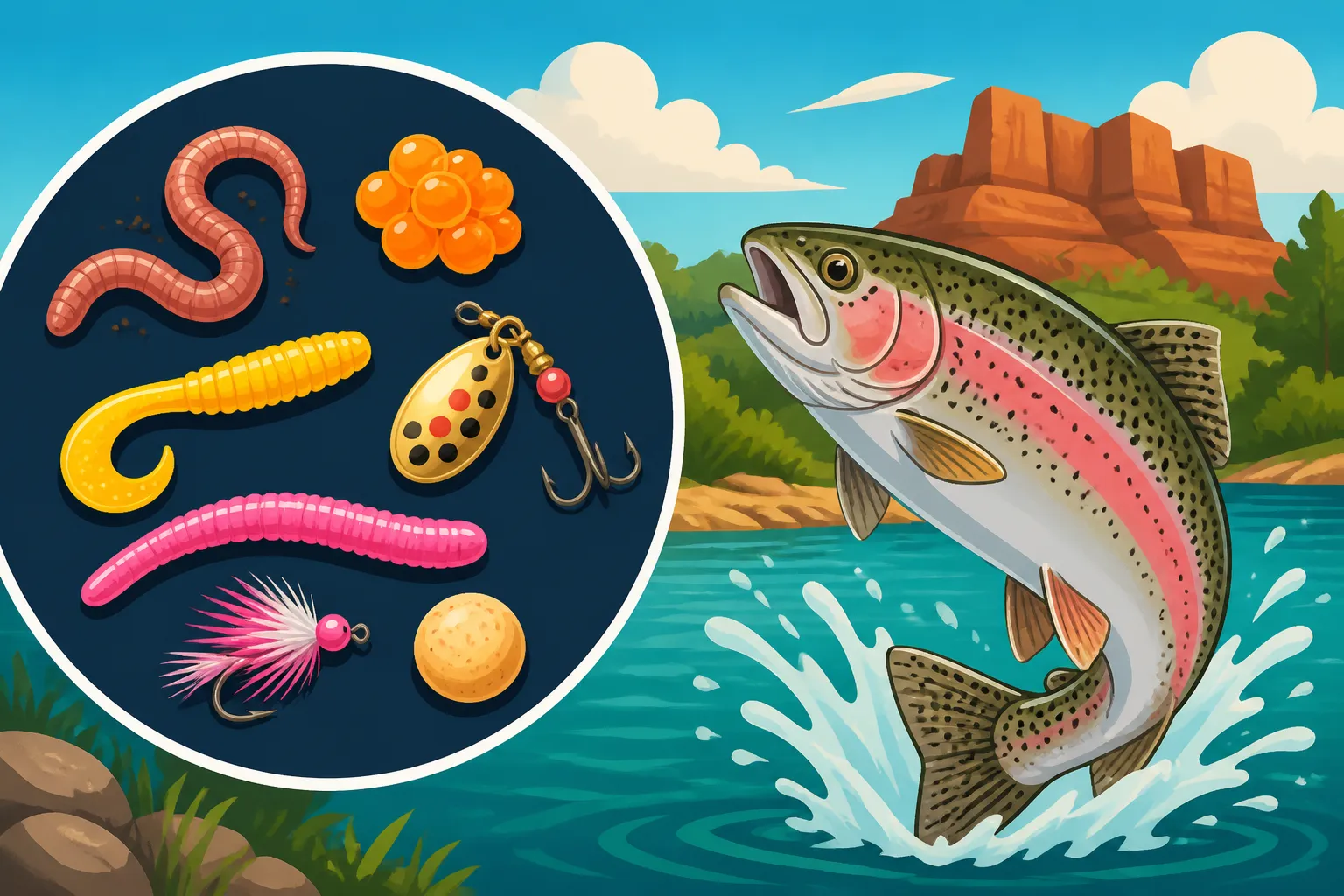
Scented dough baits, like Berkley PowerBait, are often the undisputed king for stocked rainbow trout. Why? Because the fish recognize the scent and flavor from their hatchery days. These baits come in an astonishing array of colors, from vibrant chartreuse and orange to more subtle rainbow and natural tones, and often infused with powerful fish-attracting scents. The texture is usually moldable, allowing you to shape it around your hook to create a small, buoyant ball.
The key to using PowerBait effectively is often presentation. Many anglers use a small treble hook or a single worm hook with a light lead sinker (like a 1/8 to 1/4 ounce egg sinker) above a swivel. This allows the PowerBait to float just off the bottom, putting it right in the trout's strike zone. Experiment with colors; sometimes a bright pink or chartreuse is irresistible, while other days a more muted, natural-colored PowerBait will get more bites. You can find a huge variety of PowerBait options on Amazon, which makes stocking up before a trip super easy.
Classic Corn and Marshmallows: Sweet and Simple
Believe it or not, ordinary canned corn is a fantastic bait for rainbow trout. The bright yellow color is highly visible, and the sweet scent is surprisingly attractive to trout. It's also readily available and incredibly inexpensive, making it a great choice for family fishing trips or when you're just starting out. You can use a single kernel on a small hook, or thread two or three on for a larger presentation.
Marshmallows, especially mini marshmallows, offer a similar appeal. They float, which helps keep your bait off the bottom, and their subtle sweetness can be enticing. Some anglers even combine corn and marshmallows on the same hook, creating a highly visible, floating, scented cocktail that trout often can't resist. This combination is particularly effective in slower-moving water or still ponds where trout have more time to investigate.
Worms and Grubs: The Natural Go-To
There's a reason worms are a classic bait for nearly all freshwater fish, and rainbow trout are no exception. Red worms, mealworms, and even small nightcrawlers (pinched in half) are excellent natural options. Trout, even stocked ones, have an innate instinct to feed on insects and their larvae, making worms a highly effective choice.
Worms can be fished in a variety of ways. You can rig them on a small hook under a bobber, allowing them to drift naturally with the current or slowly sink in still water. For bottom fishing, a simple slip-sinker rig with a small hook and a piece of worm will often produce bites. The natural movement and scent of a live worm are often enough to trigger a strike from even finicky trout. Many anglers swear by mealworms in particular, as their size is often perfect for the average stocked rainbow trout.
The Appeal of Live Bait for Picky Trout
While dough baits and corn are fantastic for recently stocked trout, sometimes the fish become a bit more discerning. This is where live bait, mimicking what trout might find naturally in their environment, really shines.
Small Minnows: A Hearty Meal
If you're targeting larger rainbow trout, or if the fish have been in the water for a while and have become more accustomed to a natural diet, small minnows can be incredibly effective. Trout are predatory fish, and a lively minnow struggling in the water presents an irresistible meal. Small shiners or fathead minnows, typically 1 to 2 inches long, are ideal.
Minnows are best fished on a light line with a small hook (sizes 8-12) through the lip or just behind the dorsal fin, allowing them to swim naturally. You can drift them under a bobber in rivers or lakes, or slowly retrieve them to mimic an injured baitfish. This approach works especially well in areas like the Lower Mountain Fork River where trout have access to natural forage. Just be sure to check local regulations on using live baitfish.
Crickets and Grasshoppers: Seasonal Delights
During the warmer months, if you find yourself fishing in a location where trout are present, crickets and small grasshoppers can be outstanding bait. These insects are a natural part of a trout's diet, especially in areas with vegetation near the water's edge. A trout patrolling the banks will often readily snap up a terrestrial insect that falls into the water.
Fishing with crickets is pretty straightforward. A small hook (size 10-14) threaded through the cricket's thorax, fished under a tiny bobber or free-drifted, can be deadly. For grasshoppers, try to hook them so they stay alive and kick their legs on the surface, mimicking a struggling insect. This often triggers an aggressive topwater strike, which is incredibly exciting to witness. These natural baits require a bit more patience to gather, but the results can be well worth the effort.
Salmon Eggs: A Power-Packed Snack
Another classic trout bait, especially in clear, flowing water, is salmon eggs. These bright, nutrient-rich eggs are a natural food source for many trout species in the wild, and stocked rainbows often find them irresistible. They come in various colors, from natural orange to bright red, and are often preserved in a brine solution.
Salmon eggs are typically fished single or in small clusters on a very small, sharp hook (sizes 14-18). The key here is a subtle, natural drift. Use minimal weight, often just a split shot or two a foot or so above the hook, to allow the eggs to tumble along the bottom naturally with the current. This method is particularly effective in streams and rivers like the Illinois River, where trout are often accustomed to feeding on drifting organisms. Some anglers even use "fake" salmon eggs that have added scent, which can be found on Amazon.
Effective Artificial Lures for Active Trout
Sometimes, trout are in an aggressive mood, or you simply prefer the challenge and excitement of active lure fishing. Artificial lures can be incredibly effective, especially when trout are actively feeding or chasing baitfish.
Spinners: Flash and Vibration
Small inline spinners are a staple for trout fishing worldwide, and Oklahoma is no different. Brands like Mepps, Rooster Tail, and Panther Martin are perennial favorites. The spinning blade creates flash and vibration in the water, mimicking a fleeing baitfish or insect, which often triggers a predatory response from trout.
Sizes typically range from 1/32 ounce to 1/8 ounce, depending on the water depth and current. Bright colors like silver, gold, chartreuse, and white are often very effective, especially on sunny days or in stained water. Darker colors like black or brown can be good in clear water or on overcast days. A steady, slow retrieve is usually best, just fast enough to get the blade spinning. Spinners are fantastic for covering water, casting into likely holding spots, and can be easily purchased online or at any local bait and tackle shop.
Spoons: Wobble and Flash
Similar to spinners, small spoons also rely on flash and an erratic wobbling action to attract trout. Spoons like the Kastmaster or Little Cleo are popular choices. Their unique shape causes them to flutter and dart through the water, imitating an injured baitfish—a beacon for hungry trout.
Again, smaller sizes (1/16 ounce to 1/4 ounce) are usually best. Silver, gold, copper, and even brightly painted spoons (like firetiger or orange) can be very productive. Spoons can be cast and retrieved steadily, jigged vertically in deeper holes, or trolled behind a boat or kayak. The key is to vary your retrieve speed and add occasional pauses or twitches to give the lure an even more lifelike action. They are particularly effective when trout are keyed in on baitfish, such as in the larger reservoirs that might hold stocked trout.
Small Jigs: Versatility in a Tiny Package
Don't underestimate the power of a tiny jig for rainbow trout. Marabou jigs, micro jigs, or even small tube jigs can be incredibly effective, especially when trout are a bit lethargic or holding close to structure. The soft material of a marabou jig pulsates in the water with even the slightest movement, creating a lifelike presentation.
Jigs typically range from 1/64 ounce to 1/8 ounce. Colors like white, black, olive, chartreuse, or pink are common. You can fish jigs under a small bobber, slowly twitching them, or cast and retrieve them with a subtle lift-and-drop action. This mimics a small insect, minnow, or piece of forage tumbling through the water. They are excellent for targeting trout holding in deeper pools or near submerged logs and rocks. You can often find multi-packs of various colored jigs on Amazon, giving you options for different water conditions.
| Bait Type | Best Use Case | Pros | Cons |
|---|---|---|---|
| Scented Dough Bait | Newly stocked trout, still water, bottom fishing | Familiar to hatchery fish, buoyant, variety | Can be messy, less effective on wilder trout |
| Corn/Marshmallows | Family fishing, calm water, visual appeal | Inexpensive, easy to use, visually appealing | Less scent, can fall off hook easily |
| Worms/Grubs | All conditions, natural presentation, active fish | Natural scent and action, widely available | Can be fragile, sometimes get stolen easily |
| Small Minnows | Larger, more aggressive trout, open water | Highly attractive to predatory fish, lively | Requires live bait care, regulations may apply |
| Crickets/Grasshoppers | Warmer months, bank fishing, topwater strikes | Natural food source, exciting topwater action | Seasonal, can be hard to collect, fragile |
| Salmon Eggs | Clear, flowing water, natural drift | Natural, potent scent, subtle presentation | Very small, easily swallowed, delicate |
| Spinners | Actively feeding trout, covering water | Flash and vibration, triggers aggression | Can snag easily in heavy cover |
| Spoons | Deeper water, imitating baitfish, trolling | Erratic wobble, good casting distance | Less effective on finicky fish, can snag |
| Small Jigs | Lethargic trout, targeting structure, slow retrieves | Versatile, lifelike action, subtle presentation | Requires lighter line and careful retrieve |
Rigging, Presentation, and Seasonal Considerations
It's not just about having the best bait; it's about how you present it. Even the most irresistible bait won't work if it's not put in front of the fish in a natural and appealing way.
The Right Rig for the Job
For still water or slow currents, a simple bottom rig with a small egg sinker above a swivel, then a 12-18 inch fluorocarbon leader to a small hook (size 8-12), is highly effective for dough baits, corn, or worms. The sinker holds the bait in place, and the leader allows the bait to float or settle naturally. The light leader is key because trout can be line-shy.
When fishing in rivers or streams, a slip bobber rig or a tightlining technique is often more productive. A slip bobber allows you to adjust your depth easily and lets the bait drift naturally with the current. For tightlining, you're using minimal or no weight, letting the current carry your bait (like salmon eggs or small worms) downstream, simulating natural forage. This takes practice but can be deadly. You can find more rigging tips in Best Fishing Techniques for Beginners.
Subtle Presentation is Key
Trout have excellent eyesight and can be very wary. Use the lightest line you can get away with, usually 4-6 pound test fluorocarbon or monofilament for your main line, and a lighter leader (2-4 pound test) if the water is very clear. This helps your bait look more natural and less connected to your fishing line.
Casting quietly and observing the water are also vital. Look for seams in the current, deeper pools, or areas where fallen trees provide cover. Trout will often hold in these spots, waiting for food to drift by. When using lures, try varying your retrieve speed and adding pauses or twitches. Sometimes, that slight change in action is all it takes to trigger a strike.
Seasonal Nuances for Oklahoma Trout
Oklahoma's trout fishing is heavily influenced by the seasons due to our stocking program. During the cooler months (fall, winter, and early spring), trout are typically more active and willing to chase lures or readily take scented baits. This is when the put-and-take fisheries are in full swing. The trout are fresh from the hatchery and often bite aggressively. These are often the best times to visit places like the Illinois River or the seasonal urban trout lakes. When Is the Best Time of Year to Catch Trout After Stocking has more details on this.
As water temperatures rise in late spring and summer, trout fishing opportunities become more limited, primarily to the cold tailwaters below dams, such as the Lower Mountain Fork River. In these year-round fisheries, trout can become more wary and may prefer natural baits or more subtle lure presentations. They've had more time to adapt to a natural diet and might not be as eager for hatchery pellets. Also, remember that Where to Catch Stocked Trout in Winter will have different advice than summer fishing.
Ultimately, being flexible and willing to experiment with different baits and techniques is the angler's best friend when pursuing rainbow trout in Oklahoma. Keep an eye on local stocking reports, observe the water conditions, and don't be afraid to try something new if your go-to isn't working. Happy fishing!
Disclaimer
This article is for general informational purposes only and does not constitute professional advice. Laws, prices and regulations vary by location and change over time. Consult a qualified professional for guidance on your specific situation.