Fish Finders and Electronics for Oklahoma Reservoirs
It's incredibly frustrating to be out on a beautiful Oklahoma reservoir, looking at acres of water, and having no idea what's happening beneath your boat. You know the fish are somewhere down there, but without a clear picture, it feels like you're casting blind. This comprehensive guide will pull back the curtain on the underwater world, diving deep into how fish finders and other crucial electronics work, what features truly matter for anglers on our diverse Oklahoma lakes, and how to use them effectively to turn those frustrating "no bites" days into successful fishing adventures.
Why Fish Finders Are a Game-Changer in Oklahoma Fishing
For many years, anglers relied on feel, experience, and maybe a depth sounder to find fish. While those traditional skills are still invaluable, modern fish finders have revolutionized the sport, giving you an undeniable edge, especially on Oklahoma's vast and varied reservoirs. From the deep, clear waters of Broken Bow Lake to the sprawling, structure-rich expanse of Lake Eufaula, understanding what's beneath your hull can mean the difference between a productive day and a frustrating blank.
Demystifying the Underwater World
Think about it: how often have you pulled up to a promising-looking point or a brush pile and just hoped for the best? A fish finder changes that entirely. It uses sonar technology to paint a vivid picture of the bottom contour, submerged timber, rock piles, ledges, and most importantly, the fish themselves. You can see schools of baitfish, individual lunkers holding tight to structure, and even track your lure as it descends. This visual information eliminates so much guesswork, allowing you to present your bait exactly where the fish are holding, or to quickly move on if the spot is barren. It’s like having x-ray vision for your boat.
The topography of Oklahoma's lakes is incredibly diverse. You have the deep, rocky bluffs and clear water of Tenkiller Ferry Lake, the vast, relatively shallow flats of Lake Eufaula with its abundant standing timber, and the submerged creeks and channels of Lake Texoma, famous for its Striped Bass Fishing Techniques for Oklahoma's Lake Texoma. Without a fish finder, navigating and effectively fishing these varied environments is significantly harder. You might spend hours casting over barren ground, completely missing the subtle nuances of a channel swing or a thermocline where fish are actively feeding.
Increasing Efficiency and Success Rates
Time on the water is precious, and no one wants to waste it. A good fish finder drastically improves your efficiency. Instead of blindly searching, you can quickly scan an area, identify potential holding spots, and confirm the presence of fish before even making a cast. This is particularly crucial when you're trying to locate schools of crappie in a specific depth range or track down roaming schools of white bass. You can spend more time actually fishing and less time searching, which inevitably leads to more bites and more fish in the livewell.
Imagine trying to find a submerged creek bed or a hard-to-see drop-off on Lake Keystone without electronic assistance. You could spend all day dragging baits, or you could identify that exact structure within minutes, mark it on your GPS, and start fishing it with precision. This efficiency not only saves time but also fuel, as you're not crisscrossing the lake aimlessly. For serious anglers and tournament participants, this kind of efficiency is non-negotiable.
Understanding Different Types of Fish Finder Technologies
The world of fish finders can seem overwhelming with all the different terms and technologies. But at its core, it's all about sonar – sound waves traveling through water. Understanding the basic types of sonar and how they present information will help you choose the right tools for your specific fishing needs on Oklahoma's unique waters.
Traditional 2D Sonar
Traditional 2D sonar, often called broadband or CHIRP sonar, is the foundational technology for almost every fish finder out there. It sends a conical beam of sound waves into the water and listens for the echoes. The strength of the echo tells the unit about the density of the object, while the time it takes for the echo to return indicates its depth. This information is then translated into the familiar arch-like representations for fish, and varying shades for bottom structure.
A common frustration with 2D sonar is learning to interpret those arches. Are they fish? Or just debris? The key is understanding that a strong, thick arch usually indicates a fish, while a broken or faint line might be a smaller fish, baitfish, or even a piece of timber. Many modern 2D sonar units now use CHIRP (Compressed High-Intensity Radiated Pulse) technology, which sends a range of frequencies instead of a single one. This results in much clearer target separation, allowing you to distinguish individual fish even within a tight school, and provides much crisper images of structure. On lakes like Grand Lake O' the Cherokees, where fish might suspend over deep channels, clear 2D sonar is essential for marking those suspended schools.
Down Imaging and Side Imaging
Where 2D sonar provides a more abstract, interpreted view, down imaging and side imaging offer picture-like clarity, dramatically changing how anglers perceive the underwater world.
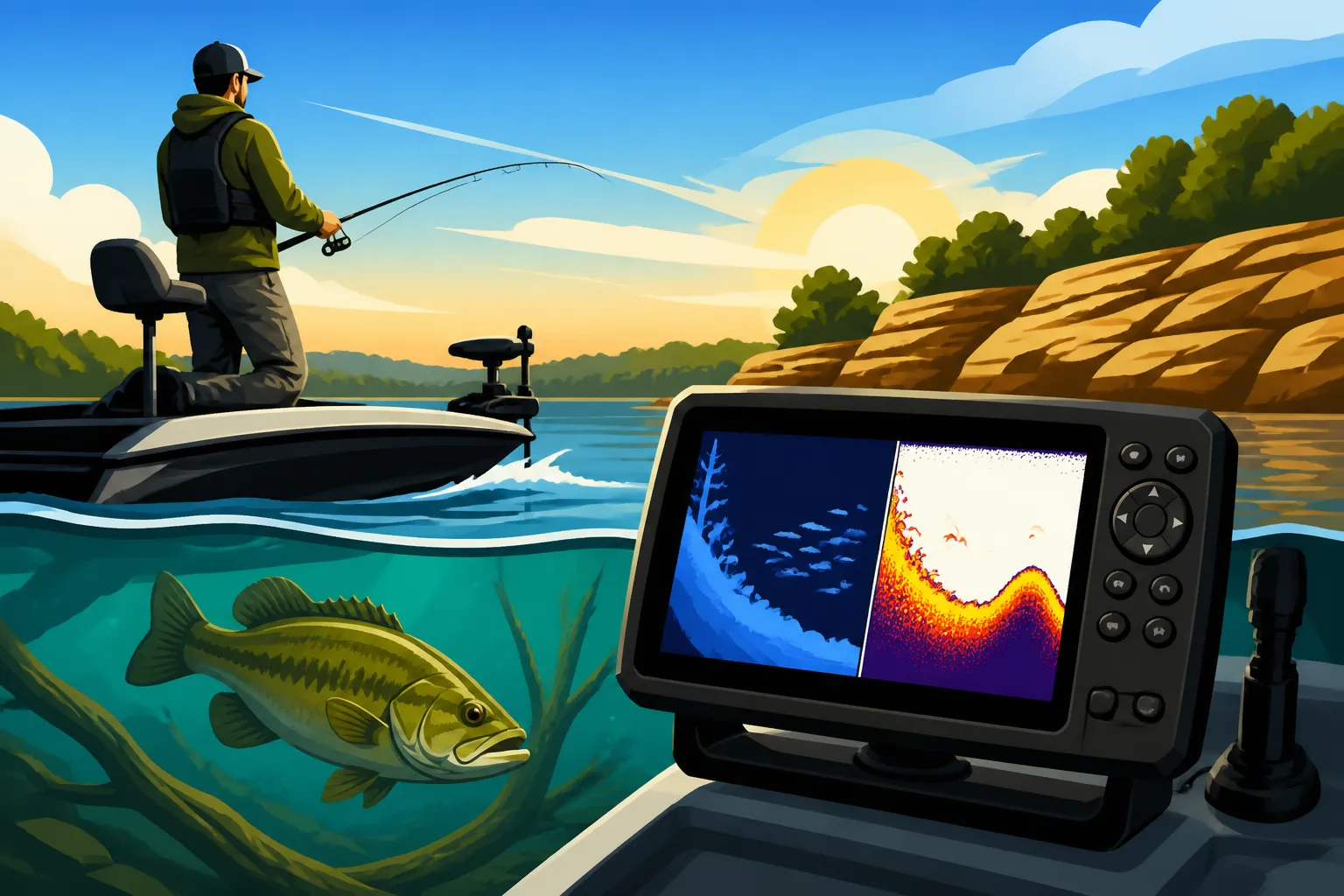
Down imaging, sometimes called DownScan or ClearVü, sends a very thin, high-frequency beam directly beneath your boat. This beam is much narrower and offers a photographic-quality view of what's directly below. You'll see detailed images of submerged trees, rock piles, brush, and individual fish holding tight to structure. This is incredibly useful for dissecting specific cover, like a submerged bridge piling on Lake Hudson or a small brush pile in a creek channel, to see if fish are actually using it. It's much easier to differentiate between a school of baitfish and a large predator lurking beneath them.
Side imaging, or SideScan/StructureScan, takes this concept even further. It sends two high-frequency beams out to the sides of your boat, creating a wide swath of coverage. You can see structure and fish hundreds of feet to either side, allowing you to quickly scan vast areas of a lake without having to drive directly over every piece of cover. This is a game-changer for finding those elusive offshore brush piles, submerged roadbeds, or scattered rock formations that might hold Oklahoma's Bass Fishing Rules and Limits. When you mark something interesting to the side, you can simply put a waypoint on it and then move your boat directly over it for a closer look with down imaging or 2D sonar. This technology is indispensable on large, open reservoirs where fish relate to subtle, widespread features.
Live Sonar Systems
The newest and most advanced frontier in fish finder technology is live sonar, such as Garmin's LiveScope or Lowrance's ActiveTarget. These systems provide real-time, video-game-like views of fish and structure. Instead of seeing historical data scrolling across your screen, you see what's happening right now, in front, below, or to the sides of your boat.
With live sonar, you can watch your bait fall, observe how fish react to it, and even see them strike. If a fish ignores your lure, you can adjust your presentation instantly. This technology is incredibly powerful for sight fishing in deeper water, following individual fish, or dissecting a brush pile to see which side the fish are on. While these systems represent a significant investment, they offer an unparalleled level of interaction with the underwater environment, fundamentally changing how many anglers approach fishing. For targeting specific trophy fish or working highly pressured areas on Oklahoma's popular lakes, the ability to see and react in real-time can be a major advantage. You can practically guide your lure right to a fish.
Key Features to Look for in an Oklahoma Reservoir Fish Finder
When you're sifting through all the different models and brands at Bass Pro Shops or browsing options on Amazon, it's easy to get lost in a sea of specifications. But for fishing our diverse Oklahoma reservoirs, a few key features stand out as being truly essential for maximizing your success.
Transducer Quality and Power
The transducer is the unsung hero of your fish finder – it's the component that actually sends and receives the sonar signals. The quality and power of your transducer directly impact the clarity, depth capability, and detail of the images you see on your screen.
Look for transducers that support multiple frequencies, especially CHIRP sonar, for the best target separation and detail. If you plan on fishing deeper lakes like Broken Bow or targeting deep-dwelling catfish in Lake Texoma, a more powerful transducer (measured in wattage) will give you better performance in those greater depths, ensuring you get clear returns even when the water is deep. For side imaging, the quality of the side-looking elements within the transducer is critical for generating those wide, clear photographic views. A high-quality transducer is not an area to skimp on, as it's the foundation of your entire fish-finding system. Investing in a good transducer means clearer images of those crucial brush piles, submerged trees, and schooling fish.
Display Size and Resolution
Imagine trying to decipher a tiny, pixelated image of a fish holding tight to a submerged log while your boat is bouncing on a windy day on Lake Eufaula. It's nearly impossible and incredibly frustrating. The size and resolution of your fish finder's display are paramount for easy interpretation and effective use on the water.
A larger screen (7 inches or more is often recommended for serious anglers) provides more real estate to display all the information clearly, especially if you plan to run multiple views simultaneously, such as 2D sonar alongside side imaging or a GPS map. Higher resolution (more pixels) means sharper, more detailed images, making it easier to identify fish, distinguish between different types of structure, and read subtle changes in bottom contour. On a bright, sunny Oklahoma day, screen brightness and anti-glare coatings are also crucial for visibility. You want to be able to glance at your screen and instantly understand what you're seeing without squinting or shading it with your hand.
GPS, Mapping, and Chartplotting
A fish finder that's just a fish finder is missing a huge piece of the puzzle for reservoir fishing. Integrated GPS, mapping, and chartplotting capabilities are arguably just as important as the sonar itself.
Oklahoma's reservoirs are massive, complex bodies of water with countless coves, channels, and submerged features. A GPS receiver in your unit allows you to precisely mark waypoints on productive spots – that specific brush pile, the exact edge of a channel, or where you caught a trophy bass. It helps you navigate safely, especially in low light or foggy conditions, and allows you to return to those "secret" spots again and again. Preloaded or downloadable mapping cards (like Navionics or LakeMaster) provide detailed bathymetric (underwater contour) charts, showing depth changes, humps, ledges, and creek channels that are invisible from the surface. This mapping data, combined with your sonar, gives you a comprehensive understanding of the lake's structure, allowing you to effectively pattern fish and plan your fishing strategy. For instance, being able to quickly see a contour line indicating a 20-foot drop-off while simultaneously scanning with side imaging for fish holding on that edge is invaluable for Best Bass Fishing Lakes Across Oklahoma or Best Crappie Lakes in Oklahoma.
| Fish Finder Feature | Description | Benefit for Oklahoma Anglers |
|---|---|---|
| Traditional 2D Sonar (CHIRP) | Sends broad sound waves, displays fish as arches and bottom as lines. CHIRP uses multiple frequencies for better detail. | Essential for all-around depth and fish detection; great for suspended fish and showing depth transitions. |
| Down Imaging (ClearVü/DownScan) | Narrow, high-frequency beam for photographic detail directly beneath the boat. | Excellent for identifying specific submerged structure (trees, rocks) and fish relating tightly to them. |
| Side Imaging (SideScan/StructureScan) | Wide beams scan hundreds of feet to either side, showing structure and fish away from the boat. | Quickly covers large areas to locate offshore humps, channel edges, and schools of fish without driving over them. |
| Live Sonar (LiveScope/ActiveTarget) | Real-time, video-like view of fish and lures in front, below, or to the sides of the boat. | Unmatched for seeing fish reactions to lures, targeting individual fish, and fishing brush piles with precision. |
| GPS & Mapping | Tracks boat position, allows waypoint marking, displays detailed underwater contours. | Navigates large reservoirs, marks productive spots, and reveals unseen structure, crucial for returning to hot spots. |
| Display Size | Physical dimensions of the screen (e.g., 7", 9", 12"). | Larger screens provide more space for multiple views and easier interpretation of detailed sonar images. |
| Display Resolution | Number of pixels on the screen (e.g., 800×480, 1280×720). | Higher resolution means sharper, clearer images, making it easier to distinguish fish from clutter. |
Mounting and Installation Considerations for Oklahoma Anglers
You've picked out the perfect fish finder, loaded with all the features you need. Now comes the crucial step: getting it properly installed on your boat. How you mount your unit and transducer can significantly impact its performance, and different boat types and fishing styles on Oklahoma's waters will dictate different approaches.
Transom Mount vs. Trolling Motor Mount Transducers
The transducer is the heart of your sonar system, and its placement is critical. The two most common mounting options are on the transom (the back) of your boat or on your trolling motor.
A transom-mounted transducer is usually ideal for boats that spend a lot of time running at higher speeds, as it generally provides the clearest 2D and down imaging readings while underway. However, it's susceptible to interference from turbulence created by the motor and prop. For slower fishing or when using the trolling motor, its effectiveness can be reduced, and it might not give you the most accurate picture of what's directly below when you're maneuvering slowly. This is a common setup for larger bass boats and deep-V walleye boats that cover a lot of water.
A trolling motor mount is a fantastic option for bass, crappie, and panfish anglers who spend a significant amount of time positioning their boat with the trolling motor. Placing the transducer directly on the trolling motor means it's always pointed in the direction you're looking, and it’s generally free from the interference of your main outboard. This is especially beneficial for side imaging, as you can slowly scan an area by using your trolling motor, giving you precise control over the beam. For live sonar systems, a dedicated trolling motor mount is almost essential, allowing you to "point" the beam exactly where you want to look. Many anglers opt for both: a transom mount for running at speed and a separate transducer (or an "all-in-one" trolling motor with a built-in transducer) on the trolling motor for detailed fishing.
Dash Mount vs. Bow Mount Displays
Where you place your display unit(s) is largely a matter of personal preference and how you fish. The two primary locations are on the boat's dash (console) or at the bow (front).
A dash-mounted unit is perfect for controlling the boat, navigating, and monitoring overall lake conditions. If you primarily fish from the console, or your boat is smaller and doesn't have a separate bow area, a single large unit on the dash might be all you need. Many anglers choose to have their largest, most feature-rich unit (often with detailed mapping) mounted here. However, when you move to the front of the boat to fish with your trolling motor, constantly turning around to look at the dash can be inconvenient and less efficient.
This is where a bow-mounted unit comes into play. For serious bass and crappie anglers who spend most of their fishing time casting from the bow, having a dedicated fish finder unit right in front of them is invaluable. This allows you to monitor sonar and GPS data directly as you work a bank or a brush pile with your trolling motor. Many anglers run a networked system, meaning their dash unit and bow unit "talk" to each other, sharing waypoints, maps, and even sonar data. This dual-unit setup is common for tournament anglers on Oklahoma's Best Fishing Boats for Oklahoma's Big Reservoirs, providing instant access to information no matter where they are in the boat.
Kayak Specific Mounts and Power Sources
Kayak fishing is incredibly popular on Oklahoma's smaller lakes and river stretches. The challenge here is compact, portable, and durable mounting. Traditional boat mounts won't work, so kayak-specific solutions are a must.
For transducers, "in-hull" mounts (where the transducer is glued or siliconed to the inside of the hull, shooting through the plastic) are common for basic 2D sonar, offering protection and a clean exterior. However, for down or side imaging, "over-the-side" or specialized transom-style mounts that attach to the stern of the kayak are needed to get the transducer directly in the water for clear signals. Many modern fishing kayaks even come with transducer scuppers or dedicated mounting plates designed to integrate fish finders seamlessly. When looking for Kayak Fishing Gear Guide for Oklahoma Lakes, be sure to consider how your chosen fish finder will attach.
Powering a fish finder on a kayak also requires a different approach than a traditional boat. Small, sealed lead-acid or lithium-ion batteries (typically 12V and 7-10Ah) are used. These batteries need to be stored in waterproof boxes or bags to protect them from splashes and submersion. Many kayak anglers opt for portable fish finder setups that can be easily removed and stored between trips, making installation and removal simple. Brands like Humminbird and Garmin offer specific kayak bundles or models designed with portability and easy mounting in mind, which can be found at retailers like Bass Pro Shops.
Interpreting Your Fish Finder's Display
So, you've got your new fish finder installed, you're out on the water, and suddenly you're staring at a kaleidoscope of colors, lines, and shapes. It can feel like reading a foreign language at first, but with a little practice and understanding of the basics, you'll be deciphering the underwater world like a pro.
Understanding Sonar Returns and Arches
On a traditional 2D sonar screen, fish typically appear as arches. This isn't because fish are naturally arch-shaped; it's due to the conical shape of the sonar beam and the movement of your boat. As your boat moves over a fish, the fish enters the edge of the beam, gradually moves into the center (where the signal is strongest), and then exits the beam. The fish finder records this journey as a gradual increase, then decrease, in signal strength, which translates into an arch on the scrolling display.
- Strong, thick arches: These generally indicate larger fish or multiple fish very close together.
- Smaller, thinner arches or dashes: These might be smaller fish, baitfish, or even just part of a larger fish caught on the edge of the beam.
- Half-arches: Often, if a fish is only briefly in the beam (e.g., you pass directly over its head or tail, or it's on the edge), it will appear as a partial arch.
It's important to remember that the speed of your boat also affects the appearance of arches. A slower boat will produce longer, more defined arches for the same fish, while a faster boat might only show short dashes. Learning to differentiate between actual fish and other submerged objects (like air bubbles or debris) comes with experience, but focusing on consistent, strong returns is a good starting point. On a heavily timbered lake like Eufaula, you'll see a lot of vertical lines from tree trunks; learning to distinguish a fish arch from a tree branch takes time.
Identifying Structure and Bottom Composition
Beyond finding fish, your fish finder is a powerful tool for understanding the underwater terrain – known as "structure." This is where fish live, hide, and ambush prey.
- Bottom Line: The solid line at the bottom of your 2D sonar screen represents the lakebed. Its thickness and color can tell you about the bottom composition. A hard bottom (rock, gravel, hard clay) will typically produce a thicker, more vibrant bottom return because the sound waves bounce back strongly. A soft bottom (mud, silt) will show a thinner, often fainter return because the sound waves are absorbed more. This is crucial for understanding where different species might prefer to forage or spawn.
- Contours and Changes: Observe the shape of the bottom line. Gradual slopes, sharp drop-offs, humps, and ridges are all visible. These contours are prime areas where fish will hold, especially if they combine with cover.
- Submerged Cover: Trees, brush piles, rock piles, ledges, and stumps will appear as distinct shapes on your screen, rising from the bottom. With down imaging, these will often look remarkably like their real-world counterparts, making them easy to identify. Side imaging is particularly adept at revealing these hidden treasures across a wide area. On Oklahoma's Lake Texoma Fishing Guide for Oklahoma Anglers, knowing how to spot those deep ledges and humps where stripers feed is key.
Reading Baitfish and Thermoclines
Fish finders aren't just for locating game fish; they're equally valuable for finding their food source – baitfish – and understanding water conditions.
- Baitfish Schools: Baitfish (like shad or minnows) will appear as dense clouds or balls on your screen, often suspended in the water column. Where there are baitfish, there are usually predators. If you see a tight ball of bait and then a larger arch or two lingering nearby, you've likely found a feeding opportunity. Sometimes, large schools of stripers or white bass will herd baitfish, creating a chaotic, dense return on your screen that you can learn to recognize.
- Thermoclines: In deeper lakes, especially during the summer, water stratifies into layers of different temperatures. The boundary between the warmer upper layer and the cooler lower layer is called a thermocline. On your fish finder, a thermocline often appears as a distinct, hazy line or band across the screen, usually at a consistent depth. Many species of game fish, especially bass and crappie, will suspend at or just above the thermocline because it offers optimal temperature and oxygen levels. Identifying the thermocline can tell you the ideal depth range to target fish. Learning How Water Temperature Affects Fishing Timing in Oklahoma is much easier with a clear thermocline reading.
Advanced Electronics: GPS, Mapping, and Networking
While finding fish with sonar is fantastic, modern marine electronics offer so much more, transforming your boat into a sophisticated fishing platform. Integrating GPS, detailed mapping, and networking capabilities takes your angling to an entirely new level, especially on Oklahoma's vast reservoirs.
Precision Navigation and Waypoint Management
Gone are the days of trying to remember that one productive brush pile by lining up two trees on the bank. With built-in GPS, your fish finder becomes a highly accurate navigation system. You can see your boat's precise location on a detailed map of the lake, ensuring you stay in safe waters and on course.
More importantly, GPS allows for meticulous waypoint management. Every time you find a productive spot – whether it's a stump that yielded a nice bass, a deep rock pile holding crappie, or a schooling area for white bass – you can mark it with a digital waypoint. You can then navigate back to that exact spot with pinpoint accuracy, day after day, year after year. This is invaluable for patterning fish and building up a mental (and digital) library of productive spots across a lake. Imagine revisiting the exact structure where you caught a trophy fish on Best Bass Fishing Spots on Grand Lake O' the Cherokees, Oklahoma. Furthermore, many units allow you to save tracks, which can be useful for retracing your path or marking specific trolling runs.
Detailed Mapping and Contour Shading
Modern marine charts take mapping far beyond simple outlines of a lake. High-definition mapping cards (like those from LakeMaster or Navionics) offer incredibly detailed bathymetric data, showing depth contours, submerged creek channels, roadbeds, humps, and even individual rocks and structure.
These maps, displayed directly on your fish finder, allow you to literally "read" the lake bottom before you even launch your boat. You can identify potential hot spots, plan your routes to target specific depth ranges, and understand how fish will relate to the underwater topography. Many units also offer contour shading options, allowing you to highlight specific depth ranges in different colors – for example, shading all water between 15-20 feet red to quickly identify crappie holding areas. The ability to overlay your boat's position and sonar data onto these detailed maps provides an unparalleled understanding of the environment and greatly aids in Planning a Fishing Trip Around Oklahoma's Free Fishing Weekend by helping you find the most productive areas.
Networking Multiple Devices
For many serious anglers, a single fish finder isn't enough. Modern electronics allow for networking, meaning multiple devices (fish finders, trolling motors, shallow water anchors, radar, etc.) can communicate and share information.
This setup is particularly common on larger bass boats or multi-species boats, where anglers might have a large unit at the console for navigation and overall lake scanning, and a separate, equally capable unit at the bow for detailed fishing. Through networking, these units can share mapping data, waypoints, and even sonar returns. For example, if your console unit marks a school of fish on side imaging, that information can be instantly displayed on your bow unit, allowing you to move to the front and cast directly to them. Some networked systems even integrate with advanced trolling motors, allowing you to control your boat's position, anchor it virtually, or follow a contour line directly from your fish finder screen. This level of integration streamlines operations and enhances fishing efficiency dramatically. Best Fish Finder for Deep Water Striped Bass on Lake Texoma often involves complex networked systems.
Choosing the Right Fish Finder for Your Fishing Style
With so many options on the market, selecting the "right" fish finder can feel like a daunting task. The truth is, there's no single best unit for everyone. The ideal choice depends heavily on your specific fishing style, the species you target, the type of boat you use, and, of course, your budget.
Casual Angler and Beginner Needs
If you're a casual angler, just starting out, or primarily fish from the bank or a small jon boat, you might not need all the bells and whistles of a top-tier system. Simplicity and ease of use will be key.
For beginners, a basic 2D sonar unit with an integrated GPS and rudimentary mapping is a fantastic starting point. These units are often more affordable and provide enough information to dramatically improve your success over blind casting. You'll be able to see depth, bottom contour, and identify fish arches, which is a huge step up. Look for units with intuitive menus and a clear, readable screen. You can find excellent entry-level models from brands like Garmin, Lowrance, or Humminbird at Bass Pro Shops or through online retailers like Amazon. Even a simple unit can help you locate those submerged brush piles on smaller ponds or rivers, giving you a significant advantage. Focus on understanding the basics of 2D sonar and how to mark waypoints effectively.
Bass and Crappie Tournament Anglers
For the serious bass and crappie tournament angler, especially on Oklahoma's highly competitive circuits, advanced technology is not just an advantage; it's often a necessity. These anglers demand speed, precision, and comprehensive data.
You'll typically see these anglers running multiple large-screen units (often 10 inches or larger) at both the console and the bow, all networked together. High-definition side imaging and down imaging are absolutely critical for quickly scanning vast areas to locate offshore structure, brush piles, and schools of fish. Live sonar systems are also becoming standard, providing that real-time visual advantage for dissecting cover and observing fish behavior. Fast processors, crisp displays, and compatibility with detailed mapping cards are also paramount. For these anglers, the investment in top-tier electronics is justified by the potential for increased tournament success, helping them find Best Bass Fishing Spots on Lake Texoma Near Durant or Where to Catch Crappie on Lake Eufaula. They need to instantly know exactly what's below and around them.
Multi-Species and Open Water Fishing
If your passion lies in chasing multiple species across large, open bodies of water like Lake Texoma (renowned for its striped bass) or exploring deeper lakes for walleye, your fish finder needs will be slightly different.
Here, a powerful 2D CHIRP sonar with excellent deep-water penetration is crucial. You'll need to mark suspended fish schools, track schooling stripers in the open water, and identify subtle changes in bottom composition in deeper areas. While side imaging is still very valuable for covering ground, down imaging's clarity in deeper water helps distinguish larger pelagic fish from bait balls. For Trolling Gear for Striped Bass at Oklahoma's Lake Texoma, a reliable fish finder helps you stay on schools and monitor your baits. Strong GPS and detailed contour mapping are also essential for navigating vast, featureless (to the eye) expanses and finding those subtle humps or ledges where fish congregate. Consider units that offer flexible display options, allowing you to prioritize different sonar views depending on the species you're targeting at any given moment.
Maintenance and Troubleshooting Your Fish Finder
Just like any other piece of critical fishing gear, your fish finder and its associated electronics need a little TLC to perform at their best and last for years. Ignoring proper maintenance or knowing how to troubleshoot common issues can lead to frustrating days on the water.
Keeping Your Unit and Transducer Clean
It might seem simple, but cleanliness is vital for optimal performance. Your fish finder's screen can get smudged with sunscreen, fish slime, or water spots, making it difficult to read. Regularly wipe the screen with a soft, non-abrasive cloth (a microfiber cloth works great) and a mild, non-ammonia-based cleaner if necessary. Avoid harsh chemicals that could damage the display's coating.
The transducer, being constantly submerged, is even more critical. Over time, algae, slime, or even small barnacles can accumulate on its face. This biological buildup can interfere with the sonar signals, leading to fuzzy images or reduced depth capability. After each trip, especially if your boat stays in the water, take a moment to gently wipe down the transducer with a soft brush or sponge. If you trailer your boat, inspect it carefully before storing. Be gentle, as the transducer is a sensitive piece of equipment, and avoid scraping it with anything abrasive. A clean transducer ensures crisp, clear returns from the underwater world.
Software Updates and Settings Management
Fish finder technology is constantly evolving, and manufacturers frequently release software updates for their units. These updates often include performance enhancements, bug fixes, new features, and improved sonar algorithms. Ignoring these updates can mean you're not getting the most out of your investment.
Check your manufacturer's website periodically for available software updates. Most modern units can be updated by downloading the file to an SD card and inserting it into your unit. It's a quick process that can lead to significant improvements. Beyond updates, take the time to learn and adjust your fish finder's settings. Things like sensitivity, color palette, ping speed, and noise rejection can dramatically alter your display. Different water conditions (clear vs. murky), depths, and fishing styles will benefit from different settings. Experiment with these settings on the water to find what works best for you and your chosen Oklahoma Fishing Seasons: A Month-by-Month Guide. Don't be afraid to save different profiles for specific types of fishing, such as a "crappie fishing" profile or a "deep striper" profile.
Common Troubleshooting and Solutions
Even with the best care, you might occasionally encounter issues. Knowing some basic troubleshooting steps can save you a trip to the repair shop.
- No Readout or Intermittent Signal: This is often a transducer issue. Check if the transducer is properly submerged and free of obstructions. Ensure all cables are securely connected to both the transducer and the head unit. A common culprit is a loose connection or a damaged cable. If your boat is running at high speed and losing bottom, the transducer might be mounted too high or in an area of turbulent water.
- Fuzzy or Cluttered Screen: This could be due to excessive sensitivity, interference from other electronics (like a trolling motor or another fish finder), or a dirty transducer. Try reducing the sensitivity, turning off other electronics one by one to isolate interference, and clean the transducer.
- GPS Not Locking On: Ensure your unit has a clear view of the sky. Tall trees, heavy boat covers, or being inside a building can block GPS signals. Check for any software updates that might address GPS performance.
- Power Issues: If the unit won't turn on or randomly shuts off, check your battery connections, ensure the battery is fully charged, and inspect the power cable for any frays or damage. Always use the correct fuse size specified by the manufacturer.
Remember, fish finders are complex tools. If you've tried these basic steps and the problem persists, consulting your unit's manual, contacting the manufacturer's support, or visiting a reputable marine electronics technician is your next best bet. Sometimes, a simple fix is all it takes to get you back to pinpointing those fish.
Disclaimer
This article is for general informational purposes only and does not constitute professional advice. Laws, prices and regulations vary by location and change over time. Consult a qualified professional for guidance on your specific situation.