Paddlefish Snagging Gear Guide for Grand Lake
There's nothing quite like the thrill of paddlefish snagging on Grand Lake, but if you've ever tried to tackle one of these prehistoric giants with your everyday bass or crappie gear, you know it's a recipe for frustration and heartbreak. This guide is dedicated to equipping you with the specialized knowledge and gear recommendations you need to confidently and successfully target paddlefish on Oklahoma's premier snagging destination.
Understanding the Unique Challenge of Paddlefish Snagging on Grand Lake
Paddlefish snagging isn't your average fishing trip. It's a high-stakes, high-impact endeavor that demands respect for both the fish and the specialized techniques involved. Many anglers underestimate the sheer power and surprising speed of a paddlefish, leading to broken lines, bent hooks, and stories of the "one that got away" that haunt them for seasons.
Why Standard Gear Won't Cut It for Paddlefish
Imagine trying to wrangle a small submarine with a garden hose – that's often what it feels like when you hook into a sizable paddlefish with inadequate gear. Your typical medium-heavy bass rod, designed for finesse and casting accuracy, simply lacks the backbone to drive a large treble hook through a paddlefish's tough hide and then stand up to its powerful runs. The drag on a standard reel might be buttery smooth for a 5-pound bass, but it will quickly seize or melt under the sustained pressure of a 50-pound paddlefish.
This isn't just about losing a fish; it's about minimizing harm to the fish you do encounter. Using undersized gear can prolong the fight unnecessarily, causing undue stress to the paddlefish. When you're practicing catch and release for smaller fish or those outside the legal limit, a quick, decisive fight is crucial for their survival post-release. Grand Lake Paddlefish Snagging Basics in Oklahoma emphasizes the importance of proper technique and gear for both success and conservation.
Beyond the immediate fight, standard fishing line, often monofilament or fluorocarbon designed for stealth and abrasion resistance against smaller fish, is no match for the abrasive environment of snagging and the force exerted by a large paddlefish. Rocks, submerged timber, and even the fish's own thrashing can quickly fray weaker lines, leaving you with nothing but a sinking feeling and an empty hook.
The Sheer Power and Size of Grand Lake Paddlefish
Paddlefish are truly unique creatures, and their size and strength are legendary, especially in a fishery as robust as Grand Lake. These filter feeders aren't striking a lure; you're actively snagging them, which means you're often hooking into their thick bodies, creating significant resistance. Once hooked, they don't give up easily. They'll make powerful, surprisingly fast runs, using their broad, paddle-like rostrum and massive tail to propel themselves through the water.
An average adult paddlefish on Grand Lake can easily weigh anywhere from 30 to 70 pounds, with some trophy specimens pushing well over 100 pounds. Imagine reeling in a 70-pound fish with a rod designed for a 10-pounder – it’s a physical battle that will test your endurance as much as your gear. The sheer mass moving against a tight line creates immense pressure, demanding components engineered to withstand incredible strain. For an idea of the potential, check out How Big Do Paddlefish Get in Oklahoma.
Their thick, leathery skin, especially around the body and head, requires a strong, sharp hook to penetrate properly. A weak hook will bend or simply bounce off, wasting your efforts. Every component of your setup, from the rod tip to the knot connecting your leader, needs to be up to the task of handling these powerful, ancient fish.
Navigating Grand Lake's Conditions for Snagging
Grand Lake O' the Cherokees, while a fantastic paddlefish destination, presents its own set of challenges that influence gear selection. You'll often be fishing in high-current areas, particularly below the Pensacola Dam or in river channels during periods of water release. These strong currents add another layer of resistance to your cast and retrieve, making heavier weights and stronger lines absolutely essential.
Furthermore, snagging often takes place from a boat, and you'll be actively moving or drifting, sometimes in crowded conditions, especially during peak Paddlefish Snagging Season in Oklahoma. This means your gear needs to be robust enough to handle the occasional bump or scrape, and your ability to control a hooked fish quickly is paramount to avoid tangling with other anglers or obstacles.
The lake bottom itself can be rugged, with submerged structures, rocks, and debris that can quickly compromise weaker lines if a hooked fish drags you through them. Investing in quality, purpose-built gear ensures that when you finally feel that distinctive "thump" of a paddlefish, you're ready for the battle ahead, regardless of what Grand Lake throws at you.
The Backbone: Choosing the Right Rod for Paddlefish Snagging
Your rod is the lever, the extension of your arm, and the primary tool for applying pressure to a hooked paddlefish. Skimping on this piece of gear is a common mistake that leads to disappointment. We're not talking about finesse here; we're talking about brute strength and durability.
Power and Action: Why You Need a Heavy-Duty, Fast-Action Rod
When selecting a rod for paddlefish snagging, "power" and "action" are your two most important considerations, and you need them dialed up to the max. For power, think heavy to extra-heavy. This isn't just a suggestion; it's a necessity. A heavy power rod means it has the stiffness throughout its blank to handle extremely heavy lines, large weights, and, most importantly, the immense force of a paddlefish. This backbone is crucial for driving those big treble hooks home through thick hide and for turning a fish that's determined to run.
Coupled with that heavy power, you need a fast action rod. Rod action describes where the rod bends when pressure is applied. A fast-action rod bends primarily in the upper third or quarter of the blank. This type of action is vital for several reasons in snagging. Firstly, it provides the sensitivity to feel the "thump" of the paddlefish when you make contact, even with heavy line and current. Secondly, and perhaps most critically, the stiff mid-section and butt of a fast-action rod give you immense leverage for a powerful hook set and allow you to quickly gain control of the fish during the fight. Why Paddlefish Snagging Needs a Heavy Rod and Treble Hooks explains this in detail.
Without a heavy power, fast-action rod, you'll find yourself struggling. A medium-heavy rod will feel like a noodle in your hands, bending excessively and offering little control, making it nearly impossible to set a hook effectively or steer a large paddlefish away from obstacles. You want a rod that feels like an extension of your body, capable of delivering a powerful, controlled punch when that paddlefish makes its move.
Rod Length: Balancing Leverage and Control
The ideal rod length for Grand Lake paddlefish snagging typically falls in the range of 7 to 9 feet. There's a sweet spot here where you get both the casting distance you need to cover water and the leverage to fight large fish, all while maintaining maneuverability in a boat. A longer rod, say 8 to 9 feet, offers greater casting distance, which can be beneficial when you need to reach fish holding further out in the channel or when drifting larger areas. The extra length also provides a bit more shock absorption, which can be a blessing when a big paddlefish makes an unexpected surge.
However, there's a trade-off. Overly long rods (anything much over 9 feet) can become unwieldy, especially in a crowded boat or when trying to land a fish. They can also be more difficult to store and transport. Shorter rods (around 7 feet) offer excellent control and make fighting a fish in close quarters easier, but they sacrifice some casting distance and leverage against truly massive fish. Most anglers find a rod in the 7'6" to 8'6" range to be the perfect balance for Grand Lake. This length provides enough reach to effectively swing the heavy weights required and enough backbone to manage a strong fish without feeling like you're wrestling an unmanageable pole.
Consider your personal comfort and the size of your boat. If you typically fish with several people, a slightly shorter rod might prevent tangles and make landing easier. If you fish solo or from a larger vessel, a longer rod could give you an edge in covering more water. Ultimately, the best length will be one that you can comfortably cast repeatedly and handle effectively when a hundred-pound paddlefish is on the other end. For some great options, check out the recommendations in Best Rod for Paddlefish Snagging on Grand Lake.
Material Matters: Durability Under Extreme Stress
The materials your rod is constructed from are paramount for paddlefish snagging. You need something that can withstand immense bending, sudden impacts, and the general abuse that comes with fishing for such powerful creatures. Modern fishing rods are primarily made from graphite, fiberglass, or a composite blend of the two.
Fiberglass rods are known for their incredible durability and flexibility. They tend to be heavier and have a slower action, but they are very forgiving and less prone to snapping under sudden, extreme loads. This makes them an excellent choice for the sheer brute force needed in snagging. Many dedicated snagging rods are made with heavy fiberglass blanks. They can take a beating and keep on fighting, which is a huge plus when you're battling a large fish or accidentally banging your rod around in a boat.
Graphite rods are lighter and much more sensitive, offering a faster action. While high-modulus graphite can be incredibly strong, it's also more brittle than fiberglass and more susceptible to breaking from impact or high-stress angles. While some heavy graphite rods can be used, many anglers prefer the robust nature of fiberglass or a composite blend for paddlefish, especially for the main body of the blank.
Composite rods, which blend graphite and fiberglass, offer a fantastic compromise. They can provide some of the sensitivity and lighter weight of graphite with the added durability and forgiveness of fiberglass. This balance often makes them a popular choice for specialized techniques like paddlefish snagging, where a good mix of strength, flexibility, and a degree of feel is desired. When you're eyeing a new rod at a Bass Pro Shops, don't just feel the bend; ask about the material composition and how it stands up to torque and impact. You're investing in a tool for a serious job, and the right material will ensure it lasts for many seasons of exciting paddlefish action.
The Workhorse: Selecting a Reel That Can Handle the Fight
If the rod is the backbone, the reel is the workhorse. It's responsible for holding enough line, providing the necessary cranking power, and, most critically, offering a smooth, reliable drag system to tire out those powerful paddlefish.
Baitcasting vs. Spinning: Making the Right Choice
For paddlefish snagging on Grand Lake, the consensus among experienced anglers leans heavily towards heavy-duty baitcasting reels. While spinning reels have their place for lighter applications, the demands of paddlefish snagging often push them beyond their comfort zone.
Baitcasting reels are engineered for power and handling heavier lines and weights. They offer direct line pull, which translates to more leverage and better control when fighting a large, hard-pulling fish. The robust construction, superior gear ratios, and larger line capacities found in quality baitcasters make them ideal for repeatedly casting heavy sinkers and managing the powerful runs of a paddlefish. Their drag systems are often larger and designed for sustained, heavy pressure, which is absolutely critical.
Spinning reels, even large saltwater models, often struggle with the repeated heavy casting of large sinkers (think 8-16 ounces or more). The bail mechanism can become stressed, and the internal gearing, while strong, may not be as robust as a dedicated baitcaster for the constant heavy load. While you can use a very large, heavy-duty offshore spinning reel, most anglers will find better performance and durability from a quality baitcaster. Look for models specifically designed for musky, catfish, or saltwater applications – these often share the heavy-duty characteristics needed for paddlefish.
Consider also the ease of maintenance. With the amount of work these reels do, being able to clean and lubricate them easily is a plus for longevity. A quality baitcasting reel, properly maintained, will be a reliable partner on countless snagging trips.
Gear Ratio and Line Capacity for Paddlefish Battles
When it comes to the gear ratio of your paddlefish reel, you're generally looking for something on the slower side, typically in the 4.1:1 to 5.3:1 range. Why slower? Because a lower gear ratio provides more torque and cranking power. Imagine trying to pull a heavy wagon up a hill; you'd prefer a lower gear on your bike for easier pedaling, right? It's the same principle here. A slower retrieve ratio makes it easier to reel in heavy sinkers against strong currents and to winch in a large, uncooperative paddlefish without feeling like you're going to break your arm. Faster retrieve reels might seem appealing for quickly getting your line back, but they sacrifice the raw power you absolutely need in this scenario.
Equally important is line capacity. Paddlefish can make long, powerful runs, especially when they first feel the hook. You need a reel that can comfortably hold a substantial amount of heavy braided line. Aim for a reel that can hold at least 200-300 yards of 80-100 pound test braided line. Running out of line mid-fight is a heartbreaking scenario that's entirely avoidable with the right reel.
A larger spool diameter often goes hand-in-hand with higher line capacity. Larger spools also tend to reduce line memory and allow for smoother line flow, which helps with casting those heavy weights. When browsing options, always check the specifications for both gear ratio and line capacity. Brands like Bass Pro Shops or even online retailers like Amazon will list these details prominently, allowing you to compare models designed for heavy-duty applications. Don't compromise here; sufficient line capacity is your insurance policy against losing a trophy fish.
Drag System: Your Most Important Ally
The drag system on your reel is arguably the most critical component for paddlefish snagging. It's the mechanism that allows line to be pulled off the spool when the pressure exceeds a set limit, preventing your line from breaking and your rod from snapping under extreme stress. For paddlefish, you need a drag system that is not only incredibly strong but also impeccably smooth and consistent.
You'll want a reel with a high maximum drag rating, ideally in the 25-40 pound range, if not more. This gives you the flexibility to apply significant pressure when needed, while still having enough reserve capacity for truly monstrous fish. More importantly than the maximum rating, however, is the smoothness of the drag. A sticky or jerky drag system can lead to sudden surges in line tension, which can snap your line, pull the hook, or even damage your gear. When a 70-pound paddlefish makes a powerful run, you want the line to peel off smoothly and consistently, steadily tiring the fish without sudden jerks.
Many high-quality baitcasting reels designed for heavy saltwater or big game use feature robust, multi-disc drag systems made with carbon fiber or other advanced materials. These materials dissipate heat efficiently and provide that consistent, butter-smooth performance under heavy load. Before you head out, always test and adjust your drag. Set it tight enough to exert significant pressure, but loose enough to allow the fish to take line when it surges. This balance is key to both landing the fish and protecting your gear. A well-tuned drag system is what separates a successful fight from a tangled mess, and it truly is your most important ally in battling Grand Lake's powerful paddlefish.
The Connection: Line Choices for Unyielding Strength
Your fishing line is the direct link between you and the fish. For paddlefish snagging, it needs to be exceptionally strong, durable, and reliable. There's little room for error when you're battling a fish that can outweigh you.
Braided Line: The Unrivaled Champion for Snagging
Without a doubt, braided line is the undisputed champion for paddlefish snagging, and for very good reason. Unlike monofilament or fluorocarbon, braided line offers incredible strength-to-diameter ratio, virtually no stretch, and excellent abrasion resistance. These characteristics are absolutely essential when you're trying to snag and then fight a large paddlefish.
The lack of stretch in braided line is perhaps its biggest advantage. When you're making a powerful sweep to set the hook, that direct, instantaneous transfer of energy means a much more effective hook set. You'll feel every bump and subtle contact with the fish much more clearly, which is crucial for determining when to sweep. Once hooked, the zero stretch means every pump of your rod and crank of your reel translates directly into pressure on the fish, helping you gain control and shorten the fight.
Braided line is also incredibly durable. It can withstand significant abrasion against rocky bottoms, submerged timber, and the rough scales of a paddlefish far better than other line types. While it's not entirely immune to cuts, it's far more resilient. When shopping, look for high-quality braided lines from reputable manufacturers. They may cost a bit more upfront, but the investment pays dividends in confidence and performance on the water.
Line Test: Going Beyond "Strong Enough"
For paddlefish snagging, you need to go beyond what you might consider "strong enough" for typical freshwater fishing. We're talking about serious line test here, typically in the 80-pound to 120-pound range. Some seasoned snagging veterans even opt for 150-pound test, especially when fishing areas with heavy current or submerged structure.
Why so heavy? First, the sheer size and power of the fish. A 100-pound paddlefish can easily snap a lighter line, especially if you're hooked in a tough spot or if the fish gets you into an underwater obstacle. Second, you're not just casting a small lure; you're casting heavy sinkers (often 8-16 ounces) repeatedly, and this puts immense stress on your line. Lighter lines would simply snap during the casting motion. Third, you need to be able to pull free of snags from time to time. While you want to minimize breaking off, occasionally your heavy sinker might get wedged. With heavy braid, you often have a chance to pull it free without losing all your tackle.
Don't be tempted to use lighter line, even if you think your drag will handle it. The heavy line is integral to the entire system – from casting the weight to setting the hook to fighting the fish. It gives you the confidence to put maximum pressure on the fish when needed, knowing your line won't be the weakest link. Remember, Grand Lake paddlefish are an experience, and your line should be ready for the adventure.
Leader Considerations: When and Why You Might Need One
While many paddlefish snagging setups use straight braided line directly to the terminal tackle, there are specific scenarios where a leader can be beneficial. Generally, a leader is used to provide a section of line with different properties, such as enhanced abrasion resistance or reduced visibility. For paddlefish, visibility isn't usually a concern, but abrasion resistance can be.
If you're fishing in exceptionally rocky areas or spots known for snags, a heavy monofilament or fluorocarbon leader (e.g., 100-150 lb test) can provide an extra layer of protection right at the business end. These materials are often more abrasion-resistant than braid against sharp edges. The idea is that if the leader gets frayed, you can easily replace just that section, rather than re-spooling a large amount of expensive braided line. However, the leader itself becomes a potential weak point if the knot connecting it to your braid isn't tied perfectly.
Another consideration for a leader might be if you're using a lighter main braided line (say, 65-80 lb test) and want to bump up the strength at the hook. While generally discouraged for paddlefish, some anglers might do this if they're also targeting other species. For pure paddlefish snagging, most anglers simplify their setup with straight, heavy braided line, focusing on impeccable knots for all connections. The fewer knots, the fewer potential points of failure. If you do opt for a leader, ensure the knot connecting it to your main line is strong and reliable, such as a FG knot or an Albright knot, and check it frequently for wear.
The Business End: Treble Hooks and Terminal Tackle Essentials
This is where the rubber meets the road, or rather, where the steel meets the paddlefish. Without the right hooks and heavy sinkers, all that powerful rod, reel, and line won't do you much good.
Treble Hook Size and Configuration for Effective Snagging
Paddlefish snagging is not about enticing a bite; it's about making contact and effectively hooking the fish as it swims past. This requires specific types and sizes of hooks. The standard for paddlefish snagging is a large, heavy-duty treble hook. We're talking about hooks in the range of 8/0 to 12/0. These aren't your typical bass trebles; they are built with thicker wire to prevent bending or straightening under the immense pressure of a snagged paddlefish.
The "0" sizes for treble hooks can be a bit confusing, but generally, a higher number before the "0" means a larger hook. Best Treble Hook Size for Paddlefish Snagging delves deeper into these specifics. The points need to be incredibly sharp to penetrate the paddlefish's tough skin, so invest in quality hooks and check their sharpness regularly. Some anglers even sharpen them before each trip.
Many anglers will fish with a single treble hook, tied directly to the main line (or leader). This setup is simple, effective, and less prone to tangling. However, some regulations may allow for multiple hooks (always check current Oklahoma regulations before fishing!). If multiple hooks are allowed and desired, they are often rigged in a "tandem" fashion, with one hook tied directly and another on a short dropper line above it, spaced a foot or so apart. The key is to keep them from tangling during the cast and retrieval.
Remember, the goal is a quick, clean snag and efficient retrieve to ensure the health of any fish you might release. Proper hook selection is fundamental to achieving this.
Heavy Sinker Weights: Getting Down to the Fish
To effectively snag paddlefish, you need to get your treble hook down to where the fish are, often near the bottom in deep channels or turbulent current. This requires heavy sinker weights, typically ranging from 8 ounces up to 16 ounces, or even more in very strong currents. Anything lighter simply won't get you down fast enough or keep your hook in the strike zone.
The most common types of sinkers used are bell sinkers, pyramid sinkers, or bank sinkers. Bell sinkers are popular due to their compact shape and ability to sink quickly. Pyramid sinkers are good in current as they dig into the bottom slightly, helping to hold your position, though this can also lead to more snags. Bank sinkers are a versatile choice, offering a good balance of weight and shape. The specific weight you choose will depend heavily on the current speed, water depth, and how fast you're drifting. On Grand Lake, especially near dam releases, you might find yourself needing those heavier weights just to maintain contact with the bottom.
You'll typically rig the sinker below your treble hook. This could be done with a three-way swivel, or by simply tying a short dropper line (often lighter than your main line, so if it snags, you only lose the weight) to the bottom of your main line, with the hook tied above it. Having a good assortment of sinker weights on hand is essential for adapting to changing conditions on the lake. Don't be afraid to go heavy; it's better to be slightly overpowered than completely out of the zone.
Swivels and Snaps: Preventing Line Twist and Failures
Even with heavy-duty gear, small components can make a big difference in the success or failure of your paddlefish snagging trip. Swivels and snaps are often overlooked but are crucial for preventing line twist and allowing for quick, secure changes of terminal tackle.
Barrel swivels or ball bearing swivels are essential, especially when repeatedly casting heavy weights or fishing in current. The constant motion and retrieval can induce significant line twist, which weakens your line and makes casting a nightmare. A quality swivel, placed between your main line and your leader (if you're using one), or even just above your hook/sinker setup, will absorb much of this twisting action, keeping your line straight and strong. Opt for heavy-duty swivels with high breaking strengths, matching the strength of your main line.
Snaps, often integrated with swivels (snap swivels), provide a convenient way to quickly change out your sinkers. When you're constantly adjusting weight for current or depth, being able to clip on a new sinker without re-tying a knot every time saves valuable fishing time. Again, ensure any snaps you use are heavy-duty and rated for the forces involved. Cheap, flimsy snaps can bend open under the strain of a heavy paddlefish, leading to instant heartbreak.
When assembling your terminal tackle, invest in quality components. A single weak link can compromise your entire setup. Brands like Bass Pro Shops offer a wide selection of robust swivels, snaps, and sinkers specifically designed for heavy-duty applications. Don't let a small, inexpensive component be the reason you lose a once-in-a-lifetime paddlefish.
| Gear Category | Key Features for Paddlefish Snagging | Typical Specifications |
|---|---|---|
| Rod | Heavy to Extra-Heavy Power, Fast Action, Durable Blank | 7'6" – 9'0" length, Fiberglass or Composite |
| Reel | Heavy-Duty Baitcasting, High Line Capacity, Smooth & Strong Drag | 4.1:1 – 5.3:1 Gear Ratio, 250-300+ yds 80-100lb braid |
| Main Line | Braided, Zero Stretch, High Abrasion Resistance | 80-120 lb Test |
| Hooks | Large, Heavy-Wire Treble, Very Sharp Points | 8/0 – 12/0 Size |
| Sinkers | Heavy, Compact, Fast Sinking | 8 oz – 16+ oz, Bell, Pyramid, or Bank Sinkers |
| Swivels & Snaps | Heavy-Duty, High Breaking Strength, Anti-Twist | Rated for 100+ lbs |
Safety First: Essential Gear for a Successful and Safe Snagging Trip
Paddlefish snagging can be exhilarating, but it also carries inherent risks, especially on large bodies of water like Grand Lake O' the Cherokees. Prioritizing safety through proper gear and awareness is non-negotiable.
Life Jackets and Throwable Devices: Non-Negotiables on Grand Lake
No matter how experienced you are on the water, personal flotation devices (PFDs), or life jackets, are absolute non-negotiables for any boat outing, and especially for active fishing like paddlefish snagging. Accidents can happen in an instant – a sudden wave, a slip, or even being pulled off balance by a massive fish. Wearing a comfortable, properly fitting life jacket can literally be the difference between life and death. Oklahoma regulations require children 12 and under to wear a PFD at all times while underway, but wise anglers of all ages wear them, especially when currents are strong or water temperatures are cold.
Beyond individual PFDs, your boat must also carry at least one Type IV throwable device if it's 16 feet or longer. This could be a throw cushion or a life ring. This piece of equipment is designed to be quickly thrown to someone who has unexpectedly fallen overboard. Knowing where it is and how to deploy it quickly is just as important as having it on board. Oklahoma Life Jacket and PFD Rules for Boaters provides a comprehensive overview of these critical regulations.
Think of your life jacket not as a hindrance, but as an essential part of your fishing uniform. There are many comfortable, modern designs available, including inflatable PFDs, that don't restrict your movement while casting and reeling. Don't gamble with your life or the lives of your fishing partners.
Heavy-Duty Gloves and Pliers: Protecting Yourself and Handling Fish
Handling large, powerful fish and heavy-duty terminal tackle can be tough on your hands and present certain hazards. That's why heavy-duty gloves and robust pliers are essential tools for paddlefish snagging.
Firstly, a good pair of gloves (cut-resistant fishing gloves or even sturdy work gloves) protects your hands from the sharp edges of treble hooks. Imagine trying to untangle a large, sharp treble hook from a thrashing 80-pound paddlefish – without gloves, you're asking for a puncture wound. Gloves also provide better grip on wet fish and slippery rods, and they can protect against chafing from heavy braided line during intense fights.
Secondly, a quality pair of long-nosed pliers or jaw spreaders is invaluable. These are essential for safely and effectively removing large treble hooks from a paddlefish, especially if you're practicing catch and release for undersized fish. Pliers give you the leverage and reach to grasp the hook securely without putting your fingers dangerously close to the sharp points or the fish's thrashing mouth. Many experienced anglers also carry stout bolt cutters or heavy-duty wire cutters as a last resort, in case a hook is deeply embedded and needs to be cut to safely release the fish or to address a major entanglement.
Don't underestimate the potential for injury from large hooks and powerful fish. Being properly equipped allows you to handle your catch safely and efficiently, minimizing stress on the fish and keeping you in good shape for the rest of your trip.
First Aid and Communication: Preparing for the Unexpected
Even with all the right safety gear, accidents can still happen on the water. That's why a well-stocked first aid kit and reliable communication devices are critical components of your paddlefish snagging safety checklist.
Your first aid kit should be waterproof and contain essentials for common fishing injuries: bandages, antiseptic wipes, pain relievers, gauze, medical tape, and any personal medications. Consider adding a tourniquet or pressure dressing for serious bleeding, especially given the presence of large, sharp hooks. Knowing basic first aid can make a huge difference in an emergency, especially when you're far from immediate medical help.
For communication, relying solely on cell phones can be risky, especially in areas with spotty signal or if your phone gets wet. A VHF marine radio is a highly recommended backup, particularly on large lakes like Grand Lake. These radios allow you to contact other boaters or emergency services directly, often with better range and reliability than a cell phone. Always tell someone onshore where you're going and when you expect to return. In case of a serious emergency, a detailed float plan can be a lifesaver. Boat Safety Equipment Checklist for Oklahoma Boaters offers further valuable insights into preparing for various scenarios on the water. Taking these precautions isn't being paranoid; it's being a responsible and prepared angler, ensuring that your memorable day on the water is memorable for all the right reasons.
Beyond the Basics: Auxiliary Gear for Grand Lake Paddlefish Anglers
Once you've got your core snagging setup and safety gear squared away, there are a few other items that will significantly enhance your Grand Lake paddlefish experience. These aren't necessarily about fighting the fish, but about making the trip more efficient, enjoyable, and compliant with regulations.
Measuring Devices and Scales: Adhering to Regulations
Oklahoma has specific regulations for paddlefish, including length limits and daily creel limits. To ensure you're always in compliance, you absolutely need reliable measuring devices and a quality scale. It's not enough to "eyeball" it; game wardens take these rules seriously, and ignorance is no excuse.
A long, flat measuring board or tape measure (at least 50-60 inches long, often with a lip to butt the fish against) is ideal for paddlefish. You'll need to measure the fish from the front of the eye to the fork of the tail. This can be tricky with a large, thrashing fish, so having a designated measuring surface in your boat makes the process quicker and less stressful for the fish. Keep it easily accessible.
A reliable digital or spring scale (with a capacity up to 100-150 pounds) is also a fantastic addition. While not strictly required for regulations, it's invaluable for accurately weighing your trophy fish and verifying its size. It's also just plain fun to know the exact weight of that monster you just pulled in! Knowing these numbers helps you contribute to conservation efforts by having accurate data and ensuring you're only keeping legal fish.
Large Landing Nets and Gaffes: Bringing in Your Catch
After a strenuous battle, the last thing you want is to lose your paddlefish at the side of the boat. This is where a large, heavy-duty landing net or a gaff becomes essential. Your typical bass net just won't cut it for a fish that can be four to five feet long and weigh over 50 pounds.
A dedicated paddlefish net is characterized by a very large hoop (often 3-4 feet in diameter or more), a deep, strong net bag (rubberized mesh is best to protect the fish's skin and prevent hook tangles), and a stout, long handle. These nets allow you to scoop the entire fish in one swift motion, minimizing stress and preventing it from thrashing off the hook.
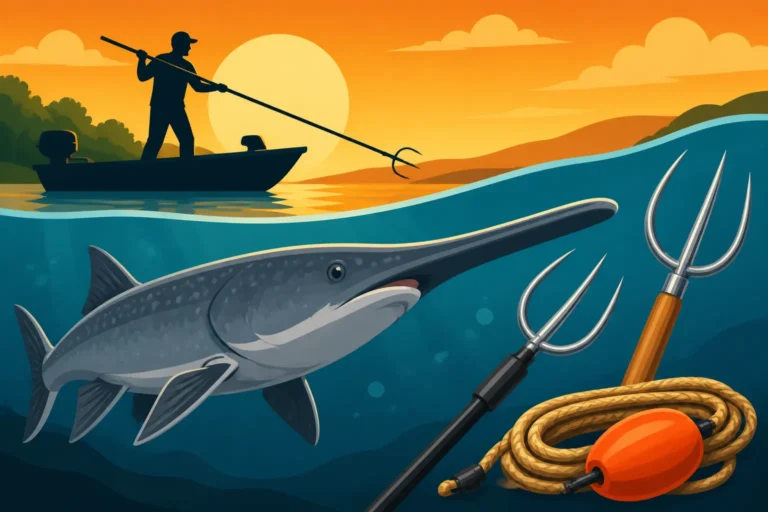
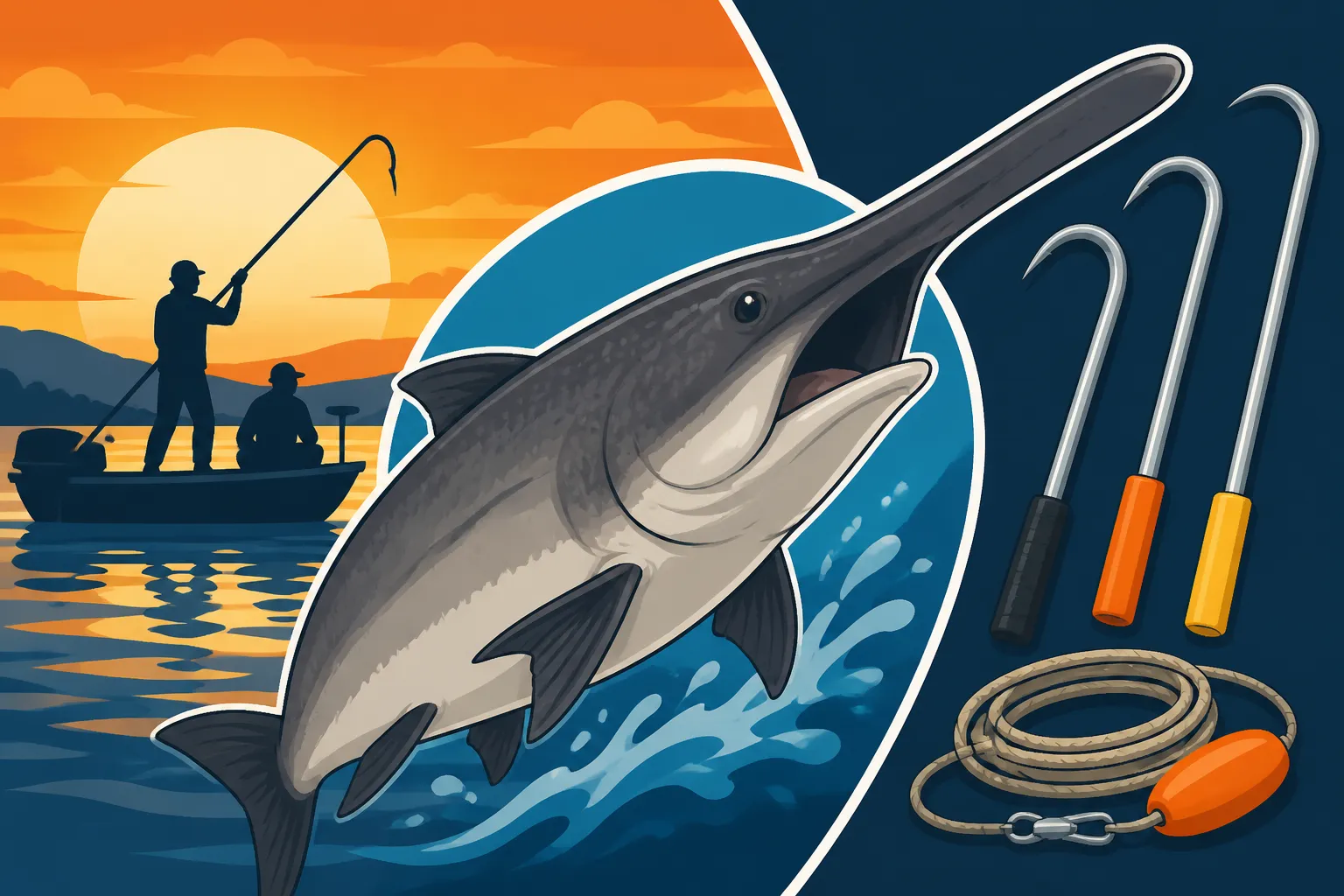
Alternatively, some experienced anglers prefer a gaff. A gaff is a sturdy pole with a large, sharp hook on the end, used to secure and lift large fish into the boat. While effective, gaffs are generally reserved for fish you intend to keep, as they can injure the fish, making release difficult or impossible. Always check specific regulations on gaff use, as they can vary. If you're going for a trophy you plan to keep, a gaff can be a powerful tool, but for catch-and-release, a large, deep net is the preferred method. For tips on managing your catch, especially trophy-sized ones, consider information found in Paddlefish Snagging Gear Checklist for Grand Lake.
Coolers and Storage: Preserving Your Paddlefish
Paddlefish are fantastic table fare, but like any fish, proper handling and storage immediately after capture are crucial for preserving their quality. That means having a large, well-insulated cooler on board, filled with plenty of ice.
Paddlefish can grow quite long, so you'll need a cooler that can accommodate the entire fish, or at least its substantial fillets if you process it quickly on the water (check regulations on processing fish on the water). Often, a cooler designed for large saltwater fish, sometimes called a "fish bag," is ideal due to its length and flexibility. Once a legal paddlefish is harvested, it needs to be immediately placed on ice to chill rapidly. This slows down bacterial growth and maintains the firm texture and fresh taste of the meat.
Don't underestimate the size of cooler you'll need. A 100-quart or even 150-quart cooler might be necessary if you're hoping to land a couple of good-sized paddlefish. Consider a cooler with strong latches and handles for easy transport. The time between catching the fish and getting it properly chilled is critical, so having your cooler ready to go will make a big difference in the quality of your harvest.
Grand Lake offers some incredible opportunities for Paddlefish Snagging at Grand Lake O' the Cherokees. By investing in the right gear and prioritizing safety and responsible fishing practices, you'll be well-prepared for an unforgettable experience on the water.
Disclaimer
This article is for general informational purposes only and does not constitute professional advice. Laws, prices and regulations vary by location and change over time. Consult a qualified professional for guidance on your specific situation.