How to Snag Paddlefish at Grand Lake O’ the Cherokees, Oklahoma
Paddlefish snagging at Grand Lake O' the Cherokees can feel like chasing a ghost if you don't know the ropes. Many anglers get out there with enthusiasm only to come back frustrated, wondering if they're even in the right spot or using the correct gear to land one of these prehistoric giants. This guide is here to cut through the confusion and walk you through everything you need to know, from the specialized tackle to the precise techniques that will help you successfully snag paddlefish in Oklahoma's premier paddlefishing destination.
Gearing Up for Grand Lake Paddlefish
Before you even think about hitting the water at Grand Lake, you absolutely have to make sure your gear is up to snuff. This isn't your average bass fishing setup; paddlefish are big, powerful, and will put a serious test to your tackle. Skimping here is a recipe for broken lines and lost fish, and believe me, there’s nothing more heartbreaking than losing a monster paddlefish because your gear failed you. It’s a common frustration to see people out there under-gunned, so let’s get you properly equipped.
Rod and Reel Combinations Built for Power
When it comes to paddlefish, you need a rod that can handle immense pressure and a reel with a robust drag system. We're talking about fish that can easily top 50, 60, or even 100 pounds! A standard medium-heavy bass rod just won't cut it, and trying to use one will leave you exhausted and defeated. Think about what it takes to stop a runaway freight train; that's the kind of power you need to harness.
For your rod, look for something specifically designed for heavy-duty saltwater or muskie fishing. A heavy to extra-heavy power rating is non-negotiable, typically in the 7 to 9-foot range. This length gives you the leverage needed for long casts and the backbone to really haul on a big fish. Graphite composites or fiberglass rods are popular choices because they offer a good balance of strength and sensitivity. You want something that can absorb the shock of a powerful run without snapping.
Paired with that beast of a rod, you need a heavy-duty baitcasting reel. Not just any baitcaster, mind you, but one with a high line capacity and a drag system that can withstand continuous pressure. Many seasoned snag fishermen gravitate towards conventional reels designed for offshore saltwater fishing. Look for models from trusted brands like Penn, Daiwa, or Shimano that are known for their robust construction and smooth, powerful drags. A good rule of thumb is to ensure your reel can hold at least 200-300 yards of your chosen line, which brings us to the next critical component.
Line Selection and Terminal Tackle Essentials
Your line is the direct connection between you and that potential trophy, so choosing the right one is paramount. Braided line is the overwhelming favorite among serious paddlefish snag anglers, and for good reason. Its incredibly high strength-to-diameter ratio means you can spool up with stout line without sacrificing too much capacity. You'll want to use braided line in the 80 to 120-pound test range. This might sound like overkill, but remember the size of these fish and the force required to pull a large treble hook through their tough hide.
When considering your terminal tackle, the most crucial element is the treble hook. These aren't tiny crappie hooks; we're talking about huge, heavy-gauge trebles. Typically, anglers use 8/0 to 12/0 treble hooks. The key is to find hooks that are incredibly strong and sharp, capable of penetrating thick skin and cartilage. Brands like Mustad or Gamakatsu offer heavy-duty options that can stand up to the challenge. Don't cheap out on hooks; a weak hook will straighten out or break, and then you’re just left with a story about "the one that got away."
Attached to your hook, you'll need heavy lead weights to get your hook down to the fish quickly and keep it in the strike zone. Depending on the depth and current, you might be using weights anywhere from 8 to 20 ounces, or even heavier. Sinker slides are often used to allow the weight to slide freely up the line, keeping it from interfering with the hook set. A robust swivel and a heavy-duty leader (often 100-pound monofilament or fluorocarbon) complete your rig, providing an extra layer of abrasion resistance and shock absorption. You can find many of these specialized items, like heavy-duty braided line and large treble hooks, for purchase on sites like Amazon, making it convenient to get everything you need shipped right to your door before your trip.
Mastering the Art of the Snag
Paddlefish snagging isn't about finesse; it's about power, timing, and repetition. It's a completely different approach to fishing than what most anglers are used to, and it requires a specific technique to be effective. Don't be discouraged if it takes a little practice to get the rhythm down – it's a learned skill, like anything else.
The Basic Snagging Technique
The fundamental idea behind snagging a paddlefish is to blindly hook the fish as it swims through the water column. Unlike traditional fishing where you entice a fish to bite a bait or lure, with paddlefish, you're actively trying to 'snag' them. The technique involves a powerful cast, letting your heavy weight and hook sink, and then executing a series of aggressive sweeps.
Here's how it generally breaks down: First, you'll make a long, powerful cast out into the area where you've marked paddlefish or know they frequent. This is where your long rod really shines. Let your heavy weight sink all the way to the bottom. Once it hits, you'll immediately begin your retrieve. The retrieve isn't a steady reel-in like with a spinnerbait; instead, it's a rhythmic, sweeping motion. You'll sweep your rod upward and backward with a strong, deliberate motion, then quickly drop your rod tip back towards the water, reeling in the slack as you do. This sweep-and-reel motion causes your heavy treble hook to move through the water in an arc, hopefully passing through the body of a paddlefish. You'll repeat this sweep, drop, and reel motion all the way back to the boat or bank. The key is consistency and covering as much water as possible.
Reading the Water and Hooking a Fish
Successfully snagging paddlefish also involves a good understanding of where these fish tend to congregate. Paddlefish are filter feeders, so they're often found in deeper channels, humps, and points where currents might concentrate plankton. Your fish finder, if you have one, will be your best friend here, as it can help you locate schools of fish. They often appear as large, dense blobs or arches near the bottom or suspended in deeper water. If you're bank fishing, look for areas with deep water access, often near dam outflows or river channels emptying into the lake.
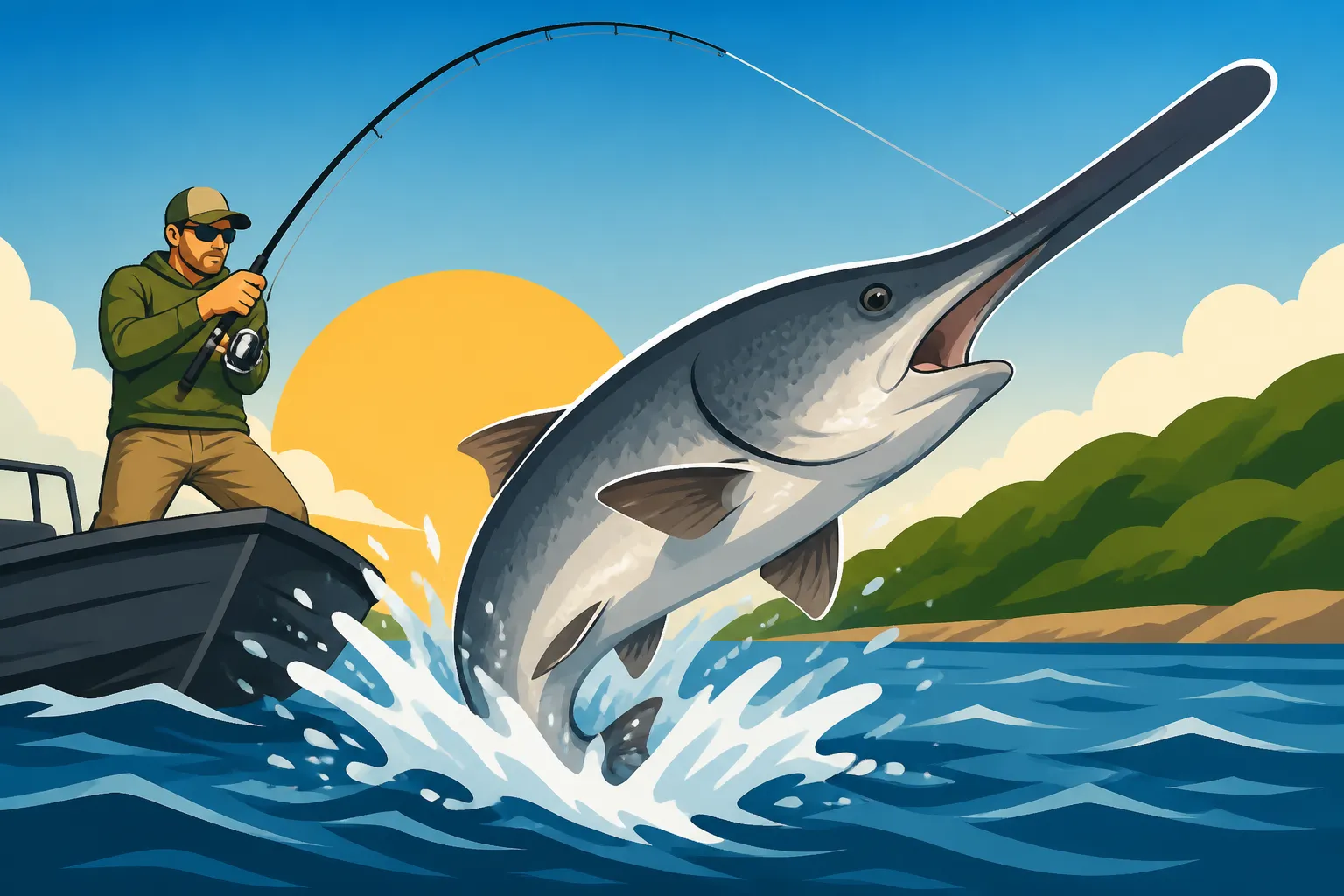
When you make a sweep and feel a sudden, heavy resistance, that’s often a paddlefish. It won't feel like a typical bite; it'll be more like hitting a submerged log that suddenly decides to move. When this happens, you need to set the hook hard and repeatedly. Don't just give one gentle tug; lean into it with multiple powerful sweeps to ensure the treble hook penetrates properly. Once you've got them hooked, the fight is on. Paddlefish are incredibly strong, and they'll make powerful, sustained runs. Keep constant pressure on them, let your drag do its job, and slowly work them towards you. This is where the heavy rod and stout line really pay off, allowing you to maintain control during their powerful surges. Landing one of these giants is an unforgettable experience.
Navigating the Season and Regulations at Grand Lake
Knowing when and where you can snag paddlefish, and what rules apply, is just as crucial as having the right gear. Oklahoma has specific regulations to protect these unique fish, and adhering to them is non-negotiable. Getting caught violating the rules can lead to significant penalties, so it’s always best to be prepared and informed. You don't want your amazing day of fishing to turn into a nightmare because you overlooked a simple regulation.
Understanding Oklahoma's Paddlefish Season
The paddlefish snagging season in Oklahoma typically runs from March 1st through May 15th, offering a prime window to target these impressive fish. However, it's absolutely vital to always double-check the current year's Oklahoma Fishing Regulations Guide from the Oklahoma Department of Wildlife Conservation (ODWC) because dates can shift slightly, and specific rules might be updated. This period is chosen because it coincides with their natural spawning migration, when paddlefish move into shallower, tributary waters, making them more accessible to snagging. Grand Lake O' the Cherokees is particularly renowned for its paddlefish population during this time, drawing anglers from all over.
During this season, you'll find the most activity in the upper reaches of Grand Lake, particularly around the Neosho and Spring River arms, as fish move upstream to spawn. Understanding the timing of their migrations is key to success. Early in the season, fish might be deeper, staging before their main push, while later in the season, they'll be more actively moving into shallower spawning areas. You can often find additional insights into specific local patterns by checking out resources like "Best Time of Year for Paddlefish Snagging Season" for more detailed seasonal advice.
Licenses, Limits, and Required Documentation
Before you even think about dropping a line, you need to make sure your paperwork is in order. Every angler 16 years of age or older must possess a valid Oklahoma fishing license. There are various types of licenses, including annual and temporary options, so be sure to get the one that suits your needs. You can learn more about specific requirements by checking out "Fishing License Requirements in Oklahoma". Beyond the standard fishing license, if you're targeting paddlefish, you'll need to be familiar with the specialized regulations that apply.
The daily bag limit for paddlefish in Oklahoma is one fish per person. This means once you've successfully snagged and kept a paddlefish, your paddlefish fishing for the day is done. There is also an annual possession limit of two paddlefish. What's even more important to remember is that once you keep a paddlefish, it must be tagged immediately with a carcass tag (which typically comes with your paddlefish permit or is available from the ODWC). You also need to record the harvest on your license. Misidentifying or misunderstanding specific regulations, especially regarding "Paddlefish Snagging Season in Oklahoma," can lead to fines, so always err on the side of caution. Carrying a copy of the current regulations, either printed or on your phone, is a smart move.
| Feature | Requirement for Paddlefish Snagging in Oklahoma (Grand Lake) |
|---|---|
| Fishing License | Required for anglers 16 and older. |
| Paddlefish Permit | Required; usually includes carcass tags. |
| Snagging Season | March 1st – May 15th (verify current year's ODWC guide). |
| Daily Bag Limit | One (1) paddlefish per person. |
| Annual Limit | Two (2) paddlefish per person. |
| Carcass Tagging | Immediate tagging required upon harvest. |
| Equipment | Heavy-duty rod/reel, 80-120lb braid, 8/0-12/0 treble hooks. |
| Legal Hours | Daylight hours only for snagging (check ODWC for specifics). |
Safety on the Water and Respecting the Resource
Paddlefish snagging often involves heavy equipment, crowded conditions, and powerful fish, so safety should always be a top priority. Wear a personal flotation device (PFD), especially if you're on a boat, and make sure everyone else aboard does too. Accidents can happen quickly on the water, and a PFD is your best defense. Also, be mindful of your surroundings, especially when making powerful casts with heavy weights and large hooks. A misplaced cast can cause serious injury to yourself or others. You can find essential safety equipment, like PFDs and safety whistles, readily available on Amazon.
Beyond personal safety, it's crucial to respect the paddlefish resource. These are long-lived, slow-growing fish, and careful management is vital for their populations. If you catch a paddlefish you don't intend to keep (perhaps it's under the legal size, or you've already met your limit), release it quickly and with minimal harm. Avoid dragging it onto the bank or boat unnecessarily. Handle it gently, remove the hook as carefully as possible, and get it back into the water promptly. Understanding that these magnificent fish are a finite resource ensures that future generations of anglers can also experience the thrill of snagging a Grand Lake paddlefish. For more on specific rules and regulations that apply to all fishing in Oklahoma, be sure to read our comprehensive guide on Fishing Regulations You Need to Know in Oklahoma.
Disclaimer
The information provided in this article is for general guidance and informational purposes only. Fishing regulations, license requirements, and seasonal dates are subject to change. Always consult the official Oklahoma Department of Wildlife Conservation (ODWC) regulations before planning your fishing trip to ensure compliance with the most current rules and laws.