How to Find Striped Bass Schools with Sonar
It can be incredibly frustrating to spend hours on the water, cruising across vast expanses like Lake Texoma or Keystone Lake, knowing that powerful striped bass are down there somewhere, but feeling like you’re just guessing. You’re burning fuel, losing precious fishing time, and wondering if you’re ever going to stumble upon that elusive school. This guide is all about taking the guesswork out of the equation, teaching you how to effectively use sonar technology to pinpoint those fast-moving, hard-fighting striped bass schools in Oklahoma's big reservoirs.
Understanding Sonar: Your Underwater Eyes
Before you can truly master finding striped bass schools with sonar, it's essential to understand what sonar actually is and how it works to paint that picture beneath your boat. Think of your sonar unit as giving you a detailed X-ray vision into the underwater world. It's not just a fancy gadget; it's a vital tool that transforms blind casting into targeted precision. For many anglers, the initial setup and understanding of sonar can feel a bit overwhelming, but once you grasp the basics, it becomes second nature.
The Magic of Transducers
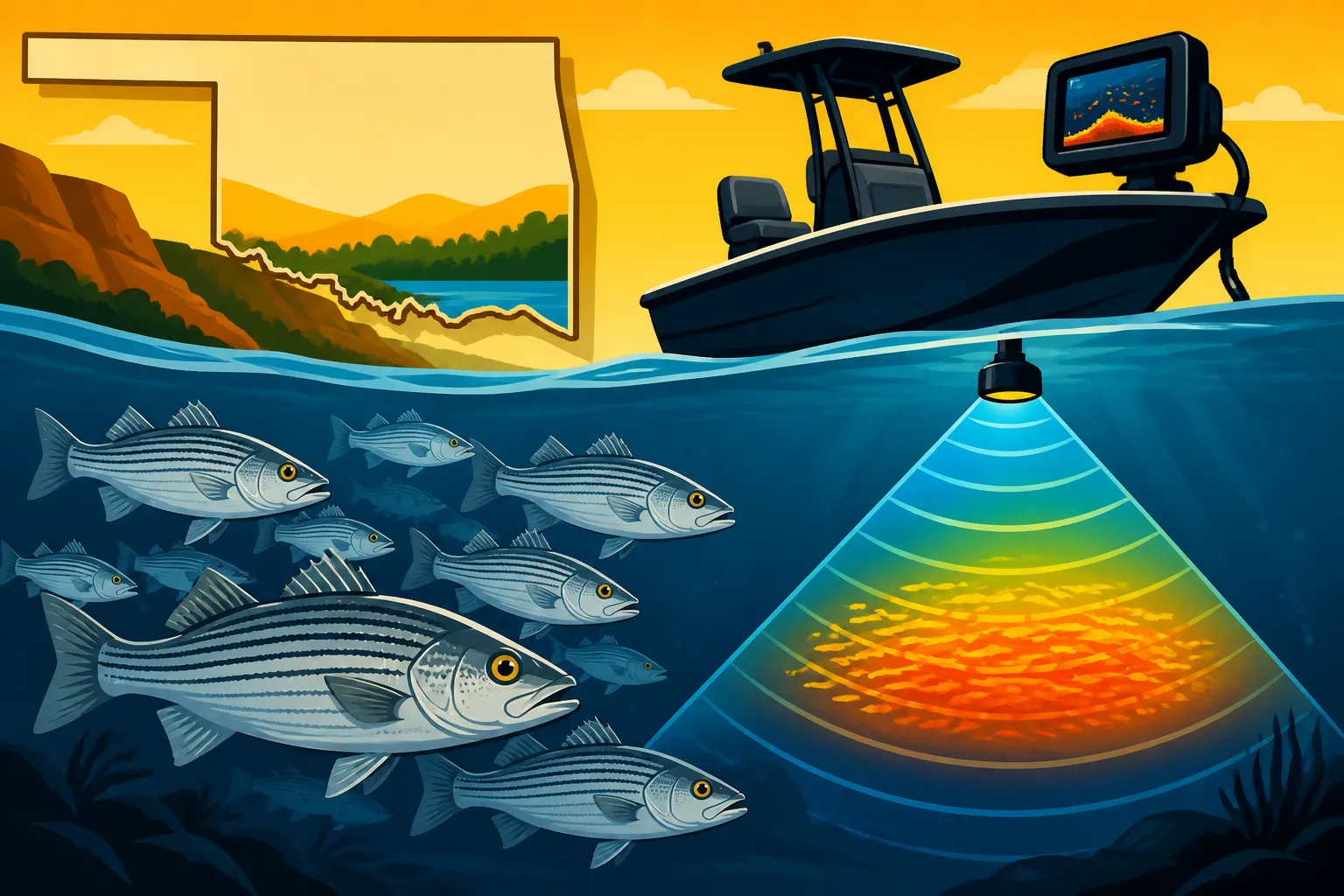
At the heart of any sonar system is the transducer. This is the unsung hero, the part that actually sends out sound waves and listens for their echoes. It’s typically mounted on the transom of your boat, on the trolling motor, or even inside the hull. These sound waves travel through the water, bounce off anything from the lake bottom to fish, and then return to the transducer. The unit then interprets these echoes, translating them into the images you see on your screen. The clearer your transducer's view, the better your chances of distinguishing a tight ball of baitfish from a massive striper lurking below.
Getting a clean signal from your transducer is paramount. If it's mounted incorrectly, too close to turbulent water, or obstructed, you'll get a blurry, noisy picture that's almost useless. Taking the time to ensure proper installation, perhaps even consulting a professional, will pay dividends in the clarity of your sonar readings. A small investment in time here can prevent hours of frustration trying to decipher garbled readings on the water.
Sonar Frequencies and Their Impact
Sonar units operate on different frequencies, and understanding how these frequencies affect your view is key to maximizing your effectiveness, especially when targeting fish that can suspend at various depths like striped bass. Lower frequencies, say 50 kHz, penetrate deeper and cover a wider cone angle, which is great for scouting large areas or deep water. However, the trade-off is less detail. Higher frequencies, like 200 kHz or even up to 800 kHz, offer incredible detail and target separation but don't penetrate as deeply and cover a narrower area.
For striped bass, which can be found from the surface down to significant depths in lakes like Grand Lake O' the Cherokees, a dual-frequency or CHIRP sonar unit is often ideal. CHIRP (Compressed High-Intensity Radiated Pulse) technology sweeps across a range of frequencies, offering a fantastic blend of depth, coverage, and detail, making it easier to see individual fish within a school, even when they're tightly packed. Knowing when to switch frequencies or how your CHIRP unit is performing at different depths will directly impact your ability to locate these fast-moving predators.
Types of Sonar for Striped Bass Hunting
The world of sonar technology has advanced leaps and bounds, offering anglers more ways than ever to peer into the underwater realm. For striped bass fishing in Oklahoma, having a good understanding of the different types of sonar available will help you choose the right tools and interpret their unique displays. Each type offers a different perspective, and often, combining them provides the most comprehensive picture.
2D Sonar: The Classic View
The traditional 2D sonar is what most of us grew up with, and it's still a workhorse for many anglers. It displays a real-time, scrolling view of what's directly beneath your boat, showing fish arches, bait balls, and bottom structure. For striped bass, 2D sonar is excellent for identifying those classic "Christmas tree" bait balls – huge congregations of shad or other forage – and the larger, typically crescent-shaped arches of individual stripers that are either chasing or lurking nearby.
One of the great advantages of 2D sonar is its simplicity and speed. It refreshes quickly, making it ideal for tracking fast-moving schools. You can adjust the sensitivity to pick up faint returns or filter out clutter, and the zoom function helps magnify specific areas of interest. Many anglers start their search using 2D sonar, covering broad areas of open water on a big reservoir, and then switch to more detailed views once they've found something promising. It's a reliable first line of defense for detecting subsurface activity.
DownScan and SideScan Imaging: Seeing More Clearly
While 2D sonar provides a good general overview, DownScan and SideScan imaging offer incredibly detailed, photo-like views of what's happening directly below and to the sides of your boat.
-
DownScan Imaging: This technology literally gives you a "snapshot" of the water column directly beneath your boat, with amazing clarity. Instead of arches, fish appear as distinct marks, and baitfish schools look like dense clouds, often with predator fish clearly visible on the edges or underneath. You can see individual tree limbs, rock piles, and even submerged vehicles with astounding detail. When you've located a promising area with 2D sonar, switching to DownScan can confirm whether those marks are indeed large fish or just debris, providing crucial confidence before you drop a line. This is incredibly valuable when you are looking for specific structures that might hold stripers, especially in deeper sections of lakes such as Lake Eufaula.
-
SideScan Imaging: Now, this is where things get really exciting for covering vast areas efficiently. SideScan sends beams out to the sides of your boat, often up to several hundred feet in each direction. It creates a panoramic view of the bottom and water column, revealing structure, baitfish, and striped bass schools that you might have completely missed with traditional 2D or DownScan. Imagine cruising along, and suddenly you see a massive school of baitfish with big fish marks trailing them, hundreds of feet off to your port side. This allows you to turn the boat and approach them stealthily, rather than driving right over the top. SideScan is particularly effective for finding those elusive offshore schools that aren't necessarily holding tight to traditional bottom structure. Many serious striper anglers consider a good SideScan unit, often available on Amazon, an indispensable tool for covering large open water bodies effectively.
Interpreting Sonar Readings for Striped Bass Schools
Having the best sonar unit in the world won't do you any good if you don't know how to interpret what you're seeing on the screen. Learning to read your sonar is like learning a new language – it takes practice, but the rewards are immense. For striped bass, specifically, there are certain patterns and signatures that scream "fish on!"
Identifying Baitfish Schools
Striped bass are apex predators, and their entire existence revolves around finding and eating baitfish, primarily shad, in Oklahoma's lakes. Therefore, the first step in finding stripers with sonar is almost always finding their food source. Baitfish schools will typically appear as dense, irregularly shaped clouds or balls on your 2D sonar. On DownScan, they look even more realistic, like tightly packed groups of small fish.
Often, these bait balls will be suspended in the water column, not necessarily on the bottom. Pay close attention to their shape and movement. If a bait ball looks compressed, elongated, or has "missing" sections, it's often an indication that predators are actively feeding on them. You might even see individual larger fish marks streaking into or through the bait ball. This is prime real estate for dropping your lures or live bait. Remember, without bait, there's usually no reason for stripers to be in that area.
Spotting Striped Bass Signatures
Once you’ve honed your eye for baitfish, it's time to identify the big players: the striped bass themselves. On 2D sonar, striped bass often show up as larger, thicker arches or elongated blobs, particularly when they are actively moving or suspended. If you see multiple large arches clustered around or beneath a bait ball, you’ve hit the jackpot. These active marks often indicate feeding fish.
With DownScan and SideScan, the distinction becomes even clearer. Striped bass will appear as distinct, elongated "blips" or "streaks," often much larger and brighter than individual baitfish. On SideScan, you might see them as individual white marks, sometimes in distinct lines or small groups, patrolling the edges of structures or the open water. When they are feeding aggressively, you'll notice them "metering" up from deeper water towards the bait, or crashing through the schools. Look for these larger, more defined marks, especially if they are positioned below or just outside the periphery of a dense bait school. This is a crucial skill to develop for successful Striped Bass Fishing Techniques for Oklahoma's Lake Texoma.
Reading Structure and Depth
Striped bass, while often found in open water, still relate to structure and changes in depth. Your sonar isn't just for finding fish; it's also excellent for mapping the underwater terrain. Look for humps, ledges, creek channels, submerged timber, and old roadbeds. Stripers will often use these features as ambush points or travel corridors. On a vast lake like Texoma, finding these subtle contours can be the key to unlocking a pattern.
Understanding the depth at which the fish are holding is also critical. If your sonar shows bait and stripers at, say, 30 feet, that tells you exactly how deep to present your lures. Pay attention to temperature breaks (thermoclines) if your unit has that capability, as fish often stack up just above or within these layers. By correlating fish marks with specific structural elements and depths, you can build a mental map of where the stripers are likely to be, even if they're not actively feeding at that moment. This information is invaluable for both active fishing and for planning future trips.
| Sonar Type | Best For | Typical Display | Key for Striped Bass |
|---|---|---|---|
| 2D Sonar | General scanning, covering wide areas quickly, deep water. | Fish arches, bait balls as clouds, scrolling history. | Identifying large bait balls and strong, distinct fish arches. |
| DownScan | Detailed view directly below the boat, structure identification. | Photo-like images, clearer fish shapes, distinct structure. | Confirming fish species, spotting stripers ambushing bait on structure. |
| SideScan | Wide area coverage to the sides, finding offshore schools. | Panoramic view of bottom and water column to the left/right. | Locating distant bait balls and striper schools away from the boat without spooking them. |
Practical Tips for Using Sonar to Find Stripers
Now that you understand the technology and how to interpret the images, let's talk about putting it all into practice on the water. It’s one thing to see fish on the screen; it’s another to consistently convert those sightings into hook-ups. These practical tips will help you maximize your sonar's potential when hunting for Oklahoma's hard-fighting striped bass.
Setting Up Your Sonar Unit for Success
Proper setup is crucial. Don't just turn your unit on and expect magic. Start by setting your sensitivity to a level where you get a clear picture without too much clutter. In deeper water or when fishing for suspended fish, you might need to increase it. For shallower areas, reduce it to avoid excessive noise. Adjust your scroll speed so that you get a clear, readable image, especially when moving at different boat speeds. For actively searching, a faster scroll speed helps you track fish quickly.
Consider customizing your display views. Many modern units allow for split screens, so you can simultaneously view 2D sonar, DownScan, and even SideScan. This multi-view approach provides a comprehensive understanding of the underwater environment. Make sure your GPS is integrated and functioning correctly, as marking waypoints where you see active schools or promising structure is absolutely critical. You can often find advanced units with built-in GPS and detailed mapping features on online retailers like Amazon.
Developing Effective Search Patterns
You can't just drive around randomly and expect to find stripers. Develop a systematic search pattern. If you're on a large, open reservoir like Lake Texoma, start by making wide passes in areas known to hold stripers, such as near major creek channels, points, or humps. Utilize your SideScan to cover large swaths of water quickly. If you see promising returns far to your side, you can then adjust your course to investigate without driving directly over the fish.
Once you find a school, don't just stop directly on top of them. Instead, note their location and approach them cautiously, perhaps making a wide circle around them to determine their direction of travel and the edges of the school. This stealthy approach, especially when Deep Water Striper Fishing Techniques are in play, will result in fewer spooked fish and more bites. Remember that stripers are constantly on the move, so you might need to adjust your boat's position frequently to stay with them.
Adjusting Settings for Different Conditions
Fishing conditions are rarely static, and your sonar settings shouldn't be either. Cloudy water after heavy rains, bright sunny days, or windy conditions can all affect your sonar's performance. In murky water, you might need to increase sensitivity or switch to a lower frequency to penetrate the water column more effectively. In calm, clear water, you can often run higher frequencies and lower sensitivity for maximum detail.
Experiment with your color palette. Different color schemes can highlight fish or structure more effectively depending on the ambient light and your personal preference. For instance, some anglers find that a high-contrast palette makes fish arches pop more against the background. Don't be afraid to tinker with your gain, range, and noise rejection settings. Your sonar unit is a powerful, adaptable tool; learning its nuances in various scenarios will make you a far more effective striped bass angler.
Combining Sonar with Other Techniques
While sonar is an incredible asset, it's just one tool in your arsenal. The most successful striped bass anglers combine their sonar readings with other tried-and-true techniques. For instance, if your sonar is showing deep-suspended stripers, you might employ Striped Bass Trolling Techniques with deep-diving crankbaits or umbrella rigs. If they're shallower or actively busting the surface, fast casting spoons or topwater lures might be more effective.
Keep an eye out for bird activity. Diving gulls or herons are often a dead giveaway that baitfish are being driven to the surface by actively feeding stripers. Your sonar can then help you confirm the presence and depth of the school below. Also, consider the time of day and season. Stripers often feed more actively at dawn and dusk, or during specific seasonal runs. Knowing these patterns, as discussed in topics like Oklahoma Fishing Seasons: A Month-by-Month Guide, combined with your sonar readings, creates a truly powerful fishing strategy. Finally, don't forget the importance of your bait. If you're seeing baitfish and stripers on your screen, ensure you're using the right presentation, whether it's live shad, a jig, or a spoon.
Locating and Engaging the School
Finding a school of striped bass on your sonar is exhilarating, but the real challenge (and fun!) is engaging them successfully. This often involves a mix of technique, observation, and quick adjustments. It’s not enough to just see them; you need to figure out how to get your bait in front of them effectively.
Mastering the Art of the Approach
Once you've identified a promising school, your approach is critical. You don't want to spook these fish, especially if they are actively feeding or somewhat shallow. If you’re running a gas motor, consider backing off and approaching with your Trolling Motor Setup for Oklahoma Striped Bass. Trolling motors are much quieter and allow for subtle adjustments to your position, helping you stay with the school as it moves.
Pay attention to wind and current. These factors will dictate how your boat drifts and how your bait presents. Position your boat upwind or upcurrent from the school if possible, allowing you to drift into them or make controlled passes. If the stripers are actively busting the surface, try to anticipate their direction of travel and position yourself ahead of them, casting into the melee. This careful approach can make all the difference between a few missed opportunities and a boatload of memorable catches.
Deploying the Right Presentation
Your sonar has told you where the fish are and how deep. Now, you need to deliver the goods. If stripers are holding deep, jigging spoons, heavy bucktails, or live bait fished on a Carolina rig can be incredibly effective. Consider using a bottom-fishing technique or a slip sinker rig if they're near the bottom, especially with a fresh shad. For suspended fish in open water, vertical jigging or trolling with crankbaits or umbrella rigs set to the precise depth indicated on your sonar is key.
If you’re seeing aggressive stripers chasing bait to the surface, that’s your cue for topwater lures, poppers, or fast-retrieved swimbaits. The visual spectacle of a striper crashing a topwater lure is unforgettable. The beauty of combining sonar with various fishing techniques is that you’re always prepared for whatever the fish are doing. A well-stocked tackle box, perhaps with some of the best lures for different seasons, purchased conveniently from Amazon, will ensure you have options ready for whatever your sonar reveals.
Staying with the School
Striped bass are highly migratory and can move surprisingly fast. Just because you found them once doesn't mean they'll stay put. Continuously monitor your sonar as you fish. If the fish marks start to thin out, or the bait disappears, it's time to adjust your position. Use your GPS to mark the location of the school, and then, if they move, make wider circles with your SideScan or faster passes with 2D sonar to relocate them.
Sometimes, after a few fish are caught, a school might temporarily disperse or move deeper. Give the area a few minutes, or make another pass. Often, they will regroup. It's a dynamic dance between you and the fish, and your sonar is your partner, helping you anticipate their next move and stay in the action. Remember, patience and persistence, backed by sound technology, are the keys to a successful day of chasing Oklahoma's powerful striped bass.
Disclaimer
This article is for general informational purposes only and does not constitute professional advice. Laws, prices and regulations vary by location and change over time. Consult a qualified professional for guidance on your specific situation.