Best Kayak Crate Setup for Tackle Storage
Kayaks are amazing for getting to those hard-to-reach fishing spots, but let's be honest, keeping your gear organized in such a compact space can feel like trying to herd a school of minnows. Tackle boxes slide around, lures get tangled, and finding that one specific jig when the bite is hot often means rummaging through a chaotic mess. This guide will walk you through how to set up the best kayak crate for tackle storage, ensuring your next trip out on Oklahoma's beautiful waters is smooth, efficient, and ultimately, more successful.
The Foundation of Kayak Tackle Organization: Why Crates Work
When you're out on an Oklahoma lake, whether it's the vast expanse of Lake Texoma or a more intimate pond, your kayak quickly becomes your entire fishing universe. Space is at a premium, and every piece of gear needs its place. Traditional fishing tackle boxes, while great for boat docks or large bass boats, often fall short in a kayak. They can be bulky, hard to access, and prone to tipping over, sending hooks, weights, and plastics scattering across your limited deck space. This is where the humble, yet incredibly versatile, kayak fishing crate steps in as a true game-changer.
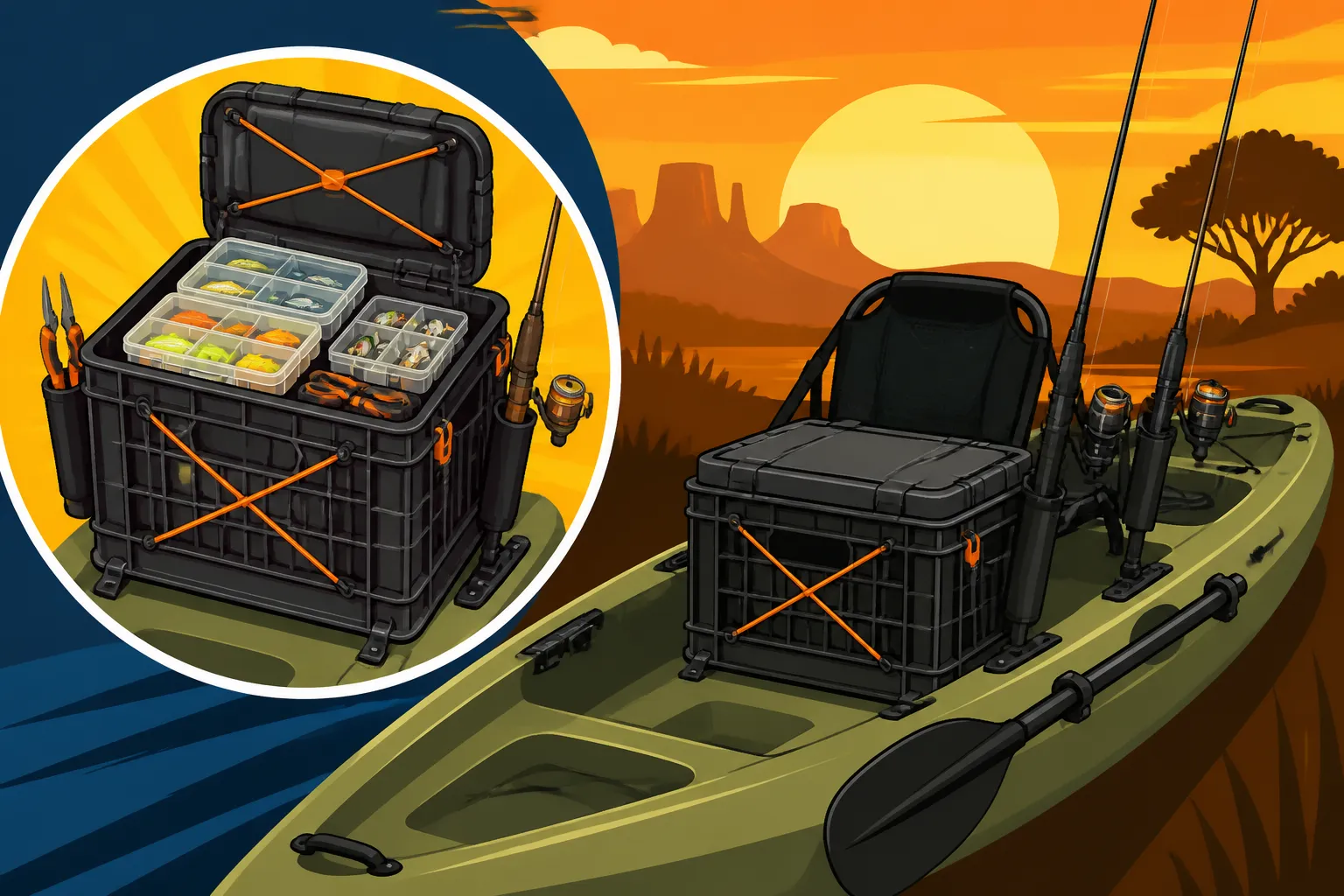
Think of a kayak fishing crate as your portable command center. It's designed to fit snugly in the tankwell (the open storage area behind the seat on most sit-on-top kayaks) or securely behind you in a sit-inside model, keeping everything contained and within arm's reach. The genius of the crate lies in its open, customizable nature. Unlike a rigid tackle box with fixed compartments, a crate provides a blank canvas for you to tailor your storage exactly to your fishing style and the species you're targeting that day. Whether you're chasing Oklahoma's Bass Fishing Rules and Limits on Grand Lake or trying to figure out Crappie Fishing Techniques and Seasonal Patterns in Oklahoma on Lake Eufaula, a well-organized crate can make all the difference.
The benefits extend beyond just neatness. A dedicated crate system dramatically improves accessibility. No more twisting awkwardly to reach a bag of soft plastics stuck under a bungee. With a crate, your rods are secured in integrated holders, your essential tools are clipped to the side, and your tackle is neatly arranged inside, ready for action. This efficiency not only saves time but also reduces frustration, allowing you to focus on the thrill of the catch rather than the hassle of your gear. It's truly a leap forward for any angler serious about kayak fishing in Oklahoma.
Choosing the Right Base for Your Kayak Tackle Crate
The journey to the perfect kayak tackle setup begins with selecting the right base crate. You might think "a crate is a crate," but there's actually a surprising variety, each with its own advantages, especially when considering the diverse fishing environments across Oklahoma. From the calm, shallow coves where you might be Bank Fishing Techniques for bluegill to the wind-swept main lake bodies requiring more robust storage, your choice of crate can significantly impact your experience.
The first consideration is size and fit. Most sit-on-top kayaks have a designated "tankwell" area designed to accommodate a standard milk crate size. However, some larger fishing kayaks have bigger wells, while smaller recreational kayaks might need something more compact. Measure your kayak's tankwell carefully before you buy, paying attention to both the length, width, and height, especially if you plan to use a lid or rod holders that extend upwards. For sit-inside kayaks, the space behind your seat is often narrower, so a more slender crate might be necessary. You want a snug fit that won't shift around, but also one that allows for easy removal if you need to portage or load up your vehicle.
Next, consider the material and durability. While a basic plastic milk crate is a budget-friendly starting point (and many anglers still swear by them), purpose-built fishing crates offer enhanced features. Look for marine-grade, UV-resistant plastic that can stand up to the harsh Oklahoma sun and repeated exposure to water. These specialized crates are designed to be robust, resisting cracking and fading over time. They often come with reinforced bottoms and corners, critical for holding heavy tackle and surviving bumps and scrapes. Some popular brands, like YakAttack and their BlackPak series, or options found at retailers like Bass Pro Shops, are specifically engineered for the rigors of kayak fishing.
Finally, evaluate the features built into the base crate. Many dedicated fishing crates come with integrated rod holders, which is a huge convenience. These might be flush-mounted, offering a clean profile, or adjustable, allowing you to angle your rods perfectly for trolling or keeping them out of the way while paddling. Some crates include built-in tie-down points, making it easy to secure the crate to your kayak's deck with bungees or straps. Lids are another important feature; a hinged or snap-on lid can protect your gear from splashes, rain, and even accidental drops if your kayak flips. Deciding between a simple DIY milk crate and a more feature-rich, purpose-built option often comes down to budget and how much customization you want to do yourself versus buying a ready-made solution. For those just starting out, a standard milk crate is a fantastic, economical option. For the serious angler looking for maximum efficiency, investing in a specialized crate from a brand like YakAttack or a sturdy model available on Amazon can be a game-changer.
Here's a quick comparison to help you weigh your options:
| Feature | Standard Milk Crate | Purpose-Built Fishing Crate (e.g., YakAttack, Bass Pro Shops) |
|---|---|---|
| Cost | Very Low | Moderate to High |
| Durability | Good, but can become brittle/crack | Excellent, marine-grade, UV-resistant |
| Integrated Rod Holders | None (DIY required) | Often included, fixed or adjustable |
| Lid Options | DIY needed | Often available as an add-on or integrated |
| Tie-Down Points | DIY needed | Often integrated for secure mounting |
| Customization | Unlimited, but requires more effort | Designed for easy accessory attachment, some assembly required |
| Water Protection | Minimal (DIY required) | Better, especially with a lid; some are fully enclosed |
| Availability | Easy to find | Specialized retailers, online (e.g., How to Buy an Oklahoma Fishing License Online from a fishing store) |
Customizing Your Crate for Peak Oklahoma Fishing Efficiency
Once you have your base crate, the real fun begins: customization! This is where you transform a simple storage box into a highly efficient, personalized fishing machine. The goal is to make every piece of tackle and every tool easily accessible, especially when you're out on the water, navigating currents in the Arkansas River or enjoying a peaceful morning on Lake Arbuckle. A well-customized crate ensures that when that bass hits your line, you're not fumbling for your pliers or net.
One of the most crucial elements for kayak fishing is rod management. Most anglers carry at least two or three rods, sometimes more, depending on the species they're targeting. Your crate can become the central hub for these. If your chosen crate doesn't have integrated rod holders, adding them is a top priority. You can find simple PVC pipe solutions that zip-tie to the sides of a milk crate, or more advanced rail-mounted rod holders that can be attached to purpose-built crates. These provide secure storage while paddling and quick access when you need to switch lures or land a fish. Having multiple rod holders means you can keep a Best Rod for Largemouth Bass Fishing ready for topwater action and a lighter setup for panfish, without them getting tangled under your feet.
Internal organization is key to preventing the dreaded "tackle box explosion." Consider adding internal dividers or small tackle trays that fit snugly inside your crate. These allow you to separate soft plastics by color or style, keep hard baits from tangling, and organize terminal tackle like hooks, weights, and swivels. Many small, modular tackle boxes fit perfectly within a larger crate, providing compartmentalized storage that can be easily pulled out as needed. Brands like Plano offer compact utility boxes that stack well, and you can often find great deals on these at Bass Pro Shops or online through Amazon. Keeping everything neatly separated means less time searching and more time fishing.
Don't forget about your essential tools. Pliers, line cutters, a measuring board, and a fishing net are non-negotiable for kayak fishing. Attaching these directly to the outside of your crate, or to a lid, keeps them immediately available. Magnetic tool holders, bungee cords, or small clips work wonders. Imagine you've just landed a decent Oklahoma Statewide Bass Bag Limit Explained largemouth at Tenkiller Ferry Lake, and your pliers are right there, clipped to the side of your crate, ready for a quick de-hook and release. This kind of efficiency is what transforms a good fishing trip into a great one.
For the tech-savvy angler, your crate can also serve as a mounting platform for electronics. Many kayak anglers attach their fish finders directly to a custom-made lid or a side-mounted accessory plate on their crate. This keeps the unit elevated for easy viewing and positions the transducer cable neatly down into the water. Similarly, action cameras can be mounted to capture all the action without cluttering your kayak's deck. Just ensure any electronics are secured properly and, if possible, in waterproof enclosures to protect them from unexpected splashes.
Finally, think about those external pockets and extra accessories. A small mesh bag attached to the side of your crate can hold a water bottle, sunblock, or a small first-aid kit. A clear, waterproof pouch can store your fishing license, car keys, and phone, keeping them safe and dry. Some anglers even attach a map of their fishing area to the lid for quick reference. The beauty of a crate is its adaptability; you can continually refine your setup as you discover what works best for your personal fishing style and the specific challenges of fishing in Oklahoma.
Essential Add-Ons and Smart Organization Hacks for Your Crate
Once you've got the basic structure and internal organization dialed in, it's time to fine-tune your kayak fishing crate with smart add-ons and clever hacks. These extra touches are what truly elevate your setup from "organized" to "optimized," giving you an edge on the water, whether you're battling the elements on a blustery day or enjoying the quiet solitude of a morning bite.
Water protection is paramount when you're on a kayak. Even on calm days, splashes are inevitable, and an unexpected rain shower can quickly drench your gear. For items that absolutely cannot get wet—like your phone, wallet, or extra clothing layers—incorporate small dry bags or waterproof boxes directly into your crate setup. You can even find specialized "crate bags" that fit inside or over your crate, offering an extra layer of splash protection for all your tackle. Keeping a few gallon-sized zip-top bags handy for wet items or trash is also a simple, yet effective hack. Remember, a lost phone or damaged car keys can quickly ruin a Family-Friendly Fishing Spots in Oklahoma trip.
Dealing with soft plastics and bulky baits can be a challenge. Instead of keeping them in their original cumbersome packaging, consider transferring them to smaller, clear, resealable pouches or dedicated soft plastic binders. These take up less space, make it easier to see what you have, and can be organized by color or lure type within your crate's dividers. For larger crankbaits or topwater lures, dedicated trays with individual compartments prevent hooks from tangling and protect the bait's finish. This level of detail helps you quickly grab the right bait when the fish are schooling, like during the White Bass Spring Runs in Oklahoma.
The concept of "quick access" should guide many of your add-on decisions. What items do you use most frequently? For many anglers, this includes a measuring tape, pliers, line cutters, and perhaps a small box of frequently used hooks or weights. These items should be secured to the outside of your crate or within the topmost layer of internal storage. Consider a retractable lanyard for your pliers or cutters, attaching them to the crate so they're always within reach but won't fall overboard.
Another excellent hack is to utilize the vertical space around your crate. Many purpose-built crates come with rails or attachment points where you can mount additional accessories like camera poles, flags for visibility, or even specialized holders for a sand anchor. For a DIY milk crate, zip ties and small bungee cords are your best friends, allowing you to attach almost anything to the crate's exterior. This can free up valuable deck space on your kayak, making paddling and casting much more comfortable.
Finally, always keep in mind the balance and weight distribution, especially for a stable but still maneuverable vessel like a kayak. Heavy items should be placed at the bottom of the crate to maintain a low center of gravity. Distribute weight evenly to prevent your kayak from listing to one side. When packing your crate, think about the specific species you'll be targeting and the techniques you'll be using. A Best Bait for Catfish in Oklahoma Lakes and Rivers trip will require different tackle than a day spent How to Catch Walleye at Dusk. A well-planned, customized crate is not just about storage; it's about making your entire kayak fishing experience in Oklahoma as enjoyable and productive as possible.
Disclaimer
This article is for general informational purposes only and does not constitute professional advice. Laws, prices and regulations vary by location and change over time. Consult a qualified professional for guidance on your specific situation.