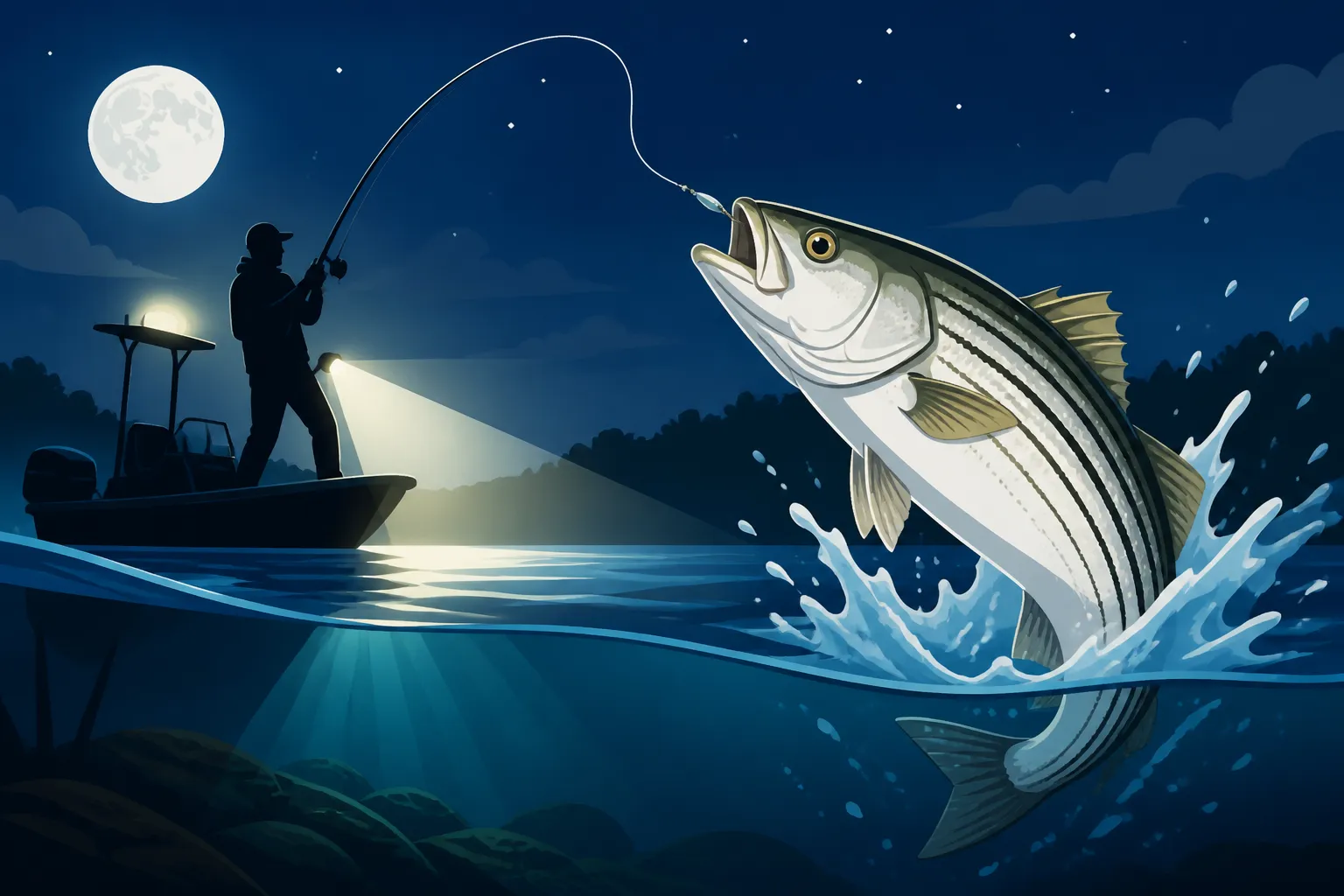
How to Catch Striped Bass at Night
The scorching Oklahoma sun can make daytime fishing a real challenge, especially when you're after powerful fighters like striped bass. The intense heat not only zaps your energy but often sends those big stripers deep or makes them lethargic. But what if I told you that some of the best striper action happens when the sun goes down and the lake cools off? This guide will dive deep into how you can effectively target and catch striped bass at night, turning those frustrating hot days into thrilling cool nights on the water.
Why Night Fishing for Striped Bass?
There’s a certain magic to night fishing, a quiet solitude that often eludes the bustling daytime hours on popular lakes. But beyond the peaceful atmosphere, there are concrete reasons why casting your line for striped bass under the moon can be incredibly productive, especially in Oklahoma.
Beating the Heat and Crowds
Let's be honest, Oklahoma summers are no joke. Trying to fish under a relentless midday sun can be downright miserable, not just for us anglers, but for the fish too. Striped bass are cool-water creatures, and when surface temperatures soar, they seek refuge in deeper, cooler thermoclines. This makes them harder to locate and often less willing to chase a lure. Night fishing sidesteps this problem entirely. As the sun sets, the surface water begins to cool, and baitfish often move closer to the surface or into shallower coves, bringing the stripers right with them. This means less time chasing scattered schools in deep water and more time casting into active feeding zones.
Beyond the temperature, the sheer number of boats and recreational users on a lake during the day can be overwhelming. Imagine trying to focus on your fish finder amidst jetskis, wakeboarders, and pleasure cruisers. It's enough to drive an angler crazy! When darkness falls, the vast majority of these disturbances disappear. You're left with a calmer lake, less boat traffic, and often, more aggressive, less pressured fish. This peaceful environment allows you to focus on your technique and truly enjoy the fishing experience without constant interruptions. It’s a completely different rhythm, one that often yields better results for trophy-sized striped bass.
Capitalizing on Striper Behavior
Striped bass are opportunistic predators, and their behavior shifts significantly after dark. Many species, including stripers, become more active and less wary under the cover of night. The low light conditions give them an advantage over their prey, which might rely more on sight during the day. This is particularly true for larger, more mature stripers who often become more solitary and nocturnal. They're less likely to be spooked by boat shadows or overhead activity.
One of the biggest behavioral changes is their movement. During the day, they might be scattered or holding tight to deep structure. At night, they tend to move into shallower water, often suspending higher in the water column or cruising along ledges and points where baitfish are congregating. This means that areas that were quiet during the day can suddenly explode with activity after dark. Understanding these nocturnal patterns is key to unlocking some incredible fishing opportunities and will greatly inform your approach to Deep Water Striper Fishing Techniques. They might be actively feeding on shad or other baitfish pushed up by the cooler water, making them prime targets for a well-placed lure or live bait.
Essential Gear for Night Striper Fishing
Night fishing isn't just daytime fishing after sunset; it requires a specific set of tools and considerations to ensure safety, comfort, and success. You'll need to adapt your tackle and add some crucial items to your checklist.
Lighting Your Way
This might seem obvious, but proper lighting is paramount for night fishing. You’re not just trying to see your bait; you need to navigate, tie knots, unhook fish, and ensure safety. A good headlamp is non-negotiable. Look for one with adjustable brightness settings and, ideally, a red light option. Red light preserves your night vision better than white light, which can be blinding to you and others on the boat, as well as potentially spooking fish. Keep extra batteries handy.
Beyond personal lighting, consider how you’ll illuminate your immediate fishing area. Many anglers use portable LED lanterns, especially if they are bank fishing, or clip-on lights for boat decks. For boat anglers, spreader lights or even small, submersible green or white LED fishing lights can be game-changers. These lights attract plankton, which attracts baitfish, which, in turn, attracts the striped bass. You can find excellent, durable options for all these lighting needs on platforms like Amazon, offering a wide range from budget-friendly to high-end marine-grade lights. Just be mindful of local boating regulations regarding navigation lights.
Rods, Reels, and Line for Nighttime Brawlers
When it comes to your primary tackle, you generally won't need anything drastically different from your daytime striper setup, but robustness is key. Striped bass are powerful fish, and fighting one in the dark adds another layer of challenge. You want a medium-heavy to heavy action rod, usually 7 to 8 feet long, capable of handling strong pulls and throwing larger baits or lures. Graphite rods offer sensitivity, while composite rods provide a bit more backbone for larger fish.
Pair your rod with a reliable baitcasting or spinning reel that has a smooth, powerful drag system. A quality reel is crucial when a big striper decides to make a run in the darkness. Spool up with a strong braided line, typically 30-50 lb test, which offers excellent sensitivity and strength. The lack of stretch in braid also helps with solid hooksets, which can be harder to feel at night. To this, tie a fluorocarbon leader of 15-30 lb test; fluorocarbon is nearly invisible underwater and has good abrasion resistance against rough structure or those toothy striper mouths. Don't forget a sturdy tackle box to keep everything organized; fumbling for gear in the dark is no fun. Many anglers find convenient, waterproof tackle boxes on Amazon, perfect for keeping essentials dry and accessible.
Lures and Bait for the Dark
Choosing the right lures and bait at night is all about maximizing sensory appeal for the fish. Since sight is diminished, you want to focus on vibration, scent, and profile. Live bait is often king for night stripers. Fresh shad, particularly gizzard shad, threadfin shad, or even live perch, are incredibly effective. Their natural scent and frantic movements are irresistible. You might want to consider larger baits than you’d use during the day to appeal to those bigger, more aggressive nocturnal feeders.
For artificial lures, anything that creates a strong vibration or has a distinct profile can be deadly.
- Swimbaits: Large soft plastic swimbaits, especially those with paddle tails, create a lot of thump in the water. Black, dark blue, or purple can be very effective as a silhouette against the moonlit sky.
- Jigs: Heavy jigging spoons or bucktail jigs worked vertically can trigger strikes from stripers holding deeper. Again, darker colors or even white can work well.
- Topwater: Believe it or not, topwater lures can be fantastic on calm, moonlit nights, especially during warmer months. Poppers or walk-the-dog baits create a surface disturbance that stripers can zero in on. The sound of a striper exploding on a topwater lure in the dark is truly unforgettable.
- Glow-in-the-dark options: While not always necessary, some anglers swear by glow-in-the-dark lures or adding glow sticks near their bait. These can be particularly useful on very dark nights or in deep, stained water. You can find a wide variety of these specialized lures and bait attractants on Amazon.
Finding Striped Bass in the Dark
Finding striped bass when the sun is down can feel like looking for a needle in a haystack if you don't know where to start. However, understanding their nocturnal habits and leveraging your electronics can turn the tables in your favor.
Locating Structure and Schools with Electronics
Your fish finder becomes an even more critical tool at night. While you won't be relying on visual cues like bird activity as much, your sonar will help you pinpoint structure and, more importantly, locate schools of baitfish and the stripers lurking beneath or around them. Look for prominent underwater features like humps, ledges, creek channels, and submerged timber. These are always striper magnets, day or night. As you're scouting, pay close attention to the thermocline if you have temperature readings; stripers will often be just above or within this zone. You can find detailed tips on How to Find Striped Bass Schools with Sonar to really hone your skills in this area.
Many modern fish finders have excellent low-light displays, and some even offer dark mode options, which can be less harsh on your night vision. Remember that baitfish, especially shad, will often ball up more tightly at night. When you mark these dense schools, the stripers won't be far behind. Mark any active spots with your GPS so you can return to them easily, even in the darkest conditions. Some anglers choose to run their main outboard for short bursts to quickly get to a new area, then switch to a silent trolling motor for stealthy approaches once they're in a promising zone.
Where to Set Up for Bank and Boat Anglers
The locations you target at night are often different from your daytime haunts.
For Bank Anglers: Focus on areas with easy access to deeper water or current. Dam discharge areas are often phenomenal at night because the current concentrates baitfish, and the turbulent water provides cover for stripers. Lighted docks or bridges can also be prime spots, as the artificial light attracts baitfish, creating a miniature ecosystem. Long points that extend into the main lake or areas where a creek channel meets the main lake are also excellent choices. You're looking for natural ambush points where stripers can intercept bait moving into shallower water.
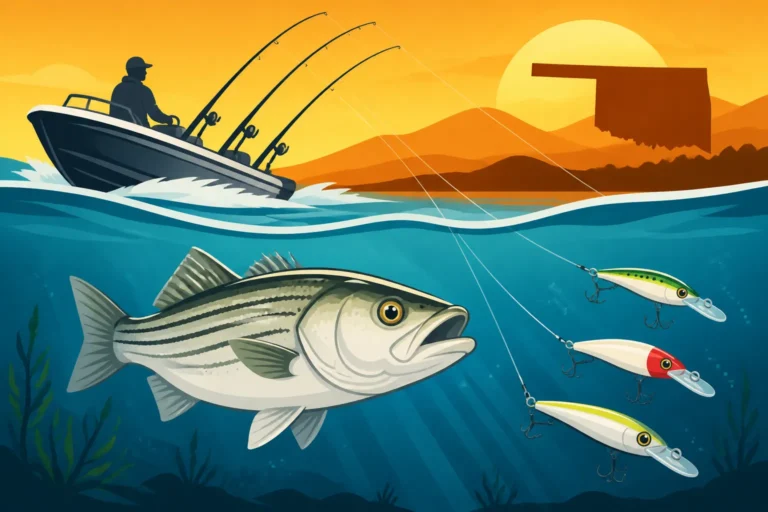
For Boat Anglers: You have more flexibility. Concentrate on major creek channels, especially near their mouths where they meet the main lake. Underwater points and humps that rise up from deep water are also classic nighttime striper spots. These locations offer access to both shallow and deep water, allowing stripers to move up to feed and then retreat if they feel pressured. The "no wake" zones in popular coves or harbors can also hold surprisingly large fish after dark, as they come in to feed on baitfish drawn to boat lights or nearby shore lighting. Remember that Lake Texoma Fishing Guide for Oklahoma Anglers can provide even more specific insights into high-percentage striper spots.
Night Fishing Techniques for Oklahoma Stripers
Now that you're geared up and have a general idea of where to find them, let's talk about the actual techniques for putting those nocturnal stripers in the boat or on the bank. Flexibility and patience are your best friends when fishing after dark.
Trolling Under the Stars
Trolling can be incredibly effective for covering water and locating scattered stripers at night, especially on vast reservoirs like Lake Texoma. This method allows you to present lures or live baits at specific depths and speeds, mimicking natural baitfish movements. For Trolling Gear for Striped Bass at Oklahoma's Lake Texoma, you'll want sturdy rods with line counters, downriggers if you're targeting really deep fish, and a reliable trolling motor to maintain consistent speeds.
Start by slow-trolling along contours, main lake points, or over humps that you've marked on your fish finder. Pay close attention to your speed, typically 2-4 mph, adjusting as needed based on how the fish are reacting. Use large diving crankbaits, spoons, or umbrella rigs, often in darker colors or with added glow components. If you're using live bait while trolling, a simple freeline or a Carolina rig with a heavy enough weight to keep the bait at your desired depth can be very effective. The key is to present your offering in a way that suggests an easy meal for a hungry striper in the low light. Learn more about How to Troll for Striped Bass in Deep Water for advanced tactics.
Casting and Vertical Jigging
When stripers are holding tight to structure, or if you've located a dense school of bait and predators on your sonar, casting and vertical jigging come into their own.
Casting: This technique is versatile for both bank and boat anglers. Cast large soft plastic swimbaits, bucktail jigs, or even topwater lures towards areas where you suspect stripers are ambushing bait. On calm, moonlit nights, a loud topwater lure can draw explosive strikes. For swimbaits, a slow, steady retrieve mimicking a struggling baitfish is often best. Let the lure sink to different depths on successive casts until you find the strike zone. If you're near lighted docks or bridges, cast just beyond the light line and retrieve through it, as stripers often wait in the dark just outside the illuminated area.
Vertical Jigging: If your fish finder shows stripers suspended in the water column or holding directly on a piece of structure, vertical jigging can be deadly. Use heavy jigging spoons or large metal jigs. Drop your lure straight down to the depth where you're marking fish, then retrieve it with sharp, upward jerks followed by a pause, letting the lure flutter back down. This erratic motion often triggers an aggressive reaction strike. This is a particularly effective tactic when the fish are concentrated and you've nailed their depth.
Live Bait Presentations
Few things are more effective for striped bass, especially at night, than live bait. The natural movement and scent are often irresistible.
Freelinning: This is a simple yet highly effective method. Hook a large live shad or perch through the nose or back, then cast it out with no weight, allowing it to swim naturally. This is perfect when stripers are feeding on or near the surface, or when they're in relatively shallow water. The bait's natural movements do all the work, drawing attention in the dark.
Bottom Fishing: For stripers holding on the bottom or near deep structure, a Carolina rig with a heavy sinker and a fluorocarbon leader is ideal. This keeps your bait near the bottom while allowing it to move freely. This is especially useful in areas with current or strong winds where you need to keep your bait stationary. Make sure your weight is heavy enough to hold bottom, but not so heavy that it restricts the bait’s movement entirely.
Suspended Live Bait: If stripers are suspended at a specific depth, a slip bobber rig is your friend. This allows you to set your bait at a precise depth above the fish. A lighted slip bobber (available on Amazon or at your local tackle shop) is perfect for night fishing, making it easy to see when a fish takes your bait. Pair it with a fresh, lively shad, and you're in business. Remember that Best Live Bait for Striped Bass Fishing will give you even more insights into choosing and presenting your live offerings.
No matter which technique you choose, remember that night fishing demands heightened senses and a methodical approach. The rewards, however, of a big striper battling under the moonlight, are well worth the effort. Consider adding some glow sticks to your rod tips for easy bite detection, or use line that shows up better under a headlamp. With the right preparation, those summer nights can become your favorite time to chase the powerful striped bass of Oklahoma.
Disclaimer
This article is for general informational purposes only and does not constitute professional advice. Laws, prices and regulations vary by location and change over time. Consult a qualified professional for guidance on your specific situation.