How Wind Direction Affects Where Fish Feed
It's happened to all of us: you get out on the water in Oklahoma, the sun is shining, the bait is lively, but the fish just aren't biting. It can be incredibly frustrating when you've done everything "right" but still come up empty-handed. Often, the missing piece of the puzzle isn't your bait or your technique, but something as simple yet profound as the wind direction. This guide will dive deep into how wind impacts fish behavior and how you can use this knowledge to turn those slow days into successful catches.
The Science Behind Wind and Water Movement
The wind isn't just an annoyance that makes casting difficult; it's a powerful force that dictates underwater ecosystems and, by extension, where fish decide to hang out and feed. Understanding this relationship is crucial for any angler hoping to consistently find fish in Oklahoma's diverse waters.
Wind-Driven Currents and Baitfish Concentration
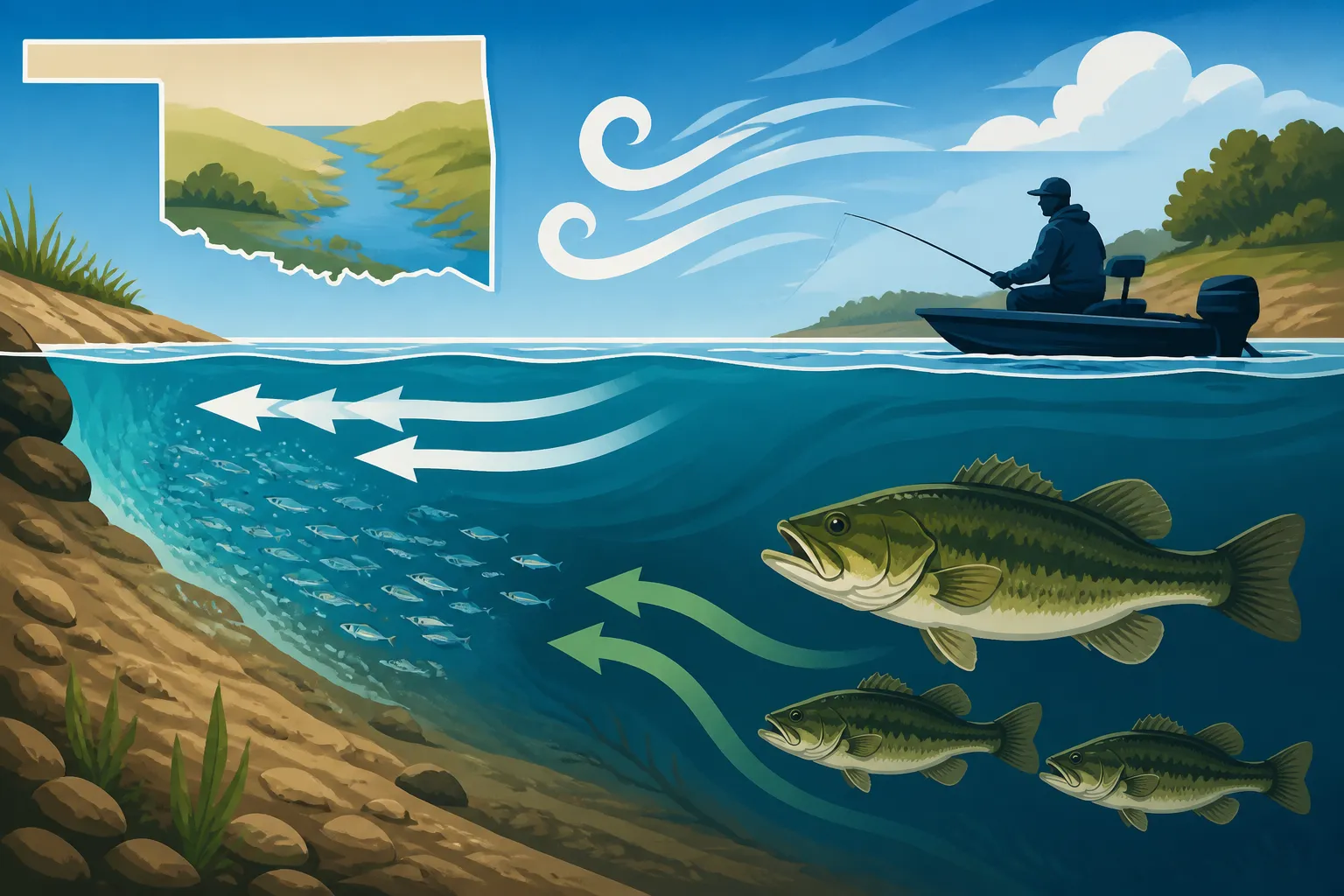
Think of the wind as a giant hand pushing the surface water across the lake. This creates subtle, or sometimes not-so-subtle, currents. These wind-driven currents are a game-changer because they move everything suspended in the water column – from microscopic plankton to schools of delicious baitfish like shad and minnows. Predatory fish, whether it's a hungry largemouth bass, a school of active crappie, or a foraging catfish, are always looking for the easiest meal. If the wind is consistently pushing baitfish into a particular area, you can bet the game fish will follow.
Imagine a large reservoir like Lake Eufaula with a steady south wind blowing for several hours. This wind will literally herd vast numbers of smaller baitfish toward the northern banks and points. As these baitfish get concentrated, they become an irresistible buffet for bigger predators. This creates a prime feeding zone where the current piles up food, and the predators gather for an easy meal. Your job as an angler is to identify these wind-blown structures and target them directly.
Oxygenation and Water Temperature Regulation
Wind also plays a vital role in maintaining the health and activity levels of fish by affecting oxygenation and water temperature. When the wind creates ripples and waves on the surface, it increases the surface area contact between the water and the air. This agitation helps dissolve more oxygen into the water, especially critical during warmer months when oxygen levels can naturally deplete in still waters. Fish, like any other creature, need oxygen to thrive and be active. Well-oxygenated water means more energetic fish, and energetic fish are often more willing to chase a lure.
Beyond oxygen, wind acts as a natural mixer for the water column. In the summer, a strong wind can help break up stratification (layers of different temperature water), mixing warmer surface water with cooler, deeper water. This can stabilize temperatures, preventing extreme hot spots where fish might become lethargic. Conversely, in colder months, wind can help circulate slightly warmer water from deeper areas to shallower feeding grounds. This thermal regulation keeps fish comfortable and actively feeding, rather than hunkering down to conserve energy due to temperature extremes.
Turbidity and Camouflage
One of the more overlooked benefits of wind, especially for predatory fish and savvy anglers, is its effect on water clarity or turbidity. Windy conditions create surface chop, which breaks up light penetration and also stirs up bottom sediment in shallower areas. This creates stained or murky water, often referred to as a "milk line" or "wind line." For an ambush predator like a bass or a crappie, reduced visibility is a huge advantage. They can hide more effectively in the stained water, waiting to dart out and ambush unsuspecting baitfish that can't see them coming.
For anglers, this turbidity offers a dual benefit. First, it makes your boat, your shadow, and your fishing line less visible to the fish, allowing for a more stealthy approach. Second, it often means the fish are less wary and more likely to strike aggressively. Instead of needing to use light line and subtle presentations in crystal-clear water, you might be able to get away with heavier tackle and more aggressive lures. This effect can be particularly pronounced along wind-blown banks where the waves crash, churning up sediment and creating a perfect low-visibility hunting ground.
Reading the Wind: How to Interpret Different Directions for Oklahoma Fishing
Understanding the general science is one thing, but knowing how specific wind directions impact your Oklahoma fishing trip is where the rubber meets the road. Every direction tells a different story about what's happening underwater and where you might find the most active bite.
South and Southwest Winds: The Oklahoma Standard
These are often the most common and, for many anglers, the most favorable wind directions in Oklahoma, especially during spring and fall. South and southwest winds tend to be warmer, blowing from the Gulf of Mexico, and they typically usher in stable, often improving weather conditions. When these winds blow, they relentlessly push warm surface water and vast schools of baitfish towards the northern banks, points, and coves of our large reservoirs.
This concentration of baitfish creates a highly attractive feeding zone for game fish. Look for bass, crappie, and even catfish to congregate along these wind-blown northern structures. Focus your efforts on primary and secondary points, rocky banks, and the mouths of creeks and coves that are directly exposed to the incoming wind. The fish will often be pushed right up against these structures, actively ambushing the bait that the wind is delivering to them. This is often an ideal scenario for a shallow-water bite, where fish are aggressive and easier to locate.
North and Northwest Winds: Post-Frontal Challenges
North and northwest winds usually herald the arrival of a cold front. These winds bring cooler, drier air, often resulting in clear skies and a noticeable drop in air and water temperatures. For anglers, this typically means a tougher bite, especially in shallow water. Fish react to these changes by often moving deeper, becoming more lethargic, and less willing to chase fast-moving lures. The clear water that often accompanies these fronts also makes fish warier.
When faced with a strong north or northwest wind, it's wise to abandon those shallow, wind-blown banks that were so productive just a day or two earlier. Instead, seek out more protected areas like deep southern coves, areas with steep drops, or main lake points that offer access to deeper water where fish can retreat. Your presentation should generally be slower and more subtle. Think about using jigs, soft plastics, or slower-moving crankbaits that give the fish time to react. The key is to present baits directly to fish that are likely holding tight to cover or structure in deeper, more stable water. If you're targeting bass, understanding How Cold Fronts Change Fishing Patterns on Oklahoma Lakes can give you a real edge.
East Winds: The Angler's Dilemma
"Wind from the East, fish bite the least" is an old angler's adage, and there's often truth to it. East winds in Oklahoma are frequently associated with unstable weather patterns, approaching rain, or even full-blown storm systems. This atmospheric instability can make fish behavior incredibly unpredictable. Sometimes, fish will go on a frantic feeding spree just before a major weather system moves in, seemingly sensing the approaching change. Other times, they will shut down completely, retreating to deep cover and showing no interest in feeding.
When an east wind is blowing, be prepared for anything. This is a time to be adaptable. Instead of focusing solely on wind-blown areas, consider fishing transition zones – places where shallow water meets deep water, or where different types of structure converge. Main lake points, ledges, and channels can be productive as fish might be moving to or from deeper water. If the bite is tough, try slowing down your presentation significantly. If the fish are active, take advantage of it! Keep an eye on the sky and be ready for weather changes.
West Winds: A Mixed Bag
West winds can be a bit of a mixed bag in Oklahoma, often bringing conditions that fall somewhere between the warm, stable southerly winds and the challenging northerly ones. Depending on the season and whether a front is moving in or out, a west wind can either be quite productive or present its own set of challenges. In warmer periods, a steady west wind can act much like a southwesterly wind, pushing baitfish and warm water to eastern banks and structures. These areas can become prime feeding grounds, especially if the wind has been consistent for a while.
However, a strong west wind, particularly one that shifts after a period of calm, can also be accompanied by cooler, drier air, creating similar challenges to a mild cold front. When this happens, fish might move deeper or seek more protected areas on the lake's eastern side. Your strategy should involve actively scouting. Look for areas on the eastern side of the lake where baitfish might be stacked up or where the wind is creating that desirable "milk line." Don't be afraid to experiment with different depths and presentations until you find what the fish are reacting to.
Adjusting Your Strategy: Fishing Techniques for Various Wind Conditions
Knowing how the wind affects fish is one thing, but translating that knowledge into actionable fishing strategies is the key to success. You've got to adapt your approach to match what Mother Nature is throwing at you.
Targeting Wind-Blown Banks and Points
When the wind is blowing steadily, especially from the south or southwest, those wind-blown banks and points become irresistible fish magnets. The strategy here is to position yourself to effectively cast into and along these areas. If you're in a boat, use your trolling motor (or even a drift sock if the wind is really ripping) to keep your boat positioned so you can cast with or slightly into the wind. This allows for longer, more accurate casts and better line control. For bank anglers, identifying a wind-blown point or riprap bank is paramount.
The fish on these banks are often aggressive and looking for an easy meal. This is prime time for reaction baits that imitate disoriented baitfish being washed into the area. Think spinnerbaits, chatterbaits, lipless crankbaits, or even shallow-diving crankbaits that mimic shad. Cast parallel to the bank or point, allowing the lure to work naturally with the current. Pay close attention to any current breaks or seams where the wind-driven water meets calmer water – these are often crucial "feeding zones" where fish stage to ambush their prey. Remember, How to Catch Bass Through Every Season will often involve these wind-driven strategies.
Fishing Protected Coves and Stained Water
Sometimes the wind is just too strong to comfortably fish the open, wind-blown areas, or perhaps a cold front has moved in, and fish have retreated. This is when seeking out protected coves and areas of stained water becomes your best bet. Look for coves on the opposite side of the lake from the prevailing wind, or areas behind large points or islands that block the wind's force. While these spots might not have the same direct current, they often offer more stable conditions where fish can find refuge.
In these protected, often calmer areas, you might find fish that are less active but still catchable. If the wind has created a "milk line" of stained water near the mouth of the cove, work that transition zone diligently. In stained water, consider using noisier baits like rattling crankbaits or jigs with rattles, or brightly colored lures that create a strong visual presence. Pitching jigs or soft plastics to isolated cover like laydowns, docks, or brush piles can also be very effective, as fish might be holding tight to structure to conserve energy.
Weighting and Line Management in the Wind
Wind can make casting and line control a nightmare, but with a few adjustments, you can overcome these challenges. The most immediate impact of wind on your presentation is usually line bow – your line forming a large arc in the wind, making it hard to feel bites and set the hook. To combat this, using heavier weights or jig heads than you normally would is often necessary. A heavier weight helps your bait cut through the wind and maintain better contact with the bottom, or sink quickly to the desired depth. You can find a wide selection of various weights and sinkers on Amazon, ready for those blustery days.
Line choice also plays a big role. Braided line, with its thinner diameter and no stretch, can be excellent for long casts in windy conditions, as it cuts through the wind better and offers superior sensitivity. However, its buoyancy can also be a disadvantage in heavy wind if you're trying to achieve a deep, natural presentation. Fluorocarbon, with its lower stretch and sinking properties, can also be beneficial as it tends to sink below the surface chop, reducing wind interference. For anglers fishing from a boat, mastering your trolling motor is essential for maintaining boat position and casting accuracy against the wind. Many modern trolling motors even have GPS spot-lock features that can hold your boat in place, freeing you up to focus on fishing, even in strong gusts.
Equipment and Safety Considerations for Windy Days
Fishing in windy conditions isn't just about changing your lures; it's also about preparing your gear and prioritizing safety. A little foresight can prevent a lot of headaches (and potentially dangerous situations) when the wind picks up on an Oklahoma lake.
Rods, Reels, and Line Choices
When you know you'll be battling the wind, choosing the right rods and reels can make a world of difference. Heavier action rods, especially those with a fast tip, provide better backbone for casting heavier baits and fighting fish in choppy conditions. They give you more control over your cast, helping you punch through the wind rather than having your lure get caught by it. For baitcasting setups, a reel with a good braking system is crucial to prevent backlashes when casting into a headwind or crosswind. Spinning gear can also work, but lighter lures can be harder to control.
Regarding fishing line, as mentioned earlier, braided line is a fantastic choice for many windy situations. Its minimal stretch and strong breaking strength allow for better feel and hook sets, even with a little bow in the line. The thinner diameter means less wind resistance on your cast, potentially adding a few crucial feet to your reach. Fluorocarbon is another excellent option because it sinks, helping to keep your line under the surface and out of the wind's direct grasp, enhancing sensitivity. Conversely, monofilament, being more buoyant, can be a struggle in heavy winds. You can find specialized wind-resistant fishing line and various weights on Amazon to fine-tune your setup. Considering Best Rods and Reels for Oklahoma Fishing will always include options that perform well in diverse weather conditions.
Anchoring and Boat Control
On windy days, controlling your boat can be as challenging as catching fish. A robust anchor system is vital for boat anglers who want to hold a precise spot. Whether it's a traditional anchor, a shallow-water anchor system, or a GPS-enabled trolling motor with a spot-lock feature, having reliable boat control allows you to focus on fishing rather than constantly fighting the elements. Position your boat strategically to cast with the wind (for maximum distance) or against it (for better control and feel with lighter baits).
Safety is paramount when boating in high winds on Oklahoma's larger reservoirs like Lake Texoma or Grand Lake. Choppy waters can quickly become dangerous, creating large waves that can swamp smaller vessels or throw passengers overboard. Always check the weather forecast before heading out, and if conditions are predicted to be too windy for your boat size, it’s best to err on the side of caution and postpone your trip. If you do venture out, be mindful of other boaters, reduce your speed in rough water, and ensure all passengers are seated and holding on.
Personal Comfort and Safety Gear
Beyond your fishing tackle, your personal gear is equally important for a safe and enjoyable windy day on the water. Wind chill can make even moderately cool temperatures feel frigid, so dressing in layers is crucial. A good wind-resistant outer shell will be your best friend. Don't forget a warm hat and gloves, as exposed skin can lose heat quickly. Polarized sunglasses are essential not only for eye protection but also for cutting glare off the choppy water, helping you spot subtle bites or submerged structure.
Most importantly, always ensure everyone on board has a properly fitted life jacket or Personal Flotation Device (PFD). Choppy water increases the risk of accidental falls overboard, and even strong swimmers can be quickly incapacitated by cold water or disorientation. Familiarize yourself with Oklahoma Life Jacket and PFD Rules for Boaters before every outing. Beyond PFDs, a well-stocked marine first-aid kit, a fully charged cell phone (in a waterproof bag), and possibly a marine radio are smart additions. A sturdy tackle box, like many available on Amazon, can also prevent your precious lures and accessories from blowing away in a sudden gust. Preparation means you can focus on fishing, no matter what the wind decides to do.
Wind Direction and Fishing Strategy Overview
Here’s a quick summary of how different wind directions might influence your fishing approach in Oklahoma:
| Wind Direction | Typical Weather Impact | Fish Behavior Tendency | Recommended Fishing Strategy | Key Lure Types & Focus Areas |
|---|---|---|---|---|
| South/Southwest | Warm, stable, often pre-frontal | Active, pushed to wind-blown banks, concentrating baitfish | Target northern/eastern wind-blown banks, points, creek mouths | Spinnerbaits, crankbaits, swimbaits (reaction baits) |
| North/Northwest | Cold front, clear skies, falling temps | Less active, move deeper, wary due to clear water | Seek protected, deeper coves, steep drops, main lake points | Jigs, soft plastics, slow-moving crankbaits (subtle presentations) |
| East | Unstable, approaching storms/rain | Unpredictable (pre-frontal bite or post-frontal shutdown) | Fish transition areas, structure, be flexible, slow down | Adapts to fish activity: aggressive before front, subtle after |
| West | Mixed bag; can be warm/stable or cooler/drier | Can concentrate bait on eastern banks or push fish deeper | Scout eastern banks for bait, protected western coves for refuge | Experiment with reaction baits on wind-blown areas, slower baits deeper |
Disclaimer
This article is for general informational purposes only and does not constitute professional advice. Laws, prices and regulations vary by location and change over time. Consult a qualified professional for guidance on your specific situation.