White Bass vs Striped Bass: How to Tell Them Apart
It's a common scenario for Oklahoma anglers: you've got a feisty fighter on the line, and as you reel it in, you start wondering, "Is this a white bass or a striped bass?" These two popular game fish share a striking resemblance, often leading to confusion and sometimes even misidentifications that could impact your adherence to local regulations. This guide is here to untangle that mystery, providing you with clear, practical ways to tell white bass and striped bass apart, ensuring you can confidently identify your catch and understand their unique characteristics.
Understanding the White Bass: Oklahoma's Feisty Fighter
White bass, often called "sand bass" by many Oklahoma locals, are a beloved species known for their aggressive schooling behavior and willingness to strike a variety of lures. They might not reach the monumental sizes of their striped cousins, but what they lack in sheer bulk, they more than make up for in fighting spirit and abundance. You'll find these guys across many of Oklahoma's reservoirs and rivers, particularly during their exciting spring runs.
Size and Appearance: Subtle Distinctions
When you first land a white bass, you'll notice it's generally a smaller, stockier fish. Most adults you catch in Oklahoma will typically range from 10 to 15 inches, though some can push a little larger. Their body shape is somewhat deep and compressed, giving them a taller, flatter profile compared to the more torpedo-like striped bass. The color often ranges from silvery-white on the belly to a darker, greenish-gray on the back, with several distinct horizontal lines running along their sides. One crucial detail often missed is that these lateral lines, especially the ones above the lateral line, are usually broken or faded towards the tail. If you look closely at the lower lines, they might appear continuous, but pay attention to those upper lines; they're rarely perfectly straight all the way.
The head of a white bass is also a bit smaller in proportion to its body, with a slightly more pointed snout. Their eyes tend to be proportionally larger, which makes sense given their predatory habits and reliance on sight. It's these subtle nuances in size and body structure that, once you learn to recognize them, make identification much easier, even from a distance. Don't worry if it takes some practice; it's all part of becoming a seasoned angler.
Habitat and Behavior: Where to Find Them
White bass are incredibly adaptable and can be found in a wide range of Oklahoma's freshwater environments, from large reservoirs like Lake Eufaula and Grand Lake O' the Cherokees to major river systems. They prefer open water with good forage, often congregating around submerged structure, humps, and points. One of their most defining behaviors is their schooling nature. These fish are almost always found in large groups, chasing baitfish to the surface in what anglers affectionately call "jumps" or "boils." Seeing a school of white bass actively feeding on shad is an exciting sight and a surefire way to know where to cast your line.
They are less tolerant of extremely warm water than some other species, often seeking deeper, cooler water during the scorching Oklahoma summers. However, they remain active, just changing their depth. Their strong schooling instinct also means that if you catch one white bass, there are almost certainly many more nearby, making for fast-paced and thrilling fishing action. White Bass Spring Runs in Oklahoma are particularly famous for this intense schooling behavior.
Spawning Habits and Spring Runs
Spring is prime time for white bass in Oklahoma, as these fish undertake significant spawning runs up rivers and creeks that feed into larger reservoirs. These migrations are an incredible natural spectacle and offer some of the most consistent and exciting fishing opportunities of the year. White bass don't build nests; instead, they broadcast their eggs over rocky bottoms or submerged vegetation in flowing water. This "broadcast spawning" method requires moving water to help disperse and oxygenate the eggs.
During these runs, literally thousands of white bass will pack into relatively small areas, making them easy targets for anglers. They become incredibly aggressive, striking at nearly anything that moves, from small jigs to spinnerbaits. After the spawn, they gradually make their way back to the main lake bodies, resuming their open-water schooling patterns. Understanding these seasonal movements is key to consistently locating and catching white bass throughout the year. For those looking for the right bait during this exciting time, Best Lures for White Bass During the Spring Run offers some excellent suggestions.
Decoding the Striped Bass: The Lake Texoma Powerhouse
Striped bass, often simply called "stripers" or "rockfish," are a different beast entirely. While also a schooling fish, they reach far greater sizes and possess a power and stamina that makes them a true trophy for many anglers. In Oklahoma, the most famous stronghold for striped bass is undoubtedly Lake Texoma, where a thriving population offers world-class fishing. Lake Texoma's Striped Bass Fishery in Oklahoma is legendary for a reason.
Size and Appearance: Built for Battle
The most immediate difference you'll notice about a striped bass is its size. These fish can grow enormous, with many anglers regularly catching fish in the 10-20 pound range, and true giants exceeding 50 pounds being a real possibility in certain fisheries. Their body is much more elongated and cylindrical, resembling a powerful torpedo built for speed and endurance in open water. Coloration is similar to white bass, with a silvery body and darker back, but the key visual differentiator lies in their lateral lines. Striped bass typically have seven or eight prominent, unbroken, and distinct horizontal lines running along their sides, often extending all the way to the tail. These lines are usually very clear and easy to count, which is a major tell.
Their head is larger and more robust, with a powerful, somewhat underslung jaw. The mouth is also larger, perfectly adapted for engulfing baitfish. When you hold a striped bass, you'll feel the sheer muscle and density of the fish, which hints at the incredible fight it will put up. This more substantial build is a critical indicator of a true striper.
Preferred Habitat and Schooling Patterns
Striped bass thrive in large, open bodies of water, particularly those with deep channels and abundant baitfish like shad. Lake Texoma, being a massive reservoir with a strong current influence, provides the ideal environment. Stripers are pelagic, meaning they spend most of their lives in the open water column, constantly roaming in search of food. Like white bass, they are aggressive predators that school, but their schools can be immense, sometimes covering acres of water. They will often drive baitfish to the surface, creating spectacular feeding frenzies that can be spotted from a distance, much like white bass.
However, stripers will also hold in deeper water, suspending over channels or around significant underwater structure. They are highly attuned to water temperature and oxygen levels, moving throughout the water column to find their comfort zone. Their nomadic lifestyle means that finding them can sometimes be a challenge, requiring anglers to cover a lot of water, often using electronics to locate schools of fish and bait. For those keen to learn more about the best ways to catch them, Striped Bass Fishing Techniques for Oklahoma's Lake Texoma offers comprehensive advice.
Hybrid and Landlocked Stripers
It's worth noting that Oklahoma also has populations of hybrid striped bass, often called "wipers." These are a cross between a striped bass and a white bass, created in hatcheries and stocked into many reservoirs across the state. They typically exhibit characteristics of both parents, often growing larger than white bass but not quite as big as pure stripers, though they are known for their incredibly fierce fight. Visually, hybrids usually have broken or interrupted lateral lines like a white bass, but the lines are much more distinct and pronounced, and there are more of them, similar to a striper. They can be a bit of a curveball when you're trying to differentiate.
The striped bass found in Oklahoma are primarily landlocked populations, meaning they complete their entire life cycle in freshwater, rather than migrating to saltwater like their anadromous ocean-dwelling cousins. This is a fascinating aspect of their biology and how they've adapted to inland environments. It’s a testament to the success of stocking programs that have created such vibrant fisheries. Did you know that How Striped Bass Came to Oklahoma: An Introduced Species is quite a story?
Key Visual Differences: Side-by-Side Comparison
When you're out on the water, especially if you catch a fish of ambiguous size, having a clear checklist of visual cues can be invaluable. It's often not just one feature but a combination of several that will give you the definitive answer.
The Lateral Lines Tell the Story
This is perhaps the most reliable and easiest way to distinguish between white bass and striped bass. Take a good look at the horizontal lines running down the fish's side.
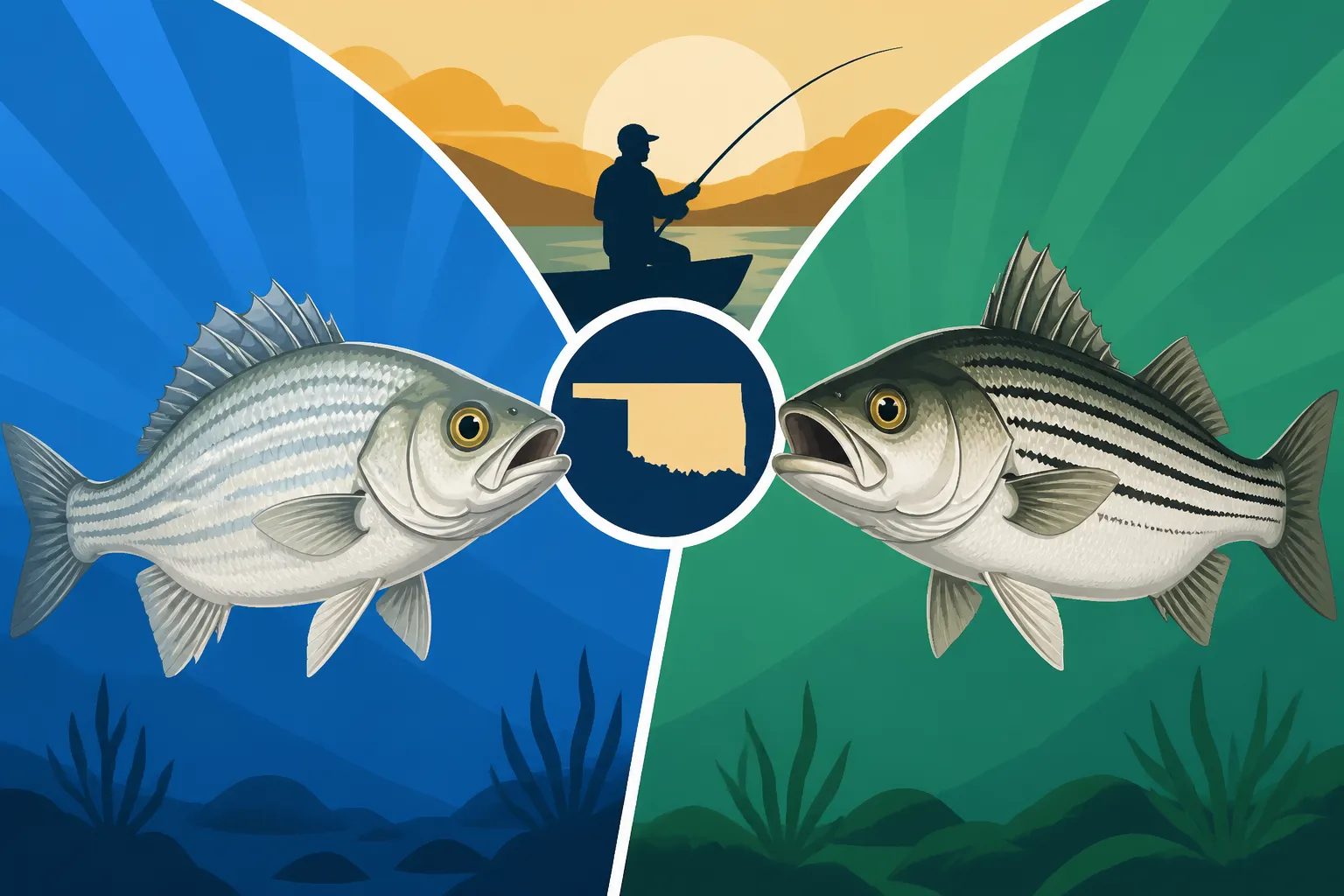
- White Bass: The lateral lines on a white bass are typically fewer (around 5-7), less defined, and crucially, often broken or faded towards the tail, especially the lines above the main lateral line. Imagine drawing a straight line from head to tail; on a white bass, some of those upper lines won't make it.
- Striped Bass: In contrast, a striped bass will have 7-8 distinct, dark, and unbroken lateral lines that run continuously from the gill plate all the way to the tail. These lines are usually very prominent and easy to count.
Even with hybrids, while some lines might be broken, they are generally much darker and more numerous than on a pure white bass. Getting used to spotting these line patterns is probably the single most helpful tip for identification.
Body Shape and Fin Characteristics
Beyond the lines, the overall body shape and fin details offer further clues.
- White Bass: As mentioned, white bass have a more compressed, 'taller' body profile. They tend to be deeper from back to belly. Their dorsal fins (the ones on their back) are clearly separated; the spiny dorsal fin is quite distinct from the soft-rayed dorsal fin. The anal fin (underneath the fish, near the tail) will typically have three spines, with the first spine being noticeably shorter than the second and third.
- Striped Bass: Stripers are built like a football – long, sleek, and cylindrical, designed for power and speed. While they also have two dorsal fins, they are generally closer together or even slightly connected at the base compared to the more distinct separation on a white bass. Their anal fin also has three spines, but they are usually more equal in length, or the second spine is not disproportionately longer than the others.
These anatomical differences are adaptations to their preferred habitats and hunting styles, so once you recognize the patterns, they become quite intuitive.
Mouth and Jaw Structure
Another helpful, though sometimes trickier, detail is the mouth and jaw configuration.
- White Bass: The mouth of a white bass is generally smaller and more proportionate to its head. When you look at its jaw, the upper jaw usually extends slightly beyond the lower jaw, giving it a somewhat "overbite" appearance. This is a subtle characteristic but can be a final confirmation when other features are ambiguous.
- Striped Bass: Striped bass have a much larger, more cavernous mouth, designed to engulf bigger prey. Their lower jaw typically protrudes past the upper jaw, creating a distinct "underbite." This aggressive jawline is another indicator of their powerful predatory nature.
Here’s a quick summary table to help you compare these features side-by-side:
| Feature | White Bass (Sand Bass) | Striped Bass (Striper) |
|---|---|---|
| Body Shape | Deeper, more compressed | Long, sleek, cylindrical, torpedo-shaped |
| Lateral Lines | 5-7 lines, often broken/faded, especially upper ones | 7-8 prominent, dark, unbroken lines to tail |
| Size | Typically 10-15 inches, rarely over 3 lbs | Often 10-20 lbs, can exceed 50 lbs |
| Dorsal Fins | Clearly separated | Closer together, sometimes slightly joined |
| Anal Fin Spines | 3 spines, 2nd & 3rd often much longer than 1st | 3 spines, more uniform in length |
| Jaw | Upper jaw slightly extends past lower jaw | Lower jaw protrudes past upper jaw ("underbite") |
| Teeth | Single tooth patch on tongue | Double tooth patch on tongue |
| Common Habitat | Reservoirs, rivers, creeks; often shallower | Large, open reservoirs, deep channels |
This table should be a handy reference tool when you're trying to quickly identify your catch. Don't forget that hybrid stripers will have a mix of these traits, often with broken but very distinct lines.
Fishing Strategies and Fight Characteristics
Knowing what you've caught isn't just about identification; it also helps you understand the kind of fight you're in for and the best ways to target them in the future. Their differences in size and power naturally lead to different fishing experiences and gear requirements.
Targeting White Bass: Light Tackle Fun
White bass are perfect for light tackle. Their smaller size and aggressive nature make them an absolute blast on ultralight or light spinning gear. When you find a school of white bass actively feeding, it can be non-stop action, often resulting in multiple hook-ups if you're using tandem rigs. Anglers typically target them with small inline spinners, spoons, lipless crankbaits, or small jigs, often tipped with a grub or a piece of plastic. Brands like Rooster Tail or Kastmaster are always a good bet and can be found easily on platforms like Amazon.
Their fight, while spirited, is generally characterized by short, powerful runs and a lot of head shaking. They're often described as "feisty" rather than "bulldogging." The key to success is often finding those active schools, either visually (looking for surfacing fish) or with a good fish finder, then casting into the frenzy. Many anglers cherish white bass for the sheer volume of catches and the consistent action they provide, especially during the spring runs. They're also a fantastic fish to introduce new anglers, especially kids, to the joys of fishing.
Battling Striped Bass: Heavy Gear Required
Tackling striped bass is a whole different ballgame. Given their size and immense power, you'll want to step up your gear considerably. Medium-heavy to heavy conventional or spinning rods paired with robust reels spooled with strong braided line are typically the standard. Stripers are known for their long, powerful runs and incredible stamina, often pulling drag repeatedly. A 20-pound striper can feel like a freight train, and fighting one to the boat requires patience, strength, and a well-tuned drag system.
Popular baits for stripers include live gizzard shad, threadfin shad, or large artificial lures like big swimbaits, Sassy Shads, bucktail jigs, and deep-diving crankbaits. Trolling with large plugs or umbrella rigs is also a highly effective method, especially in vast open waters like Lake Texoma. Finding stripers often means looking for deeper structure, current breaks, or again, visible surface activity. The thrill of landing a large striped bass is an experience every Oklahoma angler should have at least once. When stocking up on heavy-duty gear, remember that Amazon often has a wide selection of specialized rods and reels for battling big fish.
Culinary Considerations: What's for Dinner?
Both white bass and striped bass are excellent table fare, though their taste and texture can differ slightly, often influenced by their diet and the water they inhabit.
- White Bass: Many consider white bass to be quite delicious, especially when caught from clean, cool water. Their flesh is typically white, flaky, and has a mild, somewhat sweet flavor. They are excellent pan-fried, grilled, or baked. Because of their abundant numbers and smaller size, they are a popular choice for fish fries.
- Striped Bass: Striped bass also have white, flaky meat, but it can be richer and firmer than white bass, especially with larger specimens. Some people prefer to remove the darker "bloodline" from the fillets, which can impart a stronger flavor if left in. They are versatile in the kitchen, suitable for baking, grilling, broiling, or even smoking. For a deeper dive into their edibility, you might want to check out Is Striped Bass Good to Eat?. Just like with any fish, freshness is key to a great meal, so make sure to keep your catch on ice. In comparison, if you're ever curious about other popular species, Is White Crappie Good to Eat? discusses another Oklahoma favorite.
Ultimately, both white bass and striped bass offer incredible fishing experiences in Oklahoma. Knowing how to tell them apart not only makes you a more knowledgeable angler but also ensures you're following any specific regulations that might apply to each species in different waters. Happy fishing!
Disclaimer
This article is for general informational purposes only and does not constitute professional advice. Laws, prices and regulations vary by location and change over time. Consult a qualified professional for guidance on your specific situation.