Fishing Techniques for Bank Anglers vs Boat Anglers
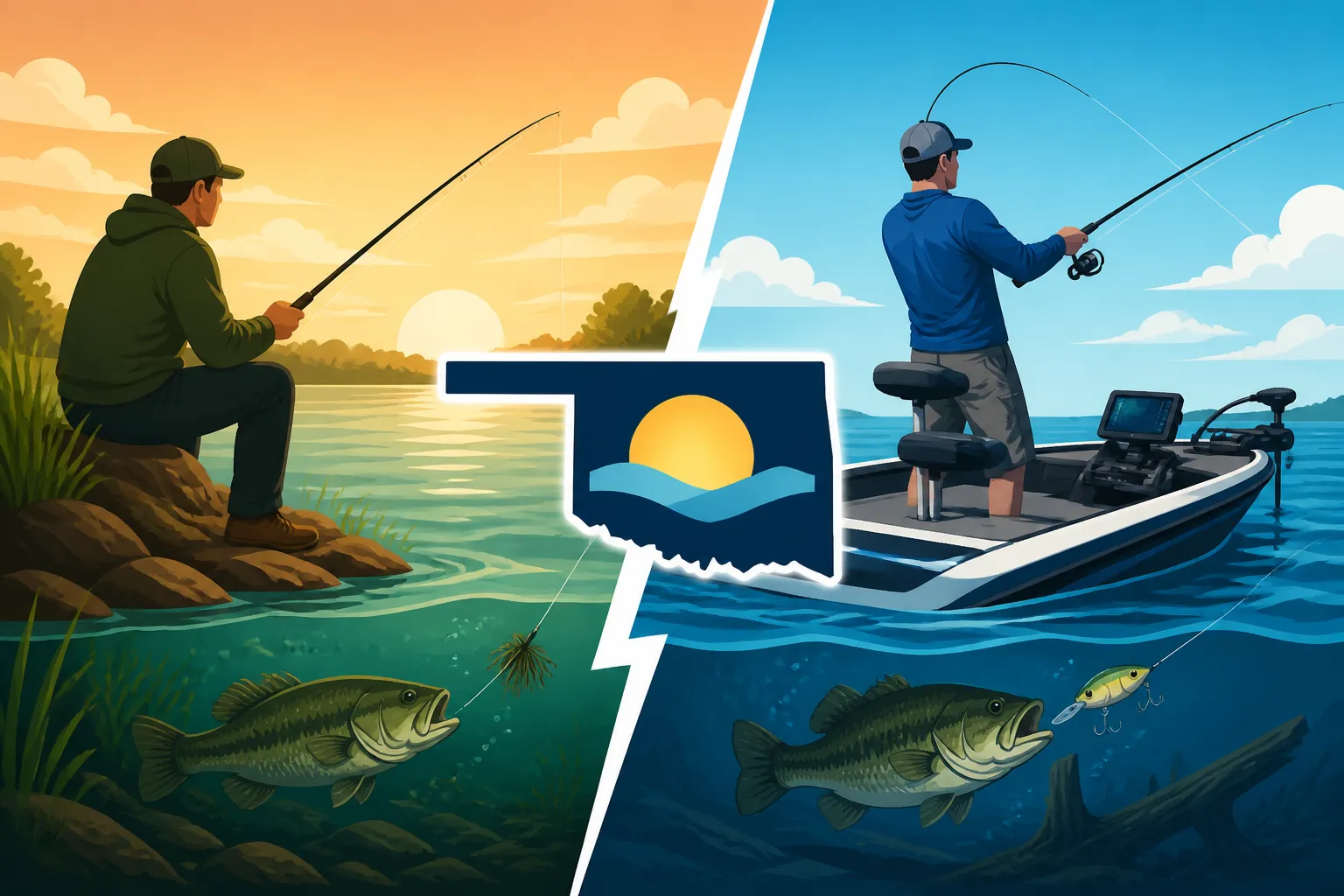
It’s a tale as old as time for many Oklahoma anglers: you pull up to a beautiful lake, ready to cast a line, and the immediate question hits you – should I try my luck from the bank or head out on the water in a boat? This isn't just a matter of convenience; your choice profoundly impacts your approach, the techniques you'll use, and ultimately, your fishing success. This comprehensive guide will meticulously break down the distinct worlds of bank and boat fishing in Oklahoma, helping you understand the nuances of each, and empowering you to make the most of every fishing trip, regardless of your chosen platform.
The Fundamental Differences Between Bank and Boat Fishing
The moment you decide between fishing from the bank or a boat, you're essentially choosing a different set of rules, advantages, and limitations. It's not just about where you stand or float; it's about how you interact with the water and the fish within it. Understanding these core distinctions is the first step toward becoming a more effective angler in Oklahoma's diverse waters.
Accessibility and Mobility
Bank fishing is often about pure accessibility. Picture a spontaneous afternoon: you can grab a rod, a small tackle box, and walk up to a local pond, a creek winding through a state park, or a designated public fishing dock at a reservoir like Lake Hefner. It requires minimal planning, no boat ramps, and certainly no trailer. This ease of access makes it incredibly appealing for quick trips, after-work outings, or when you just need to scratch that fishing itch without a major production. However, your mobility is inherently limited. You're confined to what your legs can carry you to, and if the fish aren't biting in one spot, moving to a new, promising location might involve a long, discouraging walk or even require packing up and driving to an entirely new area.
Boat fishing, conversely, offers unparalleled mobility once you're on the water. Imagine the freedom of covering miles in minutes on a vast body like Lake Texoma, exploring different coves, points, and humps that are utterly unreachable from shore. This ability to rapidly change locations allows you to chase schooling fish, adapt to shifting weather patterns, and escape crowded areas with ease. The trade-off, of course, is the significant logistical hurdle of launching and retrieving a boat, which involves a specific vehicle, a trailer, navigating busy boat ramps, and the considerable financial investment in the vessel itself. It's a commitment that pays off in freedom on the water, but demands preparation on land.
Consider a busy weekend at Lake Eufaula, Oklahoma’s gentle giant. A bank angler might find a quiet spot near a campground or public access point, casting diligently for bass or crappie. But if the fish aren't cooperating there, their options are limited to other accessible shoreline areas, often meaning they're fishing the same general depth and structure. A boat angler, however, can swiftly navigate across the lake, checking out multiple promising locations like submerged creek channels, offshore brush piles, or main lake points, drastically increasing their chances of finding active fish by sampling different environments and depths. The ease of getting started versus the expansive freedom once you are afloat is a huge, defining factor in deciding your approach.
Reach and Coverage
When you're bank fishing, your reach is largely determined by how far and accurately you can cast. This means you are primarily targeting fish that are within casting distance of the shore, or those that naturally move into shallow water. This isn't inherently a disadvantage, as many species, especially during key seasons like the spring spawn or during feeding times, will congregate near the banks. However, it unequivocally means that deep water structure, offshore humps, vast open-water expanses, and distant submerged cover are entirely out of bounds. You're essentially fishing a linear, limited slice of the available water, relying on fish to come to your zone.
Boat anglers, by contrast, possess the capability to reach virtually any part of a lake or river, provided it's navigable by their craft. This opens up opportunities to target fish holding in deep water, suspended over open water, or tucked away in submerged timber far from the bank. They can effectively fish entire bodies of water, from the shallowest, most protected coves to the deepest main lake channels. This expansive coverage allows for a much wider range of fishing opportunities and strategies, especially for species like suspended crappie that might be holding 20 feet deep over a brush pile, or enormous blue catfish that prefer the swift currents of a river channel far from shore.
Imagine trying to consistently catch schooling striped bass at Lake Texoma, a species known for its open-water pursuits. From the bank, you might luck into a few if they cruise close to shore, particularly during a surface feeding frenzy or a seasonal run into a tributary. But to reliably find and catch the large schools of striper that often hold in the deep, open water or around the vast river channel, you absolutely need a boat. It enables you to cover miles, troll with multiple lines, or chase boils, employing techniques that are simply impossible to execute effectively from the limited vantage point of the shore.
Gear and Storage Constraints
Bank fishing typically involves a more minimalist gear setup, driven by the practical necessity of portability. You’re limited by what you can comfortably carry from your vehicle to your chosen spot, sometimes over rough terrain. This often translates to one or two versatile rods, a compact tackle box or a small backpack, and perhaps a personal cooler. This inherent portability is a huge advantage for quick trips, when hiking to secluded spots, or just minimizing clutter. However, it also means you’ll often have to make tough choices about which lures, baits, and tools to leave behind, potentially limiting your adaptability if the fish aren’t responding to your chosen presentation on a particular day. You can only bring so much.
Boat fishing, on the other hand, allows for an almost unlimited amount of gear, transforming your vessel into a mobile tackle shop. You can bring multiple rods rigged for different techniques, several large tackle boxes, substantial coolers, well-aerated livewells for bait or catch, a plethora of anchors, and a whole host of electronic equipment like advanced fish finders and GPS units. This means you’re prepared for almost any scenario and can quickly switch tactics, bait, or even target species without needing to return to shore. The downside, of course, is the sheer volume of gear requires dedicated storage, meticulous organization, and regular maintenance, both for the gear itself and the boat that carries it all. Furthermore, the boat itself becomes a significant piece of gear, demanding its own set of accessories, upkeep, and safety considerations.
For instance, a bank angler going after crappie might bring a single lightweight spinning rod, a small selection of 1/16 oz jigs, and a portable minnow bucket. They’re ready for a casual afternoon and can easily pack out. A boat angler targeting crappie on the same lake might have a dedicated crappie boat equipped with several rods rigged for spider rigging, a dedicated side-imaging graph, a large cooler full of minnows and ice, and a dozen different jig colors and styles. This comprehensive setup allows them to precisely target suspended fish at various depths, cover wide areas, and adapt to whatever the crappie prefer on that particular day, offering a level of versatility that’s simply not feasible from shore.
Essential Techniques for the Dedicated Bank Angler
Don't let the limitations of bank fishing deter you; it's an art form in itself, demanding a keen eye, precise casting, and a deep understanding of fish behavior in accessible waters. Many trophy fish are caught from shore every year in Oklahoma.
Mastering the Art of Casting and Retrieval from Shore
When you're stuck on the bank, your casting accuracy and distance become absolutely paramount. You often need to get your bait out to subtle structure like submerged timber, specific rock piles, or the edge of a distant weed line that are just beyond the immediate shoreline. Learning various casting techniques – from basic overhead casts to more advanced sidearm and skip casts – allows you to present your bait precisely where the fish are most likely to be hiding or feeding. It's not just about distance; it's about putting the bait exactly where you want it without spooking fish or getting snagged. Mastering a quiet, accurate pitch or roll cast can be a game-changer in tight spots.
Many bank anglers overlook the importance of fanning casts, especially when blind casting into unfamiliar territory. Instead of repeatedly casting to the same spot straight out, try methodically fanning your casts in a wide arc, covering as much water as possible in front of you. Start by casting straight out, then gradually move your casts to the left by a few degrees, retrieving, and then moving further left. Repeat this process, then return to the center and work your way to the right. This methodical, grid-like approach helps you thoroughly search the area and increases your chances of encountering active fish that might be cruising a wider zone.
Understanding how to control your retrieve speed and depth is also critical, particularly when you often have a more limited water column to work with compared to fishing from a boat. If you’re targeting fish near the bottom, a slow, deliberate retrieve with pauses might be best. For fish higher in the water column, a faster, more erratic retrieve can trigger strikes. For species like bass, working parallel to the bank can be incredibly effective. Cast your lure so it runs parallel to a log, a rock wall, or a weed edge, keeping it in the strike zone for a longer duration. This is often more productive than casting straight out and retrieving, as many predatory fish patrol these edges looking for unsuspecting prey. Think about how many times you’ve seen a big bass cruising right along the riprap or a fallen tree; presenting your bait along that same path is key.
Reading the Water and Identifying Shoreline Structure
Since you can't rely on expensive electronics from the bank, your eyes become your most valuable and sophisticated tool. You must learn to "read" the water, observing every subtle clue the environment offers. Look for changes in water color, which might indicate depth changes, incoming creeks, or areas of disturbed sediment. Scan for disturbances on the surface, such as ripples from feeding fish, the darting movements of schooling baitfish, or even the subtle V-wake of a cruising predator. Pay close attention to prominent points, sheltered coves, fallen trees, visible brush piles, and rock outcroppings along the bank – these are all prime areas where fish will congregate, seeking cover, ambush points, or food.
Understanding the bottom composition can also give you a significant edge, even if you can't see it directly. A sandy or muddy bottom might hold different types of fish and forage than a rocky or gravelly area. While you can't see the bottom in deep water, observing the geology of the visible shoreline often provides strong clues about what lies beneath the surface. If you see large boulders on the bank, there's a good chance similar rock structure extends into the water. If the bank is gradually sloping and muddy, expect more of the same underwater. Additionally, pay attention to the vegetation; emergent weeds near the shore usually indicate shallow, soft bottom, while areas with no weeds might suggest deeper, harder bottom.
Even seemingly mundane features can be overlooked fish magnets. Overhanging trees not only provide crucial shade, especially on hot summer days, but also drop insects and small creatures into the water, attracting baitfish and hungry predators. Docks and piers offer invaluable cover, shade, and ambush points for a variety of species. Any irregularity in the shoreline, like a small cut or a deeper pocket, can create a current break or an ideal holding spot. Learning to spot these subtle cues and interpret them in relation to fish behavior is a skill that develops with experience and can significantly improve your success as a bank angler, often outperforming someone who just casts blindly.
Targeting Shallow Water and Transition Zones
Many anglers, particularly those new to bank fishing, make the mistake of thinking all the biggest fish are offshore. In reality, shallow water, especially in transition zones where shallow water meets deeper water or where different types of cover converge, can be incredibly productive for bank anglers. Fish frequently use these areas for feeding, spawning, and seeking refuge from predators or harsh sunlight. Think about the very edge of a distinct weed bed, a sudden drop-off near the shore, or where a rocky point tapers into a muddy flat – these are all prime locations for finding fish within casting distance.
During the critical spring season, species like crappie and bass actively move into shallow coves and along protected banks to spawn. This is a prime time for bank anglers, as these fish are highly accessible and often concentrated. Using baits that imitate their natural prey, such as small jigs for crappie or soft plastic worms and creature baits for bass, can be incredibly effective when presented slowly and deliberately in these areas. As the seasons change and waters warm or cool, fish might move deeper, but they still often use these shallow areas for quick feeding forays, especially during low light periods like dawn and dusk when they feel safer. For more insights into seasonal patterns, checking out our guide on Oklahoma Fishing Seasons: A Month-by-Month Guide can be extremely beneficial.
Even in the colder months, some species, particularly channel catfish and sometimes blue catfish, will cruise shallow flats or congregate in deeper holes adjacent to accessible banks, especially if there's a warmer inflow. Don't be afraid to experiment with different depths and retrieves in these transition zones. A slow retrieve along the bottom with a jig or a piece of cut bait might entice a sluggish winter catfish, while a quicker presentation higher in the water column could attract a passing white bass. Remember that Oklahoma's various fish species often behave differently based on temperature and season, so being versatile with your presentations and understanding these key transition areas is crucial for maximizing your chances as a bank angler.
Strategies for Effective Boat Fishing on Oklahoma's Vast Waters
For the angler who seeks to explore, adapt, and maximize their time on the water, a boat unlocks a world of possibilities that land-locked anglers can only dream of. It’s about leveraging technology and mobility to actively pursue fish.
Covering Large Areas and Locating Offshore Structure
The primary and most compelling advantage of boat fishing is the sheer ability to cover vast expanses of water and access areas utterly unreachable from shore. This means you can actively search for fish rather than passively waiting for them to come to you. Trolling is a fantastic technique for covering water, especially for pelagic species like striped bass on Lake Texoma or walleye on Canton Lake. By systematically dragging multiple lures behind your boat at varying speeds and depths, you can intercept actively feeding fish or quickly locate schools, effectively mapping out their preferred depths and travel routes. This expansive search capability dramatically increases your odds on large bodies of water.
Identifying and effectively fishing offshore structure is critical for consistent success as a boat angler. This includes hidden features like submerged humps, deep ledges, old creek channels, forgotten roadbeds, and meticulously placed brush piles that are often completely invisible from the surface. These structures act as highways, ambush points, and homes for fish, providing essential cover, temperature breaks, and congregating areas for both predators and prey. Learning to accurately interpret your sonar and mapping units to pinpoint these subtle features – distinguishing between a rock pile and a brush pile, or finding the hard bottom edge of a creek channel – is a game-changer for consistent success, allowing you to target fish where they actually live.
Don't be afraid to travel, particularly on Oklahoma's larger reservoirs. If one area isn't producing after a thorough work-up, pick up and move to another. Lakes like Lake Eufaula or Grand Lake O' the Cherokees offer hundreds of square miles of water and endless possibilities, and sitting in one unproductive spot wastes precious fishing time. Having a pre-planned milk run that includes several potential spots based on current conditions – wind direction, water temperature, time of day, and recent fishing reports – will greatly improve your chances. Using your boat to quickly and efficiently move between these spots allows for rapid exploration, adapting to changing conditions, and the discovery of active fish, making every minute on the water count.
Precision Positioning and Presentation
A boat, especially when equipped with modern aids, allows for incredible precision in bait presentation that is simply impossible from the bank. You can position your boat directly over a submerged brush pile that your sonar just revealed, precisely along a deep contour line, or right in front of a schooling baitfish ball. This allows you to execute precise vertical drops, accurate pitches to specific targets, or controlled drifts that keep your bait in the strike zone for extended periods. This level of meticulous control over your boat and bait placement is a significant advantage when fish are relating tightly to structure, holding in deep, isolated spots, or are finicky about presentation.
Spot-Lock technology on modern GPS-enabled trolling motors (like those from Minn Kota or Lowrance, which are readily available on Amazon) has truly revolutionized this aspect of boat fishing. You can motor to a precise spot, hit a button, and your boat will automatically hold its position, even against wind or current, freeing you from constant manual steering. This hands-free precision allows you to relentlessly pick apart a productive spot, making repeated accurate casts or vertical presentations over a small target area without drifting away. It frees you up to focus entirely on the subtleties of your presentation and detecting bites, greatly enhancing your effectiveness.
Whether you're carefully drop-shotting for suspended bass over a deep rock pile, vertically jigging for crappie over a brush pile you've identified, or hover-strolling for enormous blue catfish on a flat, the ability to precisely place and maintain your bait exactly where the fish are holding is a tremendous asset. It's not just about getting to the spot; it's about holding your position, presenting your lure or bait in the most enticing way possible, and repeating that presentation accurately. This precision minimizes unproductive casts and maximizes your chances of a strike, turning potential into tangible results.
Utilizing Electronics to Find Fish
Modern fish finders and advanced sonar units are no longer luxuries; they are indispensable tools that act as your underwater eyes for boat anglers. They allow you to "see" underwater, revealing not only individual fish but also the critical structure and cover they relate to. Side imaging and down imaging sonar provide incredibly detailed, photo-like views of the bottom and water column, clearly showing brush piles, rock formations, subtle creek channels, and even individual fish and bait schools. Integrated GPS mapping capabilities, often pre-loaded with detailed lake contours, guide you to productive spots, help you navigate safely, and allow you to mark waypoints for future reference, building a library of proven locations.
Learning to accurately interpret your electronics takes time, patience, and practice, but it's an investment that pays huge dividends in fishing success. Look for baitfish schools, which often appear as clouds or dense balls on your screen, as game fish are usually not far behind. Identify distinct "arches" or solid marks that indicate individual fish, especially if they are suspended near structure or predators like a lone striper. Understanding the difference between a school of white bass actively feeding and a deep-holding group of crappie relating to cover is key to selecting the right technique and maximizing your time.
Temperature gauges, often built directly into fish finders, provide crucial information that many anglers overlook, especially during seasonal transitions. Fish are highly sensitive to water temperature, and knowing where the optimal temperature zones are can help you locate active fish. For example, understanding how water temperature affects bass spawning in Oklahoma is a vital piece of information for springtime success, guiding you to the right coves and depths. Don't just use your electronics to find fish; use them to thoroughly understand the entire underwater environment – the contours, the cover, the bait, and the conditions – to predict fish behavior and position yourself for optimal success.
Gear Considerations: What Works Best Where
The choice of fishing platform – bank or boat – profoundly dictates the type of gear you'll need. What’s ideal for a quick shoreline excursion might be wholly inadequate for an all-day offshore expedition.
Rods, Reels, and Line for Bank Fishing
For bank fishing, versatility, portability, and durability are paramount. A medium-action spinning rod, typically 6'6" to 7' in length, paired with a reliable spinning reel (size 2500-3000), is an excellent all-around choice for a wide range of Oklahoma species. This setup allows for good casting distance, handles a variety of lure sizes (from small jigs to modest crankbaits), and has enough backbone to fight most common freshwater species you'll encounter from shore, such as bass, crappie, and channel catfish. Monofilament or fluorocarbon lines in 8-12 lb test are generally sufficient for most applications, offering a good balance of strength, castability, and abrasion resistance.
If you're targeting smaller panfish like bluegill or smaller crappie, a lighter, more sensitive ultra-light spinning combo with 4-6 lb test line can be incredibly fun and effective. It allows for delicate presentations of tiny jigs and live bait (like worms or crickets), making even small fish feel like a prize. For heavier duty bank fishing, perhaps for large flathead or blue catfish in a river, a sturdy medium-heavy catfishing rod (often 7-9 feet) with a robust baitcasting or conventional reel and heavy braided line (30-50 lb or more) would be more appropriate. This beefier setup allows you to cast heavy weights, absorb powerful runs, and pull in substantial fish from challenging spots without fear of breaking your gear.
Given the potential for snags from the bank, especially around fallen timber, submerged brush, or rocky areas, having a reel with a smooth, reliable drag system is crucial. When you're locked in place on the bank, you need your drag to absorb the shock of a sudden run from a big fish, preventing line breaks. You might also consider bringing a longer-handled landing net if you're targeting larger fish, as getting them up a steep or muddy bank can be a significant challenge. A good tackle backpack, like those widely available on Amazon, can keep your limited gear organized, protected, and easy to carry, allowing you to move from spot to spot with minimal fuss.
Specialized Equipment for Boat Anglers
Boat anglers truly have the luxury of carrying highly specialized gear tailored for virtually any technique or species. For serious bass fishing, you might have a dozen rods: a heavy power baitcasting rod for flipping jigs into dense cover, a medium-heavy rod for accurately throwing crankbaits, a dedicated deep-diving crankbait rod, and several spinning rods for finesse presentations like drop-shotting or shaky head worms. Each rod is specifically designed and ideally suited for a particular task, maximizing your efficiency and effectiveness for different situations. For open-water striped bass, a stout trolling rod with a conventional reel and heavy braided line is a common and necessary setup.
Beyond rods and reels, boat anglers frequently utilize a vast array of specialized equipment that greatly enhances their capabilities. GPS-enabled trolling motors with Spot-Lock are almost standard for bass and crappie anglers, providing hands-free boat control and precise positioning. Shallow water anchors like Power-Poles or Talons provide silent, instant anchoring in depths up to 10-12 feet, perfect for pitching to shoreline targets or holding steady over a brush pile. High-end fish finders with detailed mapping, side imaging, and live sonar views are absolutely crucial for locating fish and structure on Oklahoma's larger, complex lakes.
Don't forget the practical and safety aspects of boat gear either. A good, large cooler for drinks and food, a well-aerated livewell (essential for tournaments or keeping bait healthy), multiple marine batteries, a reliable battery charger, and mandatory safety equipment like Coast Guard-approved life jackets (for all passengers, especially kids 12 and under who must wear them), a fire extinguisher, a throw cushion (Type IV throwable device for boats 16 feet and longer), and sounding devices are all critical. Investing in quality boat electronics and accessories can significantly enhance your fishing experience and success, turning your boat into a highly effective, comfortable fishing machine.
Tackle and Bait Selection Differences
The choice of tackle and bait also undergoes a significant shift when comparing bank and boat fishing, driven by the differing access and presentation capabilities. Bank anglers often favor baits that are easy to cast a good distance, relatively snag-resistant, and durable enough to withstand repeated casts and potential encounters with shoreline snags. Topwater lures, spinnerbaits, soft plastic worms (Texas-rigged for weedless presentation), and small crankbaits are perennial favorites for bass from shore. For catfish, readily available and easy-to-use options like stink baits, prepared punch baits, simple cut bait, or good old nightcrawlers are classic choices that don't require constant manipulation. Live bait, like minnows under a slip bobber, is also a bank fishing staple for crappie and panfish.
Boat anglers, thanks to their mobility and technological aids, have a much broader and often more specialized palette of tackle to choose from. They can effectively employ heavier jigging spoons in deep water, large umbrella rigs for trolling stripers across vast flats, or delicate drop-shot rigs to precisely target suspended fish marked on their sonar. The ability to carry a wide array of options means they can adapt to what the fish are biting on any given day, quickly switching from deep-diving crankbaits to finesse jigs. Furthermore, well-designed live bait wells allow boat anglers to carry a larger quantity and diversity of live baits, such as shiners, gizzard shad, or large bluegills, which can be irresistible to trophy fish of various species.
The presentation itself also varies significantly. A bank angler might use a simple slip-sinker rig to bottom fish for catfish, allowing the bait to sit passively on the lakebed. A boat angler might use a similar rig, but precisely drop it onto a subtle depth change or a submerged log identified on their fish finder, ensuring the bait is in the prime strike zone. For crappie, a bank angler might use a small jig under a fixed bobber near shore, while a boat angler might spider rig multiple rods with different colored jigs and minnows, slowly trolling them at various depths across an open flat to find the active fish. Exploring different options for your target species is always recommended, and you can find a huge variety of tackle and bait on sites like Amazon, catering to both bank and boat setups.
Common Fish Species: How to Target Them from Bank vs. Boat
Oklahoma boasts an incredible variety of fish species, and how you approach each one changes depending on whether you're standing on solid ground or floating on the water.
Bass Largemouth, Smallmouth, Spotted
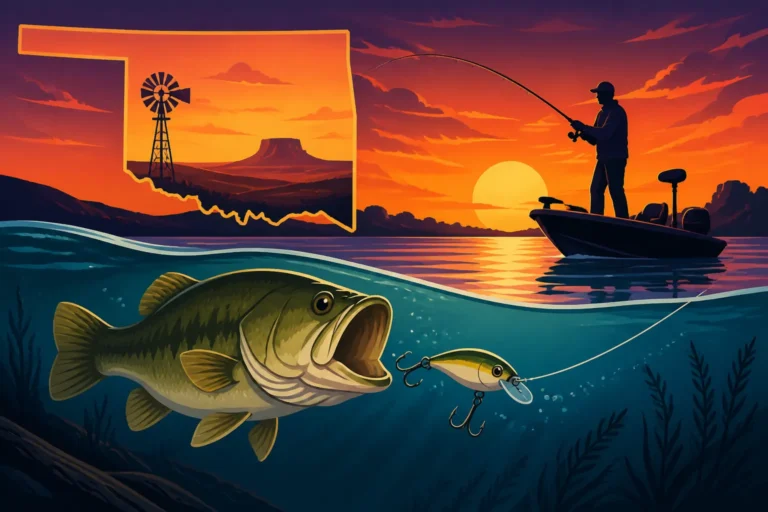
Bank Fishing for Bass: From the bank, you're primarily targeting bass that cruise shallow water, relate tightly to shoreline cover, or are in spawning areas during the spring. Focus your efforts on casting parallel to the bank, thoroughly working visible structure like docks, fallen trees, brush piles, and distinct weed lines. Topwater lures like poppers, walking baits, or buzzing frogs are fantastic during low light conditions (dawn/dusk) near shore, as they draw explosive strikes. Soft plastics, particularly Texas-rigged worms or weightless Senkos, are excellent for working slower and probing cover with a weedless presentation, minimizing snags. Spinnerbaits and squarebill crankbaits allow you to cover water efficiently in shallow areas, often triggering reaction strikes. Early morning and late evening are prime times for bank bass, as they move shallower to feed.
Boat Fishing for Bass: The world truly opens up for boat anglers targeting bass. You can systematically target bass on offshore humps, deep ledges, submerged roadbeds, vast timber fields, and main lake points that are impossible to reach from shore. Use your electronics to find schools of baitfish and the associated bass. Deep-diving crankbaits, heavy football jigs, and large jigging spoons excel in deeper water presentations. Finesse techniques like drop-shotting or shaky head worms become incredibly deadly when bass are pressured, suspended, or holding tight to subtle deep structure. During the critical spring spawn, you can quickly move between shallow coves, pitching to visible beds or flipping jigs into dense shoreline cover, covering far more potential spawning grounds. It's crucial to remember that Oklahoma's Bass Fishing Rules and Limits apply to all anglers, regardless of whether you're fishing from the bank or a boat, so always know the length and creel limits.
Crappie Black and White
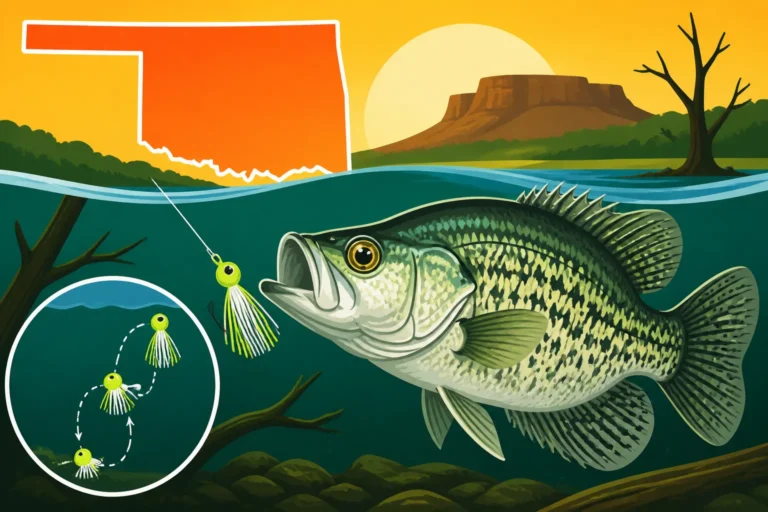
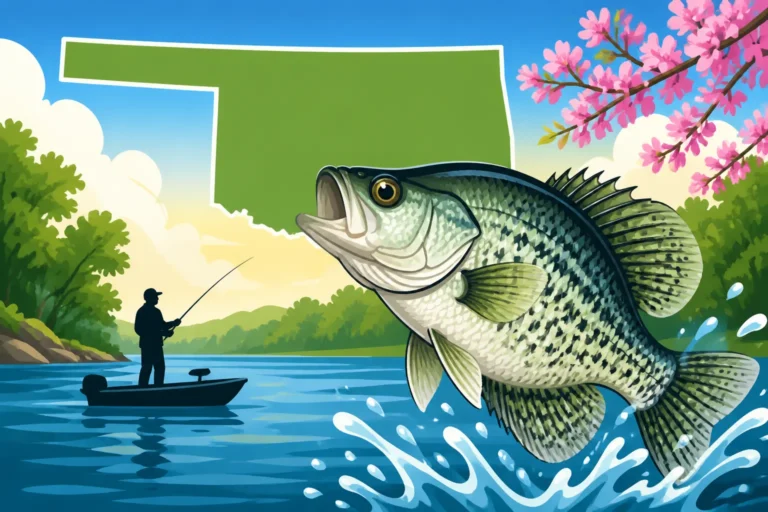
Bank Fishing for Crappie: Bank anglers typically find crappie in shallower water, especially during the spring spawn when they move into accessible areas. Look for brush piles, submerged trees, docks, and bridge pilings that are within casting distance of the shore. Small jigs (1/16 to 1/8 ounce) tipped with a live minnow or a small soft plastic grub under a bobber are highly effective and easy to present. Cast parallel to cover or slowly retrieve jigs through likely holding areas, paying attention to subtle bites. Night fishing under lights from a dock or pier can also be incredibly productive for crappie, as they are drawn to the light source which attracts baitfish. Patience and a slow retrieve are key for success from shore.
Boat Fishing for Crappie: Boat anglers have a distinct advantage, being able to locate and fish crappie in a much wider range of depths and over expansive areas. Spider rigging (running multiple long rods from the front of the boat, each with a jig or minnow rig) is a popular and highly effective technique for slowly trolling over flats, creek channels, or brush fields, allowing you to present baits at various depths simultaneously. Vertical jigging directly over deep brush piles or submerged timber, precisely located with electronics, is also highly effective. During summer, crappie often suspend in open water, relating to thermoclines or baitfish schools, which can only be effectively reached and targeted from a boat. Be sure to be aware of Crappie Fishing Rules and Limits in Oklahoma, especially the stricter limits that apply at specific lakes like Tenkiller, Fort Gibson, or Hudson. Many of the Best Crappie Lakes in Oklahoma are best fished from a boat.
Catfish Channel, Blue, Flathead
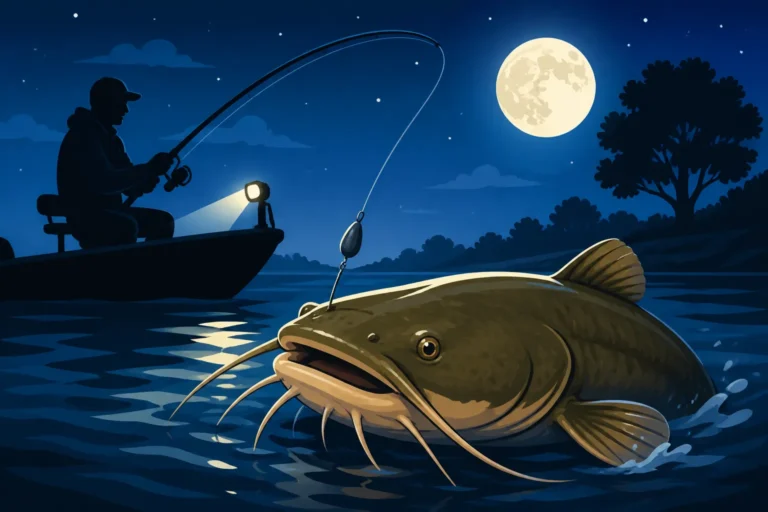
Bank Fishing for Catfish: Catfish are perhaps the most accessible and consistently caught species for bank anglers in Oklahoma. They cruise shallow flats, deep river bends, and deep holes near accessible shores. Bottom fishing with a reliable slip-sinker rig is the tried-and-true technique. Bait choices are incredibly varied and often depend on the species and conditions: strong-smelling punch baits, prepared stink baits, fresh cut bait (shad or sunfish work wonders), chicken livers, and good old worms are all effective. Cast your bait out into a promising area, let it settle on the bottom, and wait patiently. Night fishing for catfish from the bank is a popular and often highly successful endeavor, as they are primarily nocturnal feeders.
Boat Fishing for Catfish: Boat anglers can effectively target the biggest blue and flathead catfish in deep river channels, along dam structures, and over expansive flats. Drifting with fresh cut bait (gizzard shad is king for trophy blues) or large live bait (for flatheads) over these areas is incredibly effective, allowing you to cover vast stretches of water. Jug lining and trotlining are popular boat-based methods for setting out multiple baited hooks to cover a large area, although these methods require specific regulations to be followed. Utilizing your electronics to find schools of baitfish, deep holes, current breaks, and structural irregularities will lead you directly to the biggest trophy catfish. Remember that Oklahoma's Catfish Fishing Rules and Limits include specific regulations, such as the one blue catfish over 30 inches rule, which every angler must know.
Navigating Oklahoma's Unique Fishing Environments
Oklahoma's diverse landscape means a variety of fishing environments, each with its own quirks and best practices for both bank and boat anglers.
Reservoir and Lake Approaches
Oklahoma is dotted with numerous large reservoirs like Lake Texoma, Grand Lake O' the Cherokees, and Lake Eufaula, each offering unique and diverse fishing opportunities. For bank anglers, these lakes often provide designated fishing piers, public bank access points near recreation areas, and extensive shorelines around bridges, causeways, or riprap. Focus your efforts on these accessible spots, paying particular attention to points that extend into the lake or areas with visible cover like docks or fallen trees. Always be mindful of boat traffic, especially in high-use areas, and consider quieter spots for a more peaceful experience. For a list of great starting points, check out Best Places to Fish in Oklahoma.
Boat anglers on these vast reservoirs have the entire lake at their disposal. This means exploring vast open waters, navigating through submerged timber fields, and finding subtle humps or deep ledges that consistently hold fish. The sheer scale of these lakes means you'll rely heavily on GPS for accurate navigation and sophisticated sonar for finding fish and structure. Understanding how wind and current affect these large bodies of water is crucial, as they dictate where baitfish and game fish will position themselves. On a lake like Grand Lake O' the Cherokees, knowing how to approach its diverse structure, from shallow coves to deep main lake channels, is absolutely key to success. A Grand Lake O' the Cherokees Bass Fishing Guide will provide excellent insights for boat anglers.
For example, targeting white bass during their frenzied spring run is a prime scenario where the distinction between bank and boat fishing is clear. Bank anglers can intercept them in tributary streams or along windy banks where baitfish are pushed. Boat anglers, however, can follow the schooling white bass throughout the lake, using their electronics to find them in open water and then casting into the feeding frenzy, often catching dozens in a short period. The ability to chase these schools down across miles of water is a distinct boat advantage.
River and Stream Strategies
Rivers and streams present a unique challenge and opportunity for both bank and boat anglers in Oklahoma, defined by the constant flow of water. For bank anglers, focus on accessible stretches with visible current breaks, such as eddies behind large boulders or log jams, undercut banks, or deeper pools below riffles. Smallmouth bass, channel catfish, and various panfish are common river catches. Learning to present your bait in the current so it drifts naturally, or slightly behind a current break, is critical. Fly fishing can also be incredibly effective for trout in Oklahoma's designated trout streams during stocking seasons.
Boat fishing in rivers and smaller streams often means utilizing specialized craft like kayaks, canoes, or shallow-draft jon boats to navigate shallower waters and reach secluded spots. The ability to motor upstream and then slowly drift back down, or to hold your position precisely in current with a powerful trolling motor, gives you a significant advantage. Focus on deep river bends, confluence points where tributaries join the main river, and major current breaks. These are prime areas where fish hold to ambush prey. Always be aware of submerged hazards, strong currents, and any specific Black Bass Rules for Oklahoma Rivers and Streams that dictate length or creel limits.
Whether you're fishing from the bank or a boat, understanding the flow of the water is paramount in rivers. Fish will position themselves to expend minimal energy while having easy access to food washing by. Look for those "sweet spots" where the current slows down, creating an eddy, or where fish can easily ambush unsuspecting prey. Presenting your bait in a natural drift, rather than fighting the current, will almost always be more productive. A quiet approach is also vital, as fish in rivers can be easily spooked by sudden movements or loud noises.
Pond and Farm Pond Tactics
Ponds and farm ponds are truly a bank angler's paradise in Oklahoma. They are often highly accessible, hold good numbers of bass, crappie, channel catfish, and panfish, and require minimal gear. For bank anglers, focus on fishing all available structure: the dam face, distinct weed edges, fallen trees, brush piles, and any deeper areas near the center. These smaller bodies of water are also ideal for teaching beginners, as fish are often more concentrated and less pressured. It's especially welcoming for young anglers, as in Oklahoma, children under 16 generally don't need a license to fish, making it perfect for a family outing. For more details on this, check out Do Kids Need a Fishing License in Oklahoma?.
While less common, boat fishing in ponds can be done effectively with small jon boats, kayaks, float tubes, or even belly boats. This allows you to reach the middle of the pond, target dense weed beds that are out of casting range from shore, or explore the opposite bank if access is limited. The main advantage here is stealth; you can move quietly and position yourself for precise casts to specific targets without spooking the fish from shore. However, the smaller size of ponds often limits the need for extensive boating, making them predominantly bank-friendly and a great place to hone your casting skills. A good, portable Kayak Fishing Gear Guide for Oklahoma Lakes could be adapted for pond use.
Ponds are usually less pressured than large public lakes, making them a great option for a relaxing day of fishing and often offering consistent action. The biggest challenge for ponds on private property is simply gaining permission; always ask before you cast! Once you have permission, approach quietly, observe any visible signs of fish activity (like rises or schooling baitfish), and work the available cover. Ponds are often a fantastic place to simply enjoy the outdoors and catch a variety of fish without the complexities of larger water bodies.
The Pros and Cons: Making the Choice for Your Trip
Deciding between bank and boat fishing often comes down to a balance of convenience, cost, and your personal fishing goals. Each has its distinct advantages and disadvantages that can make or break your trip.
Advantages and Disadvantages of Bank Fishing
Advantages: Bank fishing is undeniably accessible and often the most affordable way to enjoy fishing in Oklahoma (beyond your necessary fishing license, of course). It requires minimal investment in gear – a rod, reel, line, and a small assortment of tackle are often all you need – making it a fantastic entry point for beginners or a low-stress option for experienced anglers looking for a quick outing. You completely bypass the hassles of boat ramps, trailers, and the ongoing costs and maintenance associated with boat ownership. It's often a more peaceful and contemplative experience, allowing you to connect directly with the natural environment without the distractions of engines or electronics. It's also incredibly easy to include the whole family for a casual, no-pressure day out by the water.
Disadvantages: The most significant drawback is your severely limited mobility, restricting your access to offshore structure, deep water, and expansive areas of the lake. Your reach is confined to casting distance, meaning many prime fishing spots, especially those holding larger, less pressured fish, are simply out of bounds. You're more susceptible to fishing pressure from other anglers in popular bank access areas, which can make fishing tougher. If the fish aren't biting where you're at, moving to a new, promising spot can be a significant and time-consuming undertaking, potentially cutting your trip short. Weather can also be more of a factor, as you have less shelter from sun, wind, or rain compared to a boat.
Ultimately, bank fishing excels in convenience, cost-effectiveness, and simplicity. It's perfect for those spontaneous trips to a local pond, an accessible creek, or a designated fishing pier at an Oklahoma state park. However, if your goal is to consistently target trophy fish in vast waters, explore diverse ecosystems, or adapt rapidly to changing conditions, its inherent limitations quickly become apparent. It’s a wonderful way to fish, but it requires accepting its specific boundaries.
Advantages and Disadvantages of Boat Fishing
Advantages: The mobility and reach offered by a boat are unparalleled, providing the ultimate freedom on the water. You can access virtually any part of a lake or river, cover vast amounts of water quickly, and target offshore structure that holds fish. With modern electronics, you can actively hunt for fish, dramatically increasing your chances of success, especially for elusive species or those holding deep. The ability to carry extensive, specialized gear means you're prepared for almost any scenario and can switch tactics at a moment's notice. Boat fishing often leads to more consistent catches of larger, less pressured fish, and offers opportunities for specific techniques like trolling or deep vertical jigging.
Disadvantages: The most significant disadvantage is undoubtedly the cost – purchasing a boat, motor, trailer, and all the associated safety and fishing equipment is a substantial initial investment. There are also ongoing costs for fuel, maintenance, storage, insurance, and the annual registration and titling. For example, understanding Oklahoma Boat Registration and Titling Rules Explained is just one of many financial and legal obligations. Launching and retrieving a boat can be a hassle, especially on busy weekends or at crowded ramps, requiring skill and patience. Boat ownership also comes with responsibilities like knowing Oklahoma Life Jacket and PFD Rules for Boaters and general navigation rules, adding to the complexity.
For serious anglers looking to maximize their time on the water, explore every nook and cranny, and consistently put themselves on fish, a boat is an invaluable tool. It transforms fishing from a passive activity to an active pursuit of discovery and challenge. However, the commitment of time, money, and effort required to own and maintain a boat is not to be underestimated. It’s a lifestyle choice as much as a fishing preference.
Hybrid Approaches and When to Consider Both
Sometimes, the best solution isn't strictly one or the other, but a smart, flexible combination of both approaches. Many experienced anglers who primarily fish from a boat still cherish the simplicity and quietude of a bank fishing trip to a local pond or stream. It offers a chance to slow down, use lighter tackle, and simply enjoy the immediate surroundings. Conversely, dedicated bank anglers might occasionally rent a boat for a day, hire a professional guide, or join a friend with a boat to experience offshore fishing opportunities they normally miss, allowing them to expand their horizons without the commitment of ownership. There's no shame in enjoying both worlds and using each for its unique benefits!
Consider the increasingly popular kayak fishing option as a fantastic hybrid. A fishing kayak offers much of the mobility and stealth of a traditional boat, allowing access to shallow, tight spots that larger boats can't reach, and even covering decent distances on larger lakes. It’s significantly cheaper than a powerboat, easier to launch, transport, and maintain, yet still provides a much wider reach than pure bank fishing. A good, stable fishing kayak can be found on Amazon and rigged with simple electronics, offering a great balance between cost, mobility, and capability. You'll still need to understand Kayak Fishing Gear Guide for Oklahoma Lakes to get started, but it represents an excellent middle ground.
Ultimately, the "best" approach depends entirely on your budget, your available time, your target species, and your personal preference for how you want to experience the outdoors. Don't feel pressured to choose one exclusively; instead, embrace the incredible diversity of Oklahoma's fisheries and be open to different experiences. Sometimes, a relaxing evening on the bank with a simple worm and bobber is exactly what you need to unwind, while other times, the thrill of chasing schooling fish from a powerful bass boat is the ultimate reward. The goal is to enjoy your time fishing, and knowing your options helps you do just that.
| Feature | Bank Fishing | Boat Fishing |
|---|---|---|
| Cost | Low (license, basic gear, bait) | High (boat, motor, trailer, fuel, maintenance, advanced gear) |
| Accessibility | High (ponds, designated public access, shorelines) | Moderate (requires boat ramps, suitable towing vehicle, dock access) |
| Mobility | Low (limited to walking distance along shore) | High (cover vast areas quickly, move between spots with ease) |
| Reach & Coverage | Limited (casting distance from shore, shallow water) | Extensive (any navigable water, deep offshore structures, open water) |
| Gear Volume | Minimal (portable, backpack-friendly, lightweight) | Extensive (multiple rods, tackle boxes, electronics, safety gear, livewells) |
| Target Depth | Primarily shallow to mid-depths near shore | All depths, from shallow coves to deep channels and suspended fish |
| Stealth | High (quiet movements, minimal disturbance) | Variable (trolling motors can be quiet, gas motors loud; anchoring can be noisy) |
| Electronics Use | None (rely solely on visual cues, water reading) | Essential (sonar, GPS, mapping, SideScan, DownScan, Live Sonar) |
| Comfort/Shelter | Exposed to elements, limited seating | Can offer shade (bimini), comfortable seating, sometimes shelter from elements (console) |
| Learning Curve | Lower (simpler techniques, less gear to manage) | Higher (boat operation, navigation, electronics, complex techniques) |
| Best For | Quick trips, beginners, family outings, specific shallow-water targets, peaceful solitude | Serious anglers, covering water, targeting deep/offshore fish, tournaments, maximizing catch potential |
Disclaimer
Fishing regulations and licensing requirements can change. Always consult the latest Oklahoma Department of Wildlife Conservation (ODWC) regulations before heading out to fish. The information provided in this guide is for general informational purposes only.