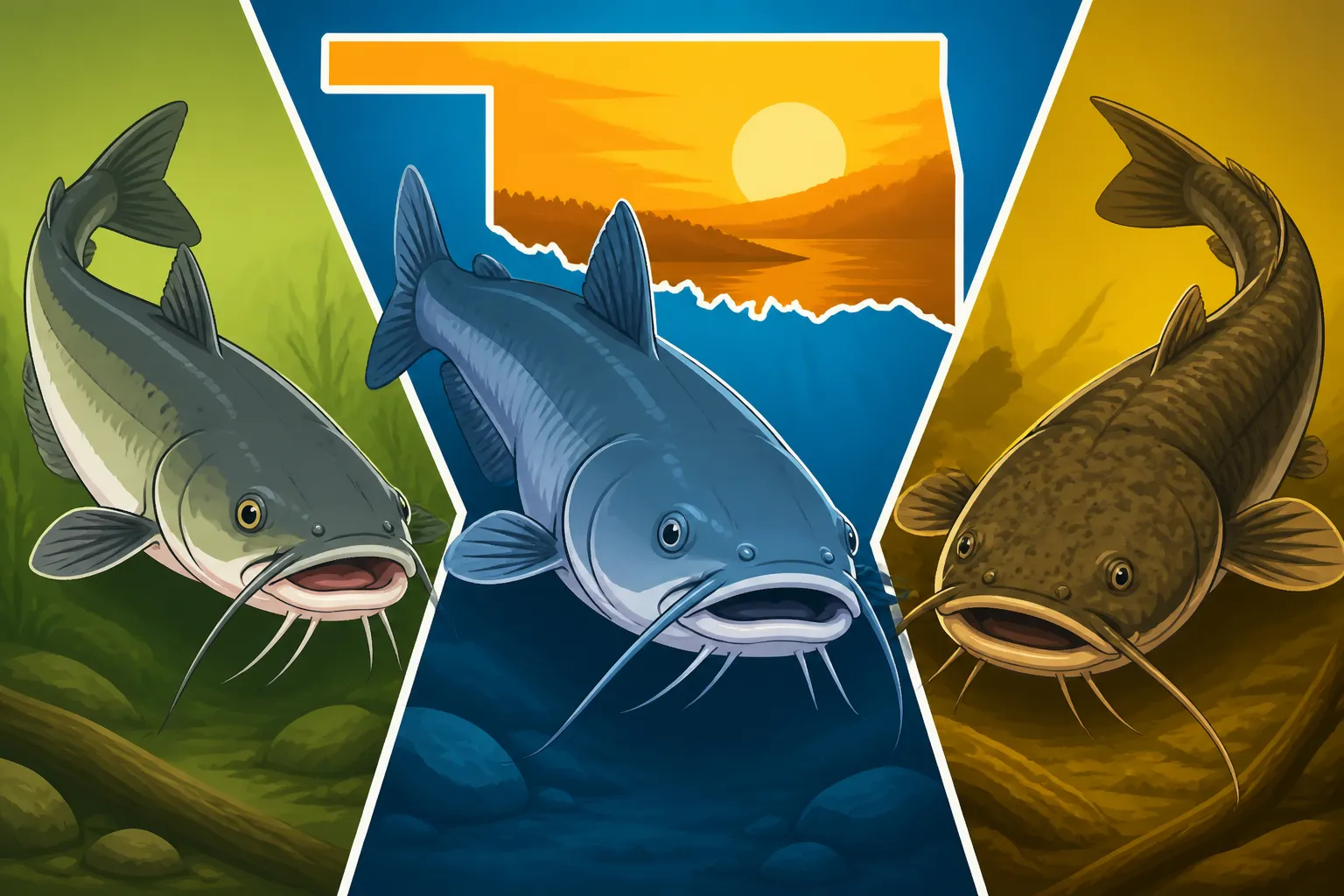
Channel Catfish vs Blue Catfish vs Flathead Catfish in Oklahoma
It's incredibly frustrating when you're out on the water, the reel is screaming, and you finally land a big catfish, only to stare at it and wonder, "Is this a blue cat, a channel cat, or a flathead?" Many Oklahoma anglers, from seasoned veterans to excited newcomers, face this common identification challenge, which is crucial not just for bragging rights but also for adhering to specific fishing regulations. This comprehensive guide is here to clear up the confusion, helping you confidently distinguish between Oklahoma's three most popular catfish species and become a more informed angler.
Introduction to Oklahoma's Catfish Trio
Catfish hold a special place in the hearts of Oklahoma anglers. They're strong fighters, delicious table fare, and they're found in almost every corner of our beautiful state, from tiny farm ponds to vast reservoirs. But while many might just see a "catfish," Oklahoma is home to three distinct species – channel, blue, and flathead – each with unique characteristics, preferred habitats, and even different daily limits. Knowing these differences isn't just a matter of trivia; it's essential for responsible and successful fishing.
Why Catfish are So Popular in Oklahoma
There's something undeniably satisfying about catfishing. Maybe it's the thrill of the fight, the unexpected size of some of the fish, or the promise of a delicious fish fry at the end of the day. Oklahoma's diverse waters, from the deep, rocky structure of Lake Texoma to the slow, muddy rivers, provide ideal habitats for all three major catfish species, making them accessible to almost anyone with a rod and reel. They're abundant, relatively easy to catch (especially channel cats), and they provide consistent action, which is why they've become a go-to target for so many of us.
Beyond just the catch, there's a real culture around catfishing here. Families gather on the banks with coolers and camp chairs, telling stories and making memories. Serious trophy hunters spend countless hours tracking down the giants. It's a fundamental part of the Oklahoma angling experience, embodying the spirit of outdoor adventure and good old-fashioned fun. This popularity also means a lot of investment in our fisheries, ensuring these species continue to thrive for future generations.
The Challenge of Identification for New Anglers
While channel, blue, and flathead catfish are all "catfish," they really are quite distinct. However, for someone new to the sport, or even for those who've only caught one type predominantly, telling them apart can be surprisingly tricky. They all have whiskers (barbels), smooth skin, and that characteristic catfish shape. Often, it's the subtle details – the shape of the tail fin, the coloration, the jawline – that give them away. Missing these details can lead to confusion, especially when you're excitedly pulling a fish into the boat or off the bank.
This identification challenge is more than just academic. Oklahoma's Catfish Fishing Rules and Limits can vary depending on the species, particularly for blue catfish with their special size restrictions. Misidentifying your catch could, in the worst-case scenario, lead to inadvertently violating regulations. That's why taking the time to learn the specific features of each species is such an important step in becoming a truly knowledgeable and responsible Oklahoma angler. Don't worry, once you know what to look for, it becomes much easier to tell our whiskered friends apart.
Understanding Channel Catfish: The Widespread Favorite
The channel catfish is, without a doubt, the most widely distributed and frequently caught catfish species in Oklahoma. If you've ever caught a catfish, chances are it was a channel cat. They're adaptable, thrive in a variety of environments, and are found in nearly every lake, pond, and river system across the state. These are the catfish that often bite readily on stink baits, cut bait, or even a worm, making them a fantastic target for anglers of all skill levels, from kids with cane poles to seasoned pros.
Their ubiquity and willingness to bite contribute to their "favorite" status. They don't typically reach the gargantuan sizes of blue cats, nor do they possess the same reclusive habits of flatheads, making them a consistently accessible and enjoyable catch. Whether you're planning a casual afternoon of bank fishing or a dedicated search for dinner, channel catfish are almost always a reliable option, providing steady action and a tasty meal.
Key Identifying Features of Channel Catfish
So, how do you spot a channel cat in a lineup? Look for these specific traits:
- Forked Tail: This is perhaps the most defining characteristic. Channel catfish have a deeply forked tail, much like a swallow's tail or a pair of scissors. This feature alone often distinguishes them from the other two species.
- Spotting: Younger channel catfish, and sometimes even larger ones, will have distinct dark spots along their sides. These spots can fade as the fish gets older, but they are very common.
- Anal Fin: Examine the anal fin (the fin on the underside, towards the tail). A channel cat's anal fin will be rounded and typically have between 24-29 rays.
- Head Shape: Their head is relatively small and rounded compared to their body. Their mouth is subterminal, meaning it's slightly underneath the snout, suitable for bottom feeding.
- Coloration: Their color can vary from olive-brown to slate-blue on the back, fading to silvery-white on the belly. The presence of those spots is a big giveaway.
If you're still unsure, remember that deeply forked tail – it's your best friend for channel cat identification! Compared to the other catfish, they often have a more sleek and streamlined body shape, designed for moving through various water types.
Where to Find and How to Catch Channel Cats
Channel catfish are incredibly versatile, thriving in everything from murky, slow-moving rivers to clear, rocky reservoirs and even small farm ponds. They prefer areas with some current or structure, such as submerged timber, rock piles, or channel edges. In lakes, look for them around points, creek channels, and humps. In rivers, they'll congregate in deeper holes, eddies, and below riffles. Basically, if there's water and a food source, a channel cat is probably nearby.
As for catching them, they're not particularly picky. Catfish Bottom Fishing Techniques are extremely effective. A simple Carolina rig or slip-sinker rig with bait presented on the bottom is often all it takes. Popular baits include prepared stink baits (available at most sporting goods stores or online on Amazon), cut shad, chicken livers, shrimp, or even hot dogs. For more active fishing, try drifting baits along ledges or through creek channels. They tend to feed most actively at dawn, dusk, and throughout the night, especially during warmer months.
The Culinary Appeal of Channel Catfish
When it comes to eating, channel catfish are highly prized. Their flesh is firm, flaky, and has a mild, sweet flavor, especially from cleaner waters. They are excellent fried, grilled, baked, or blackened. Many anglers consider them the best-tasting of the three main catfish species, particularly the smaller "eater" size fish, typically under 5 pounds. The bigger fish can sometimes have a stronger, muddier flavor, though proper cleaning and preparation can go a long way.
For a classic Oklahoma fish fry, you can't beat fresh channel catfish. Fillet them, coat them in cornmeal or a seasoned breading, and fry them until golden brown. Serve with hushpuppies, coleslaw, and a squeeze of lemon, and you've got a meal that's hard to beat. Their popularity on the plate is a big reason why they're such a target for recreational anglers across the state.
Diving into Blue Catfish: The Giants of the Deep
If you're looking to tangle with a true freshwater behemoth in Oklahoma, the blue catfish is your target. These magnificent fish are the largest species of catfish in North America, with individuals capable of exceeding 100 pounds. While not as widespread as channel cats in smaller waters, they dominate the larger reservoirs and river systems, especially the Red River basin and its associated lakes. Catching a trophy blue cat is a bucket-list item for many serious anglers, and Oklahoma offers some incredible opportunities to do just that.
Their sheer size and power make them an exhilarating catch. Unlike the more diverse diet of channel cats, blue catfish are primarily piscivorous as adults, meaning they prefer to eat other fish. This dietary preference often dictates the baits and techniques used to target them, making blue catfishing a specialized pursuit that rewards patience and dedication.
Distinctive Characteristics of Blue Catfish
Blue catfish share some similarities with channel cats, which can cause confusion, but they have key differences:
- Forked Tail (but less deep): Blue catfish also have a forked tail, but it's noticeably less deeply forked than a channel cat's. It's more of a subtle "V" shape rather than a deep "U."
- No Spots: This is a crucial identifier. Adult blue catfish will generally not have the dark spots that are common on channel catfish. Their coloration is typically a slate-blue or grey on the back, fading to a silvery-white belly, giving them their name.
- Anal Fin: The anal fin of a blue catfish is relatively straight-edged and has a much higher ray count, typically between 30-35 rays. This is a very reliable distinguishing feature if you can count them.
- Head Shape: Blue cats have a more robust, slightly flattened head compared to channel cats, especially the larger specimens. Their mouth is also subterminal, but it appears larger and more suited for engulfing prey.
- Body Build: They have a more massive, stout body build than channel cats, reflecting their potential for enormous size.
Remember, the combination of no spots, a less deeply forked tail, and a high ray count on the anal fin are your best bets for identifying a blue cat. This combination often leads to a more streamlined, powerful appearance overall.
Prime Locations and Techniques for Blue Catfish
Blue catfish are primarily found in large rivers and vast reservoirs. Key Oklahoma lakes for blue catfishing include Lake Texoma, Lake Eufaula, Grand Lake O' the Cherokees, and Keystone Lake. They prefer deeper, open water areas, often congregating in main river channels, deep holes, old creek beds, and around significant underwater structure like submerged timber or rock ledges. They are highly migratory within these large bodies of water, often following baitfish schools.
Targeting these giants requires different tactics. Fresh cut bait is king for blue cats – shad, carp, sunfish, or even fresh perch are excellent choices. They are often caught using Trotline Fishing for Catfish or Jug Fishing for Catfish methods, but tight-lining with heavy tackle from a boat or bank is also popular. Look for concentrations of baitfish on your fish finder, as blue cats will often be nearby. They feed aggressively, and when a big one hits, you'll know it!
The Thrill of a Trophy Blue Catfish
There's a reason so many anglers dedicate their lives to pursuing trophy blue catfish. The sheer power of a 50-pound, 80-pound, or even 100-pound fish on the end of your line is an unforgettable experience. They pull like freight trains, testing your gear and your stamina. Many anglers practice catch-and-release with these larger fish, preserving the trophy fishery for others, especially given the state's specific regulations like The 30-Inch Blue Catfish Rule in Oklahoma.
Beyond the fight, the pursuit of a trophy blue cat is often a social endeavor. Anglers share tips, compare catches, and revel in the challenge. It’s not just about landing the fish; it’s about the journey, the camaraderie, and the respect for these magnificent aquatic predators. For those who want to get serious about it, investing in specialized rods, heavy-duty reels, and strong line (many can be found on Amazon) is a must.
Exploring Flathead Catfish: The Ambush Predator
The flathead catfish is the third member of Oklahoma's catfish trio, and it's quite distinct from its channel and blue cousins. Flatheads are solitary, territorial, and primarily nocturnal predators that prefer live bait. They're often found in different types of habitats and require different techniques to catch, making them a unique challenge and a prized catch for many dedicated anglers. If you're tired of catching channel cats and looking for something different, the flathead might be your next obsession.
These fish are true ambush predators, lurking in dense cover and waiting for an unsuspecting meal to swim by. This behavior dictates their habitat choices and makes them a tougher, but incredibly rewarding, species to target. They might not get as large as the biggest blue cats, but they can still grow to impressive sizes, often exceeding 50 pounds, and their powerful, muscular build makes for a fantastic fight.
Unique Looks of the Flathead Catfish
Flathead catfish are arguably the easiest of the three to identify due to their very distinctive appearance:
- Flat Head: As their name suggests, flatheads have a remarkably broad, flattened head, almost shovel-like. This is their most obvious identifying feature.
- Non-Forked Tail: Unlike channel and blue cats, flatheads have a square or slightly rounded tail fin – not forked at all. This is a dead giveaway.
- Protruding Lower Jaw: Their lower jaw extends beyond their upper jaw, giving them an almost "underbite" appearance. This is a clear adaptation for their predatory, ambush feeding style.
- Anal Fin: The anal fin is short and rounded, with only 14-17 rays, a much lower count than the other two species.
- Coloration: They are typically mottled yellow-brown to olive on their backs and sides, with lighter, yellowish bellies. This camouflage helps them blend into their often murky, structured environments. They don't have spots.
With that flat, wide head, the non-forked tail, and the protruding lower jaw, you should have no trouble telling a flathead apart from a channel or blue cat. They really stand out in a crowd!
Targeting Flatheads in Their Lair
Flathead catfish are creatures of cover and structure. They prefer slow-moving or stagnant waters within rivers, reservoirs, and large ponds, but always with access to dense cover. Look for them in areas with heavy submerged timber, brush piles, rock crevices, log jams, and undercut banks. They're often found lying in wait within these structures, ready to ambush prey. They are less tolerant of murky water than channel cats, preferring clear to moderately turbid conditions.
Since flatheads are primarily live bait predators, you'll need to use live fish. Sunfish, perch, small carp, or bullheads are excellent choices. Rigging them on a heavy-duty slip-sinker rig or a three-way swivel rig, and presenting them right into heavy cover, is a common technique. Fishing for flatheads is often a patient game, as you're trying to put your bait directly in front of a hidden predator. Night fishing is particularly effective, as this is when they're most active. Best Bait for Flathead Catfish at Night often includes live sunfish or bluegill.
Flathead Catfish as Table Fare
Flathead catfish are also excellent eating, though their flavor profile is often described as slightly richer and firmer than channel catfish. Many anglers prefer them grilled or baked rather than fried, due to their denser, white flesh. Smaller flatheads (under 10-15 pounds) are generally considered the best for eating, as larger, older fish can accumulate stronger flavors and tougher texture.
Preparing a flathead requires good cleaning, like any catfish. Is Flathead Catfish Good to Eat? Absolutely, and they provide a substantial amount of meat. Some say their taste is closer to a white fish than the distinct "catfishy" flavor. For a more adventurous culinary experience, try smoking flathead fillets – the firm flesh holds up beautifully to the process and takes on a wonderful flavor.
Side-by-Side Comparison: Spotting the Differences
Trying to identify catfish in Oklahoma can feel like a game of "spot the difference" sometimes, especially between channel and blue cats. But once you know the key characteristics to look for, it becomes much easier to make an accurate identification. Let's break down the most crucial distinguishing features in a direct comparison. This table will serve as a quick reference, but we'll dive deeper into each aspect.
| Feature | Channel Catfish | Blue Catfish | Flathead Catfish |
|---|---|---|---|
| Tail Fin | Deeply forked | Moderately forked (less than channel) | Square or slightly rounded (not forked) |
| Spots | Often present (especially on younger fish) | Generally absent | Absent |
| Anal Fin Rays | 24-29 (rounded edge) | 30-35 (straight edge) | 14-17 (short, rounded edge) |
| Head Shape | Rounded, smaller | Slightly flattened, robust | Very broad, flattened ("shovel-like") |
| Lower Jaw | Even with upper or slightly recessed | Even with upper or slightly recessed | Protruding (extends beyond upper jaw) |
| Coloration | Olive-brown to slate-blue, silvery belly | Slate-blue to grey, silvery-white belly | Mottled yellow-brown/olive, yellowish belly |
| Diet (Adults) | Omnivorous (insects, fish, carrion) | Primarily piscivorous (other fish) | Primarily piscivorous (live fish) |
| Habitat | Varied (rivers, lakes, ponds), structure | Large rivers, deep reservoirs, main channels | Heavy cover (logs, brush), rivers, reservoirs |
This table is your quick reference guide, but understanding the nuances of these features is key to becoming proficient at identification. It truly boils down to looking at the details and not just making a quick guess.
Fin Shape and Body Structure
The tail fin is arguably the easiest and most reliable differentiator for our catfish trio. As we discussed, the channel cat has that unmistakable, deeply incised fork, almost like it's been neatly cut out. This gives it a swift, agile profile. The blue cat's tail is also forked, but think of it as a shallower "V" – still forked, but without the extreme depth of the channel cat's. It's a subtle but important distinction that often requires a side-by-side comparison, or at least a good memory of the channel cat's tail.
Then we have the flathead, which completely breaks the mold with its square or even slightly rounded tail fin. There is no fork whatsoever. This single feature, combined with its distinct head shape, usually makes flathead identification a breeze. Beyond the tail, consider the overall body build. Channel cats are often more streamlined, blue cats are typically beefier and more massive, and flatheads possess a robust, muscular body that seems built for power and hiding.
Coloration and Mouth Characteristics
Coloration can be a helpful secondary indicator, but it's important to remember that water clarity and diet can affect a fish's color. Channel catfish are known for their dark spots, especially when young, on an olive-brown to slate-blue body. As they age, these spots might fade, leading to confusion with blue cats. Blue catfish, however, generally lack these spots, presenting a more uniform slate-blue or grey color on their backs. This lack of spotting is a strong indicator of a blue cat, though some very dark channel cats might appear spotless.
The mouth is another critical feature. Both channel and blue catfish have mouths that are subterminal, meaning they open slightly below the snout, well-suited for vacuuming up food from the bottom. The flathead, on the other hand, has a distinctly protruding lower jaw. Its mouth is wider and appears designed for engulfing live prey whole, a clear adaptation to its predatory lifestyle. This "underbite" is very pronounced and, combined with the flattened head, makes the flathead truly unique. Channel Catfish vs Blue Catfish: How to Tell Them Apart often highlights these subtle mouth and tail differences.
Habitat and Feeding Habits
Understanding where these fish live and what they eat can also provide clues to their identity. Channel catfish are the most opportunistic, found in a wide range of habitats from small ponds to large rivers, and they'll eat almost anything – insects, smaller fish, crawfish, and carrion. This omnivorous diet and adaptability contribute to their widespread distribution. If you're catching a catfish in a small, relatively shallow pond, it's almost certainly a channel cat.
Blue catfish prefer vast, deeper waters, like the main channels of big rivers and large reservoirs. They are largely piscivorous as adults, meaning they primarily consume other fish. This preference for baitfish often means they roam open waters, following schools of shad or other forage. If you're pulling a giant catfish from the depths of Lake Texoma, it's very likely a blue cat.
Flathead catfish are unique in their preference for heavy cover and live bait. They are solitary ambush predators, often found tucked away in log jams, brush piles, or undercut banks in rivers and large reservoirs. They feed almost exclusively on live fish, which they snatch from their hiding spots. If you're battling a powerful fish that hit a live sunfish in a dense brush pile, you've likely found yourself a flathead. Blue Catfish vs Flathead Catfish: Key Differences often emphasizes the habitat and dietary distinctions between these two giants.
Practical Tips for Anglers: Knowing Your Catch
Knowing how to tell your catfish apart isn't just for showing off your biology knowledge at the dock. It has real, practical implications for every angler in Oklahoma. From staying on the right side of the law to choosing the right gear, understanding our catfish species will make you a more effective and responsible fisherman. There’s a sense of pride that comes with accurately identifying your catch and applying that knowledge.
Beyond the legal aspect, it helps you tailor your fishing approach. If you know you're in a blue cat hotspot, you'll reach for different baits and tackle than if you're targeting flatheads in heavy timber. This informed approach not only increases your chances of success but also enhances the overall experience of connecting with nature and our diverse aquatic life.
Legal Considerations and Bag Limits
This is where accurate identification becomes critically important. Oklahoma has specific regulations regarding catfish, and these can vary by species. For example, Oklahoma's Catfish Fishing Rules and Limits specify bag limits and size restrictions that sometimes differ for blue and channel catfish. Most notably, there is often a special rule regarding blue catfish over a certain size (e.g., The 30-Inch Blue Catfish Rule in Oklahoma which states you can only keep one blue catfish over 30 inches per day).
If you accidentally mistake a large channel cat for a blue cat, or vice-versa, you could be unknowingly violating regulations. Game wardens are out there to ensure sustainable fishing practices, and they expect anglers to know what they've caught. Always check the current Oklahoma Fishing Guide before you head out, and if you're unsure, it's always safer to release the fish or assume the stricter limit applies. No one wants a citation just because they couldn't tell a blue from a channel!
Essential Gear for Different Catfish Species
Just as the species differ, so too does the optimal gear for catching them.
- Channel Catfish: For smaller channel cats, a medium-action spinning or baitcasting rod with 10-20 lb test line is usually sufficient. A simple slip-sinker rig or bobber rig works well. Baits are diverse, from stink baits to cut bait. This is often the most accessible fishing, and you can find great starter kits or individual components for channel catfishing on Amazon.
- Blue Catfish: To tackle the powerful blue cats, you'll need heavier gear. A heavy-action rod (7-9 feet), a robust baitcasting reel with a good drag system, and 30-50 lb monofilament or braided line are recommended. Heavy sinkers, large hooks (8/0 or larger circle hooks), and fresh cut bait (shad, carp) are essential.
- Flathead Catfish: Flatheads also require heavy gear, similar to blue cats, but with a focus on durability for pulling fish out of heavy cover. A stiff, heavy-action rod, a strong baitcasting reel, and 30-80 lb braided line are common. Live bait is paramount, fished on a stout hook (6/0 to 10/0 circle or J-hook) with heavy weights to keep it down. Don't forget a sturdy pair of pliers for removing hooks from their powerful jaws!
Matching your gear to your target species not only increases your chances of success but also reduces the stress on the fish and prevents lost tackle. There’s nothing worse than hooking into a monster and realizing your line or rod isn’t up to the task.
Contributing to Catfish Conservation
As anglers, we all have a role to play in the conservation of Oklahoma's incredible fisheries. Understanding the different catfish species and their specific needs allows us to fish more responsibly. For example, knowing that blue catfish are primarily fish-eaters helps us understand the importance of healthy baitfish populations. Recognizing the flathead's preference for live bait ensures we're not inadvertently harming other species by using improper techniques.
Practicing catch-and-release for larger, trophy-sized blue and flathead catfish is also a great way to contribute, as these older, larger fish are crucial for breeding and maintaining genetic diversity. Always handle fish carefully, minimize their time out of water, and use proper release techniques. By being informed, following regulations, and respecting the fish, we ensure that the thrill of catfishing remains a vibrant part of Oklahoma's outdoor heritage for generations to come. After all, we want How Many Fish Species Live in Oklahoma to continue to be an impressive number!
Disclaimer
This article is for general informational purposes only and does not constitute professional advice. Laws, prices and regulations vary by location and change over time. Consult a qualified professional for guidance on your specific situation.