Northern Pike vs Walleye: How to Tell Them Apart
It's incredibly frustrating when you're out on the water, you feel a strong tug, reel in a beautiful fish, and then find yourself staring at it, scratching your head, trying to figure out exactly what you've caught. This moment of confusion, especially between two fantastic sport fish like Northern Pike and Walleye, is a common one for many Oklahoma anglers. This guide is here to help you confidently tell these two fascinating species apart, ensuring you can correctly identify your catch and adhere to all local regulations.
The Distinct Visual Cues of Pike and Walleye
When you pull a fish from the water, the first few seconds are critical for identification, especially if you're planning a quick release. Both Northern Pike and Walleye are lean, predatory fish found in various Oklahoma waters, but they possess some very clear physical differences once you know what to look for. It's not just about size; it's in the details of their build, their coloration, and even the texture you feel.
Head Shape and Mouth Structure
Let's start from the business end: the head. This is often the easiest and most definitive way to distinguish a Northern Pike from a Walleye. You don't even need to be an ichthyologist to spot the stark contrasts here.
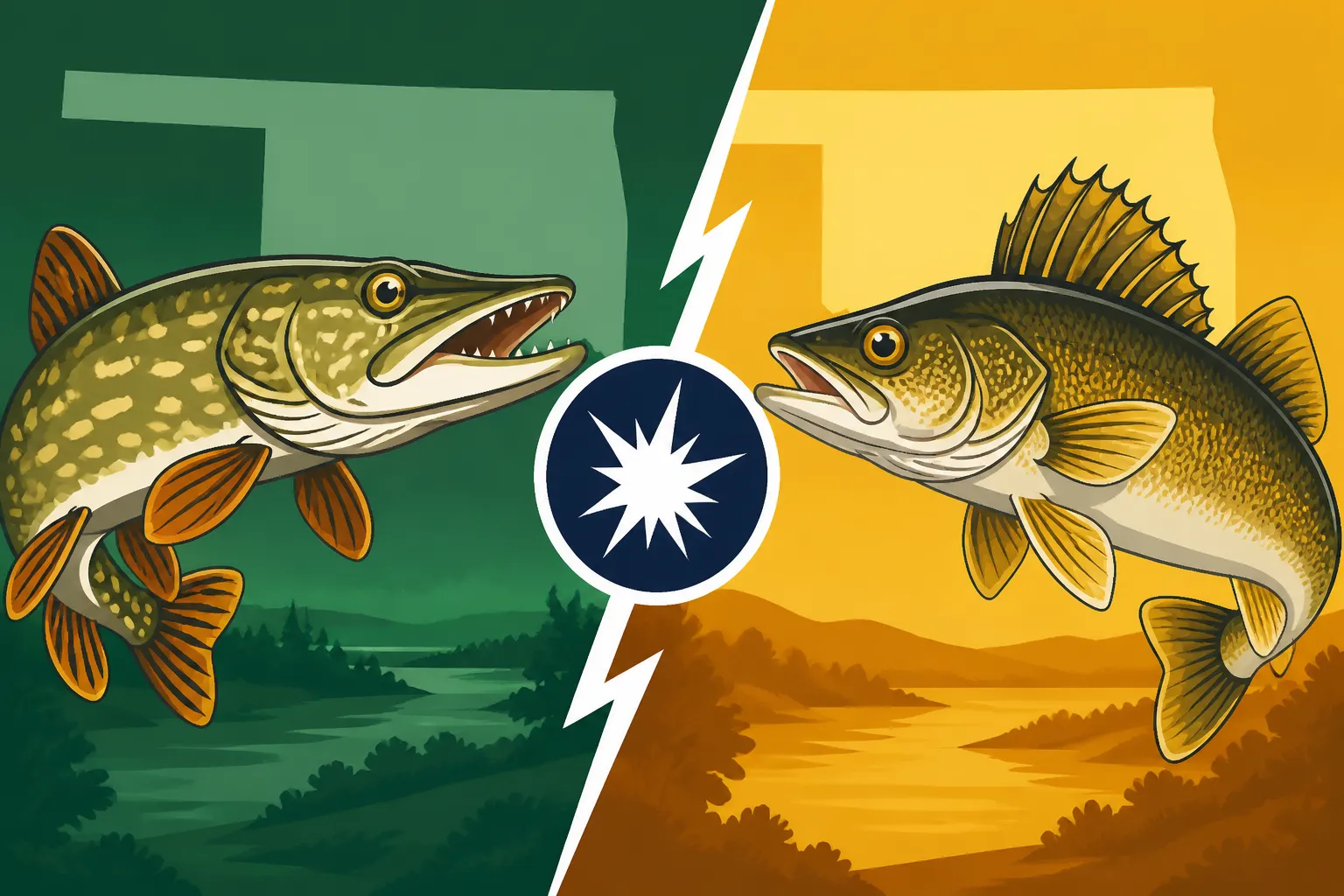
A Walleye, as its name cleverly suggests, has a distinctive, large, glassy eye that seems to "wall" out, often appearing somewhat milky or opaque, especially when reflecting light. This eye is adapted for low-light conditions, which is why these fish are such fantastic dawn, dusk, and even night feeders. Their head is relatively streamlined and somewhat pointed. Open that mouth, and you'll find a set of sharp, needle-like canine teeth, particularly prominent on the upper and lower jaws. These teeth are perfect for grasping slippery baitfish. If you're using a fishing guide app or a book, you might see clear illustrations of this elongated, toothy snout.
Now, shift your gaze to the Northern Pike. The difference is immediate and dramatic. Pike possess what anglers affectionately (or sometimes fearfully) call a "duckbill" snout. Their head is much broader and flatter, resembling the bill of a duck. This unique shape allows them to ambush prey with incredible speed and precision. Look inside a pike's mouth, and you'll be greeted by an impressive arsenal of razor-sharp teeth—not just canines, but rows of them, angling backward, designed to hold onto struggling prey. Handling a pike requires extreme caution; those teeth are no joke. Many seasoned anglers will tell you to keep a good pair of long-nosed pliers or a jaw spreader, readily available from retailers like Amazon, on hand when dealing with pike.
Body Markings and Coloration
Beyond the head, the body itself offers crucial clues to telling these fish apart. While both are generally olive to dark green on top, their patterns and the nuances of their coloring are quite distinct.
Walleye typically exhibit a more uniform, mottled coloration. Their bodies are usually olive green to gold, fading to white or cream on their bellies. What really sets them apart is often a series of faint, darker vertical bars or mottling along their sides, which can sometimes be quite subtle. The most reliable color cue, however, is on their dorsal fin. Look closely at the lower lobe of the tail fin and the tip of the bottom-most spiny dorsal fin: Walleye almost always have a distinct white or cream-colored tip. This is a tell-tale sign that helps many anglers confirm their catch quickly.
Northern Pike, on the other hand, are adorned with a much more vivid and irregular pattern. Their bodies are typically a darker olive or greenish-brown on the back, but their sides are where the action is. They are characterized by numerous horizontal, bean-shaped, or chain-like light spots or markings against a darker background. Think of them as having light spots on a dark body, rather than dark spots on a light body. These markings can range from yellowish to cream-colored and are quite striking. Their fins often have dark spots or blotches as well, lacking the clean white tip found on the Walleye's caudal and dorsal fins. This distinct pattern makes them quite beautiful, and frankly, less prone to mistaken identity once you've seen a few.
Fin Placement and Dorsal Spines
The fins, particularly the dorsal and anal fins, provide another set of clear diagnostic features. While it might seem like a small detail, these aspects of their anatomy are consistently different between the two species.
Walleye possess two separate dorsal fins. The first dorsal fin is spiny and well-defined, and it's completely separated from the second dorsal fin, which is soft-rayed. This separation is a key identifier. Their pectoral and pelvic fins are typically clear to slightly opaque, sometimes with a faint yellowish tint. When examining the mouth, you'll also notice those prominent canine teeth we discussed earlier. The overall feel of a Walleye is relatively smooth, though they do have scales.
Northern Pike, conversely, have a single, elongated dorsal fin that is positioned much further back on their body, closer to the tail fin. This dorsal fin is generally soft-rayed and doesn't have the distinct separation seen in a Walleye. Their anal fin is also set back, mirroring the dorsal fin's position. This rearward placement of both the dorsal and anal fins, combined with their torpedo-shaped body, is what gives pike their incredible burst speed for ambush predation. Their fins can also be spotted or mottled. Also, run your hand (carefully, please!) along a pike; they often feel more scaly and rough than a Walleye. A good pair of fish gloves, easily found online at retailers like Amazon, can make handling these toothy critters much safer.
Here’s a quick comparison table to summarize the key differences:
| Feature | Northern Pike | Walleye |
|---|---|---|
| Head Shape | Broad, flat, "duckbill" snout | More streamlined, pointed head |
| Teeth | Numerous, sharp, backward-angled teeth in rows | Prominent, needle-like canine teeth |
| Eye | Normal, golden or amber colored | Large, glassy, reflective "walleyed" eyes, adapted for low light |
| Body Markings | Light, bean-shaped or chain-like spots on a dark background | Faint dark mottling or vertical bars on an olive/gold body |
| Fin Tips | No distinct white tips on tail or dorsal fins | Distinct white tip on lower lobe of caudal (tail) fin and bottom spiny dorsal fin |
| Dorsal Fins | Single, long, soft-rayed dorsal fin, set far back | Two separate dorsal fins: one spiny, one soft-rayed |
| Scales/Feel | Often feels rougher, more pronounced scales | Generally smoother feel |
| Body Shape | Elongated, torpedo-shaped | More fusiform, rounded body |
Habitat and Behavior Clues in Oklahoma Waters
Beyond physical characteristics, understanding where and how these fish typically behave in Oklahoma can give you strong clues to their identity before you even see them. Both are predators, but their preferred ambush points and hunting strategies differ significantly. Oklahoma's 181 Fish Species: A Quick Overview is a great resource to learn more about the diverse fish populations in our state.
Preferred Waters and Cover
Northern Pike are often associated with cooler, weedier waters, preferring lakes and slower-moving rivers that offer abundant vegetation for cover. Think of areas with lily pads, submerged grass beds, or fallen timber. They are ambush predators that lie in wait, perfectly camouflaged, exploding with incredible speed to snatch unsuspecting prey. You'll often find them lurking just outside the thickest cover, poised to strike. In Oklahoma, while not as widespread as Walleye, pike can be found in certain impoundments, particularly in areas with good structure and clear water. If you're fishing a shallow, weedy cove, and you get a powerful, aggressive strike, there's a good chance it could be a pike.
Walleye, by contrast, tend to prefer deeper, cooler waters, often found near submerged humps, rock piles, drop-offs, and main lake points in larger reservoirs. While they appreciate structure, they don't rely on dense vegetation for ambush in the same way pike do. Their large, light-sensitive eyes make them excellent hunters in low-light conditions, so they are frequently found in deeper water during the day, moving shallower at dawn, dusk, or under cloudy skies to feed. When you're drifting a main lake flat or jigging a deep channel in one of Oklahoma's big reservoirs, and you feel that characteristic "thump," it's often a Walleye investigating your offering. For those interested in this specific species, Walleye, Sauger and Saugeye: Oklahoma's Cousin Fish offers more in-depth information.
Feeding Habits and Aggression Levels
The way these fish feed and the intensity of their strike can also provide hints. Northern Pike are famously aggressive. They are opportunistic feeders that will strike at almost anything that moves, from smaller fish to frogs, ducks, or even mice. Their strike is usually ferocious and unmistakable – a powerful, sudden jolt that can rip the rod right out of your hands if you're not ready. They are known for their strong runs and head shakes, making them an exciting, albeit challenging, catch. When fishing for pike, anglers often use larger lures, like spinnerbaits, spoons, or large jerkbaits, that mimic their preferred prey. Many of these effective lures can be purchased easily from online retailers like Amazon.
Walleye, while certainly predatory, are generally considered more subtle eaters. Their bite is often described as a soft "tick," a gentle "thump," or just a sudden heaviness on the line. They're not as prone to the explosive, rod-wrenching strikes of a pike. They primarily feed on baitfish such as shad, minnows, and shiners, but also consume insects and crawfish. Anglers targeting Walleye typically use jigs, crankbaits, or live bait rigs, often presented slower and closer to the bottom. Understanding these nuances in feeding behavior can help you anticipate what you've hooked. If you're using light tackle and get a subtle bite while fishing a rocky point, it's more likely a Walleye. If you're ripping a large spoon through a weed line and get nearly spooled, it's probably a pike. For more on targeting Walleye, explore Best Lures for Walleye at Oklahoma Reservoirs.
Why Proper Identification Matters for Oklahoma Anglers
Okay, so why bother with all these details? Beyond the satisfaction of knowing what you've caught, correctly identifying your fish is critically important for legal and conservation reasons, especially here in Oklahoma. Getting it wrong can lead to fines, or worse, negatively impact the health of our fisheries.
Bag Limits and Regulations
Every angler in Oklahoma is responsible for knowing and adhering to the state's fishing regulations. These rules are put in place by the Oklahoma Department of Wildlife Conservation to manage fish populations and ensure sustainable fishing for everyone. Fishing Regulations You Need to Know in Oklahoma covers this in detail, but the short version is that bag limits and size restrictions can vary dramatically between species.
For instance, the statewide bag limit for Walleye in Oklahoma is generally generous, but there might be specific size restrictions or lake-specific rules you need to be aware of. Northern Pike, being less common in many areas, might have different or even more restrictive regulations. Imagine accidentally keeping a pike when you thought it was a Walleye, or vice-versa, and exceeding a limit. That could land you in hot water with a game warden. Game wardens are out there specifically to enforce these rules, and they are quite good at identifying fish. Knowing the difference protects you from potential penalties and helps conserve these valuable fish populations. Make sure you check the current regulations every time you plan a fishing trip. You can often find compact, waterproof field guides for fish identification online, including on Amazon, which can be invaluable out on the water.
Photography and Release Practices
Once you've made your identification, especially if you're practicing catch and release, how you handle the fish matters. The unique physical characteristics of Northern Pike and Walleye necessitate different handling techniques to ensure their survival post-release.
For Walleye, which have those sharp canine teeth but a more streamlined head, careful handling with a wet hand supporting their belly is usually sufficient. Avoid gripping their jaws too hard, and definitely don't hold them vertically by the lower jaw, as this can damage their internal organs. Removing hooks should be done quickly and gently. If you're taking a photo, try to keep the fish in the water as much as possible, or at least minimize its time out of the water.
Northern Pike, with their "duckbill" full of teeth, require much more caution. Many experienced pike anglers use a specialized tool, often called a "jaw spreader," to safely open the mouth and remove hooks, or at the very least, a sturdy pair of long-nosed pliers. Trying to put your fingers in a pike's mouth is a recipe for serious injury. They are tough fish, but quick and gentle handling is still key for their survival. Supporting their body horizontally and getting them back into the water as soon as possible after a photo is always the best practice. Remember, healthy fish mean better fishing for everyone, and How Big Do Northern Pike Get in Oklahoma and How Big Do Walleye Get in Oklahoma can give you an idea of the trophy potential of these species, which makes proper handling even more important for future generations.
Disclaimer
This article is for general informational purposes only and does not constitute professional advice. Laws, prices and regulations vary by location and change over time. Consult a qualified professional for guidance on your specific situation.