How to Find Crappie in Deep Water in Summer
Oh, the summer crappie struggle is real, isn't it? You spend all spring chasing those slabs in the shallows, loading up the cooler, and then BAM! July hits, the sun bakes the surface, and it feels like every crappie in the lake just vanishes into thin air. You're left scratching your head, wondering if you've lost your touch or if the fish just packed up and moved out. Well, I'm here to tell you, they haven't vanished – they've just gone deep, seeking refuge from the heat and the bright sunlight. This guide is all about equipping you with the knowledge and techniques to track down those elusive summer crappie in their deepwater hideouts in Oklahoma's lakes, ensuring your cooler stays full even when the temperatures soar.
Understanding Crappie Behavior in Summer Heat
When the Oklahoma summer sun starts beating down, and those surface water temperatures climb into the 80s and even 90s, crappie, like most fish, become quite uncomfortable in the upper water column. They're cold-blooded creatures, and while they can tolerate a range of temperatures, prolonged exposure to extreme heat stresses them out, impacts their metabolism, and can even reduce oxygen absorption. This isn't just about comfort; it's about survival. They're actively seeking out more favorable conditions, and in most of our large reservoirs, that means heading for the deeper, cooler parts of the lake.
Why Crappie Go Deep in Summer
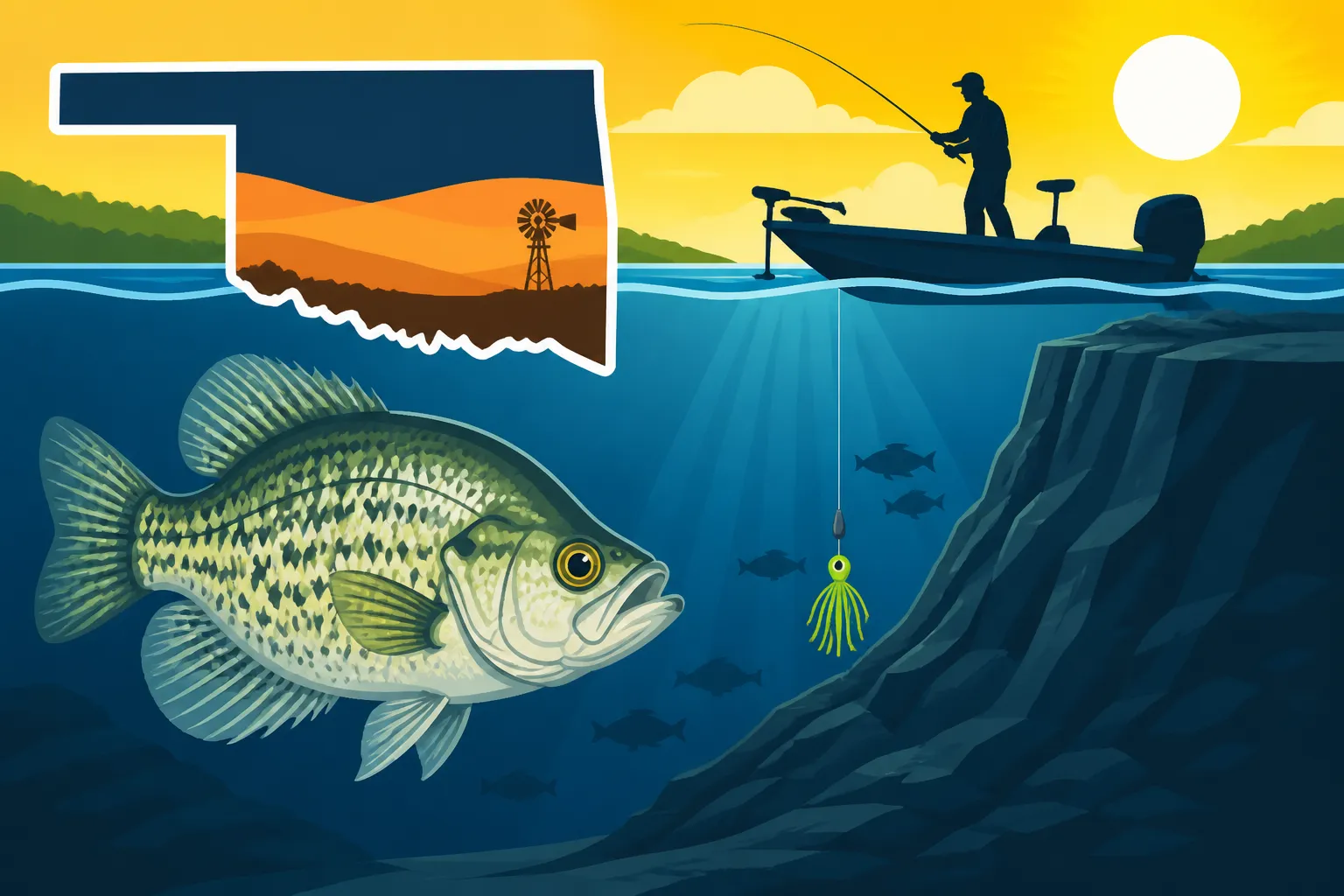
The primary reason crappie retreat to deeper water during the summer months is quite simply the heat. As the surface warms up, a phenomenon called "thermal stratification" occurs in many lakes. Think of it like a layered cake: you have a warm upper layer (epilimnion), a middle layer where the temperature changes rapidly (thermocline), and a cold, deep layer (hypolimnion). Crappie will usually seek out the thermocline or just above it, where the water is cooler and still retains enough dissolved oxygen. Below the thermocline, especially in deeper, nutrient-rich lakes, the oxygen levels can drop significantly, creating what's often called an "anoxic zone" where fish simply can't survive.
Beyond temperature and oxygen, food sources also play a massive role. The baitfish that crappie prey on, like shad, also move deeper in response to the heat and to find plankton. So, if the baitfish are deeper, the crappie will follow. It's an entire ecosystem shifting downwards. Understanding this vertical migration is absolutely critical to successful summer crappie fishing. If you're still casting tiny jigs into 5 feet of water in July, you're likely just wasting your time, no matter how good your Crappie Jigging Techniques are.
Key Water Depths and Temperatures to Target
So, what are we talking about when we say "deep"? In many Oklahoma lakes, "deep" for crappie in summer can mean anywhere from 15 to 30 feet, or even deeper depending on the lake's specific characteristics and oxygen levels. The exact depth will vary day by day and lake by lake, but a good starting point is usually the upper half of the thermocline. This zone typically holds water temperatures in the mid-70s, which is much more comfortable for crappie than the upper 80s or 90s found on the surface.
To really pinpoint this, you might need a good fish finder with temperature sensors or even a dedicated water temperature gauge. I've found that crappie will often suspend right on the edge of a significant temperature change. They're not necessarily hugging the very bottom in the deepest holes unless there's submerged cover there; more often, they're suspended over those deeper areas, following the bait. So, when you're scanning with your electronics, pay close attention to the depth at which baitfish schools are suspended, and you'll often find crappie nearby.
Essential Gear and Electronics for Deepwater Crappie
Trying to find deepwater crappie without the right tools is like trying to find a needle in a haystack blindfolded. You might get lucky, but more often than not, you'll just get frustrated. Investing in some key pieces of equipment, especially electronics, can dramatically improve your chances of success and take a lot of the guesswork out of the equation. This is where modern technology truly shines in our pursuit of those elusive slabs.
Must-Have Electronics: Fish Finders and Sonar
A quality fish finder is, without a doubt, your best friend when targeting deepwater crappie. You're not just looking for fish; you're looking for bait, structure, and changes in the bottom contour. A basic 2D sonar will show you depth, fish arches, and some bottom detail, which is a great start. However, if you're serious about deep crappie, consider a unit with Down Imaging and Side Imaging. These technologies literally paint a picture of what's below and to the sides of your boat, allowing you to see submerged brush piles, creek channels, ledges, and individual crappie or schools of baitfish holding tight to cover.
Many anglers find great deals on units from brands like Humminbird or Garmin on platforms like Amazon. Look for features that give you high-definition imagery and the ability to mark waypoints precisely. Once you've located a promising brush pile or school of crappie suspended over a channel, being able to drop a virtual pin on that spot is invaluable. It lets you return to the exact same location even if the wind or current pushes you off. For more details on what to look for, check out this guide on Fish Finder Features That Matter Most on Oklahoma Reservoirs.
Rods, Reels, and Line for Vertical Presentation
When you're fishing deep, you need a setup that allows for precision and sensitivity. Traditional short crappie rods might not cut it. I typically opt for a longer rod, around 7 to 9 feet, with a light to medium-light action. This extra length helps with line management, especially when vertical jigging directly over a suspended school of fish, and provides better hook-setting power in deeper water. A sensitive tip is crucial for detecting those subtle crappie bites, which can be even fainter in deep water.
Pair that rod with a quality spinning reel in a 1000 or 2000 size. You want a smooth drag system and good line capacity. For line, many deepwater crappie anglers swear by 6 to 10 lb test fluorocarbon or a braided main line (like 10-15 lb test) with a 6-8 lb fluorocarbon leader. Fluorocarbon is nearly invisible underwater and has less stretch than monofilament, giving you better feel and hook sets. Braid offers incredible sensitivity and no stretch, which is fantastic for detecting bites, but the fluorocarbon leader helps with stealth. You can find excellent quality line from various brands on Amazon that are perfect for this technique.
Proven Techniques for Catching Deepwater Crappie
Once you've identified where the crappie are holding deep, the next step is presenting your bait effectively. This often requires a different approach than the shallow water casting techniques many of us grew up with. The goal is to get your lure or bait down to the exact depth of the fish and keep it in that strike zone for as long as possible. Two primary methods dominate the deepwater crappie game: vertical jigging and spider rigging.
Vertical Jigging and Dropping Baits
Vertical jigging is one of the most direct and effective ways to target crappie suspended over specific deepwater structures. Once your fish finder shows you a school or individual crappie, you position your boat directly over them. Then, you simply drop your bait straight down. Small lead head jigs (1/16 to 1/8 oz) tipped with a small plastic grub or tube, or even a live minnow, are incredibly effective. The key is to use enough weight to get your bait down quickly and keep it vertical, but not so much that it's unnatural.
The presentation involves a very subtle jigging motion – a gentle lift and fall, or simply holding the bait still at the fish's level. Watch your rod tip like a hawk, and pay attention to your line; sometimes, a crappie bite will be nothing more than a slight twitch or a feeling of "weightlessness" as the fish inhales the bait on the fall. It's a precise technique that requires focus, but the reward of consistently pulling up those big summer slabs is well worth the effort. For more in-depth guidance, check out the article on Crappie Jigging Techniques.
Spider Rigging and Trolling Deep Structure
Spider rigging, sometimes called long-lining or tightlining, is a fantastic strategy for covering larger areas of deep water, especially when crappie are scattered or when you're trying to locate them over vast submerged structures like creek channels or flat ledges. This method involves deploying multiple rods (often up to eight per angler in Oklahoma, depending on the number of Fishing License Requirements in Oklahoma held and specific regulations, so always double-check the Oklahoma Statewide Crappie Bag Limit for any changes) from the front or sides of your boat, creating a "spider web" of lines. Each rod is set to a different depth and often with a different bait or jig color, allowing you to quickly find what the fish prefer on that particular day.
You then slowly troll over promising areas, usually at speeds less than 1 mph, letting your baits work their magic. Using a good trolling motor with GPS capabilities and spot-lock can make this technique much easier, allowing you to maintain a consistent speed and direction. Weights, like egg sinkers or drop shot weights, are used to get your baits down to the desired depths. For more details on this versatile technique, be sure to read How to Spider Rig for Crappie. You'll find a wide array of specialized spider rigging rod holders and multi-rod setups on Amazon to get you started.
Reading Structure and Cover
Finding crappie in deep water isn't just about finding the right depth; it's about finding the right depth and the right cover or structure. Crappie are ambush predators, and even in deep water, they love to relate to something. This could be anything from standing timber, brush piles (natural or man-made), rock piles, ledges, old creek channels, or even subtle changes in bottom contour. These structures provide protection, ambush points, and often hold baitfish.
Your fish finder becomes invaluable here. Use your 2D, Down Imaging, and Side Imaging to "see" these underwater features. Learn to distinguish between hard bottom (which often shows up as a thicker, brighter return on sonar) and soft bottom. Look for the distinct shapes of submerged trees or brush. Pay close attention to ledges where a flat bottom drops off sharply into deeper water; crappie often suspend right along these breaks. Mark any promising structure with a waypoint, and then systematically fish around and over it. Sometimes, the crappie will be right in the middle, and other times, they'll be suspended just off the edge.
| Structure Type | Common Depths (Summer Oklahoma) | Why Crappie Relate to It | How to Fish It (Deep Water) |
|---|---|---|---|
| Brush Piles | 15-35 feet | Cover, ambush points, attracts baitfish | Vertical jigging directly into/around pile, precise drops |
| Ledges/Drop-offs | 18-40 feet | Thermal breaks, ambush points, travel corridors | Vertical jigging along the edge, slow trolling adjacent |
| Standing Timber | 10-50+ feet (tops often deeper) | Cover, vertical migration routes, shade | Vertical jigging next to trunks, careful boat positioning |
| Creek Channels | 20-50 feet | Cooler water, baitfish highways, bottom breaks | Trolling along the channel, fan casting to breaks |
| Rock Piles | 15-30 feet | Holds heat, provides cover, attracts crawfish/minnows | Vertical jigging over and around the rocks, slow drifts |
Remember that not all crappie hot spots will be obvious on a map. Sometimes, the best spots are subtle humps or old roadbeds that are now submerged. Keep exploring with your electronics, and don't be afraid to experiment with different depths and techniques until you crack the code for that particular day and lake.
Top Oklahoma Lakes for Summer Deepwater Crappie
Oklahoma is blessed with an abundance of fantastic fishing lakes, and many of our larger reservoirs offer incredible opportunities for deepwater crappie, even when the thermometer is pushing triple digits. Knowing which lakes tend to hold crappie deep and where to focus your efforts can save you a lot of time and fuel. While you can find crappie in nearly any sizeable lake, some are consistently better for this summer pattern.
Specific Lake Recommendations
When it comes to consistently good deepwater crappie in the summer, a few Oklahoma lakes stand out.
- Lake Eufaula: This "gentle giant" is not only Oklahoma's largest lake, but it's also incredibly productive for crappie year-round. Its vast network of old river and creek channels, extensive standing timber, and numerous brush piles make it a prime candidate for deepwater crappie. Focus on the main river channel bends and areas with significant timber in 20-35 feet of water, especially where baitfish are abundant. You might even find crappie holding at shallower depths in the shade of very thick docks, but for consistent deepwater action, the main lake structures are key.
- Lake Texoma: While famous for its striped bass, Lake Texoma also holds a healthy population of crappie. The crappie here will often suspend over rocky ledges and around the deeper mouths of major creeks in 20-40 feet. Using your fish finder to locate bait schools and then dropping a How to Rig a Minnow for Crappie Fishing or jig directly into them can be highly effective. The deeper, clearer water near the dam can also be productive.
- Grand Lake O' the Cherokees: Up in Northeast Oklahoma, Grand Lake is another fantastic crappie fishery with plenty of deepwater options. The lower end of the lake, with its rock bluffs and deeper channels, can be excellent. Look for crappie suspended around bridge pilings, especially in deeper sections, and over submerged brush piles that local anglers have maintained. Again, those thermocline depths, typically 15-25 feet, are often the sweet spot.
- Tenkiller Ferry Lake: Known for its clear water and scenic beauty, Tenkiller also offers some great deepwater crappie fishing. The clearer water here often means crappie will go even deeper to avoid light penetration, so don't be afraid to target 30-40 feet around ledges, bluff walls, and deep timber. Remember, Tenkiller is one of the Stricter Crappie Limits at Six Oklahoma Lakes, so always check current regulations before you go!
These are just a few examples, but many other large reservoirs like Keystone, Fort Gibson, and Hudson also offer excellent deepwater crappie opportunities. For a more general overview, you might want to explore the Best Crappie Lakes in Oklahoma.
Finding Public Access and Productive Areas
Once you've picked a lake, the next challenge is finding where to launch and where to fish. Most of Oklahoma's major reservoirs have numerous public boat ramps, state park access points, and private marinas. Using online maps, fishing apps, or even just a good old-fashioned paper map of the lake can help you identify these access points and give you an idea of the lake's overall structure. Many anglers will also mark significant brush piles or productive deep ledges on their GPS, building up a personal database of fishing spots over time.
Don't be shy about striking up conversations at the boat ramp or local tackle shop. Fellow crappie anglers are often willing to share general information, even if they won't give up their secret honey holes. Pay attention to what kinds of boats are launching and what gear they're rigging; it can give you clues about successful local techniques. Lastly, always keep safety in mind on these large bodies of water, especially during the summer months when recreational boat traffic can be heavy. Having the right Oklahoma Boat Safety Equipment Checklist is just as important as your fishing gear.
Mastering the art of finding crappie in deep water during the summer can be one of the most rewarding challenges an Oklahoma angler can undertake. It demands a different approach, a keen eye for electronics, and a willingness to adapt your techniques. But when you finally dial in that deep bite and start pulling in those big, healthy crappie from their cool, dark hideaways, you'll know that all the effort was absolutely worth it. So, grab your deepwater gear, fire up that fish finder, and go conquer those summer crappie!
Disclaimer
Fishing regulations and conditions can change rapidly. Always consult the latest Oklahoma Department of Wildlife Conservation (ODWC) regulations before heading out on the water. This article is intended for informational purposes only and does not constitute official legal or safety advice. Stay safe and fish responsibly.