How to Set Up a Trotline for Catfish
There's nothing quite like the satisfaction of pulling in a trotline heavy with catfish after a productive night or morning on an Oklahoma lake or river. But for many anglers, the idea of setting up a trotline can feel a bit daunting, shrouded in questions about regulations, the right gear, and the actual technique. If you've been wanting to try this incredibly effective method for catching a mess of catfish but weren't sure where to start, you've come to the right place. This guide will walk you through everything you need to know about setting up a trotline legally and effectively in Oklahoma waters, from understanding the rules to choosing your bait.
Understanding Oklahoma's Trotline Regulations for Catfish
Before you even think about buying a spool of line or a pack of hooks, the very first thing you absolutely must do is familiarize yourself with Oklahoma's fishing regulations. Trust me, game wardens are out there, and ignorance of the law is never an excuse. Trotlines are a fantastic tool, but they are highly regulated to ensure fair chase, prevent overfishing, and maintain safety for other water users.
Specific Trotline Rules You Can't Ignore
Oklahoma has clear, concise rules for trotlines, and they’re designed to protect both the fish and the environment. One of the most important rules is about your identification. Every trotline you set out must have a durable, readable tag attached to it that displays your name and address, or your Oklahoma Department of Wildlife Conservation (ODWC) customer ID number. This isn't just a suggestion; it's a legal requirement. Without proper identification, your line could be confiscated, and you could face penalties. It's not worth the risk, so make sure your tags are clear and secure. Another crucial regulation concerns the spacing and number of hooks. In Oklahoma, a trotline can have no more than 100 hooks, and those hooks must be spaced at least 24 inches apart. This spacing helps reduce accidental entanglement of non-target species and ensures the line isn't overly efficient, promoting sustainable fishing. Don't crowd your hooks, even if you're tempted. The law is very specific here.
Furthermore, trotlines must be checked at least once every 24 hours. This rule is in place for ethical reasons and to prevent waste. Leaving a line unchecked for days on end means fish caught could die and spoil, or suffer unnecessarily. Regular checks ensure you're harvesting your catch promptly and that any accidental catches can be released quickly. Finally, remember that trotlines cannot be set in areas marked as "no fishing" or in certain restricted zones, like within 300 feet of a dam or a spillway. Always double-check local signage and specific lake regulations if you're unsure. You can find more detailed information by looking into the Oklahoma's Catfish Fishing Rules and Limits These rules are in place to preserve the resource for everyone.
Where You Can (and Can't) Set a Trotline
Knowing what a trotline is allowed to have is one thing, but knowing where you can deploy it is just as critical. Not all waters are open to trotlining in Oklahoma. Generally, trotlines are permitted in most public waters, including the state's large reservoirs and many rivers. However, there are specific exceptions. For instance, smaller, designated state park lakes or fishing areas might prohibit trotlines entirely. Also, certain private ponds or properties, even if they have public access, might have their own rules. Always look for signage at boat ramps or access points, and if in doubt, check the current Oklahoma Fishing Regulations guide from the ODWC.
Another important point involves navigation. Your trotline needs to be anchored and set in a way that doesn't impede boat traffic. This means avoiding main channels or busy boating lanes. Think about where boats commonly run and choose a less-trafficked cove or a shoreline where your line won't become a hazard. Marker buoys are also required at each end of your trotline. These buoys must be clearly visible, at least 20 inches above the water, and display your identification (name and address or customer ID). This helps other boaters see your line and prevents accidents. You’ll want to make sure these buoys are sturdy enough to withstand wind and waves, and bright enough to be seen from a distance. For more on specific species limits when you do bring in a catch, be sure to read up on Forked-Tail Catfish Limits in Oklahoma.
Gathering Your Trotline Gear: What You'll Need
Alright, now that we're clear on the rules, let's talk about the fun stuff: the gear! Setting up an effective trotline requires more than just a string and some hooks. You'll need durable, reliable components that can stand up to powerful catfish and the elements.
Essential Components of a Catfish Trotline
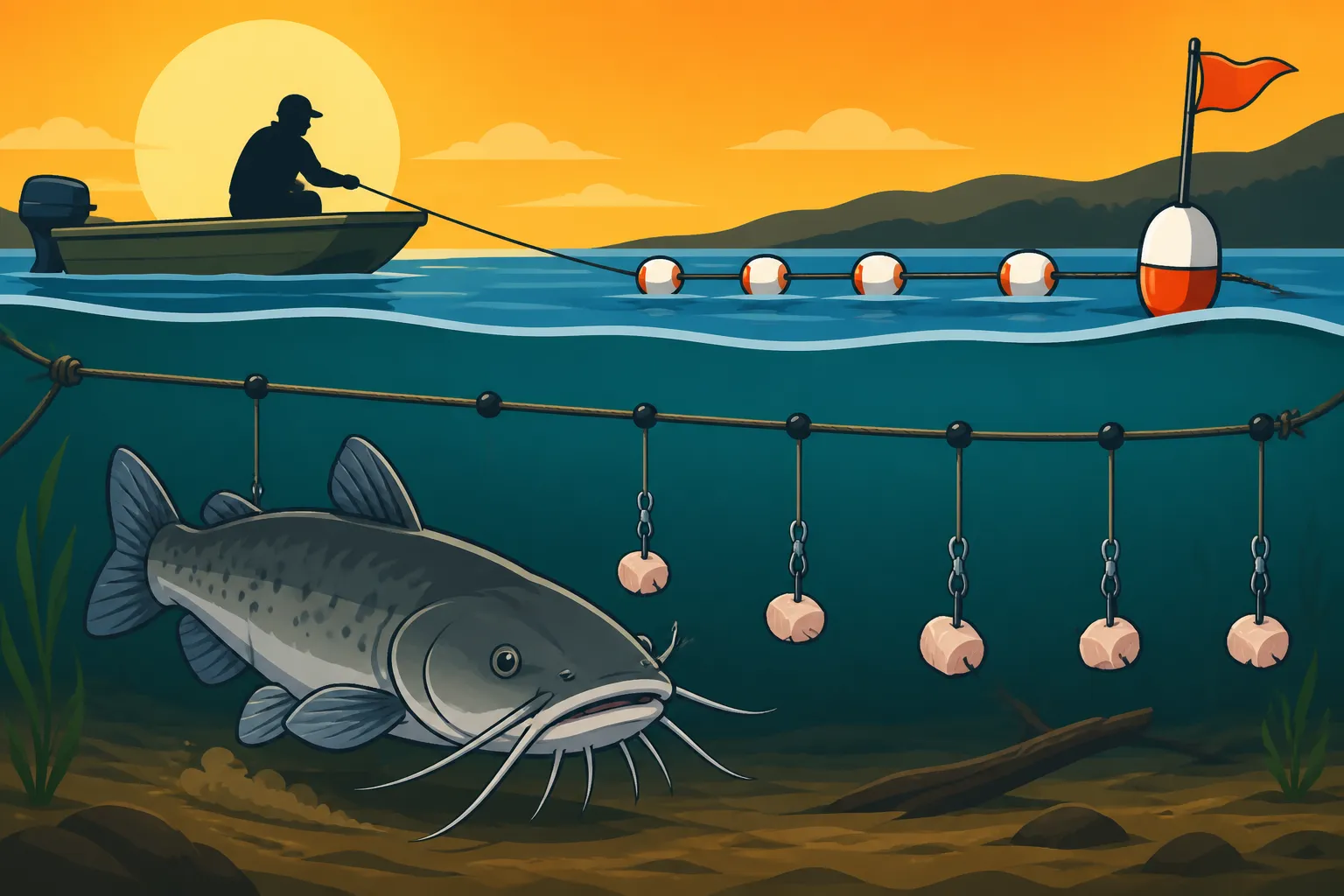
A basic trotline consists of several key components, each playing a vital role. First, you need your main line. This should be a strong, rot-resistant material like nylon or polypropylene rope, at least 1/4 inch in diameter. Many experienced anglers prefer braided nylon for its strength and resistance to tangling. You can find good quality ropes on platforms like Amazon, often in bulk spools. A general rule of thumb is to have enough line to span your chosen fishing area, plus extra for anchoring.
Next up are your leaders and hooks. Leaders are shorter lines (typically 12-18 inches) that attach to your main line, and then your hook goes on the end of the leader. Using leaders allows the bait to move more naturally and makes it easier to replace a hook if it gets snagged or broken. The leader material should be slightly lighter than your main line in terms of breaking strength, so if it gets snagged, you only lose the leader and hook, not your entire trotline. Monofilament or fluorocarbon lines in the 50-80 lb test range work well for leaders. For hooks, you’ll typically want a strong, sharp, large-gap hook, such as a 5/0 to 8/0 circle hook or an octopus hook. Circle hooks are often preferred because they are more humane and typically hook in the corner of the fish’s mouth, making release easier if you catch something you don't want to keep.
Finally, you'll need weights and anchors. Weights (like lead sinkers or concrete chunks) are essential for keeping your trotline submerged and stable. How many and how heavy depend on the length of your line and the current. Anchors are crucial for securing each end of your trotline. You can use large bricks, concrete blocks, or specialized trotline anchors. The key is that they must be heavy enough to hold your line in place, even against strong currents or the pull of a large fish. And, of course, don't forget those required marker buoys for each end of your line, along with your identification tags. Some anglers even buy pre-made trotline kits on Amazon, which can be a convenient starting point for beginners.
Tools and Additional Gear for Setup
Beyond the trotline itself, a few tools will make the setup process much smoother and safer. A sturdy pair of pliers or wire cutters is invaluable for cutting line, crimping sleeves, and removing hooks. A good knife, preferably one with a serrated edge for cutting rope, is also a must-have. You’ll definitely want some heavy-duty gloves, especially when handling sharp hooks and strong lines, as a snagged hook can easily go through skin.
If you’re setting your trotline from a boat, you'll need a way to easily move around the line. A paddle or a quiet trolling motor will be incredibly helpful for slowly navigating alongside the line as you set and bait it. A large cooler or a livewell is also essential for keeping your bait fresh and your catch alive and cool. Don't forget a first-aid kit, because accidents can happen, and a pair of binoculars might be useful for spotting your marker buoys from a distance. Thinking about where you plan to cast your line can lead you to discover some of the Best Catfish Fishing Spots in Oklahoma, so be sure to consider that research too.
Step-by-Step: Setting Up Your Trotline Properly
Now for the hands-on part! Setting a trotline correctly involves careful planning and execution to ensure it’s effective, safe, and compliant with regulations.
Anchoring and Stretching the Main Line
The first step is to get your main line anchored and stretched across your chosen fishing area. This typically involves two people if you're working from a boat, or a bit more creativity if you're bank fishing.
If you're using a boat, start by dropping your first anchor at one end of your desired trotline path. Make sure you tie your main line securely to this anchor, and remember to attach your marker buoy with the required identification tag. Once the first anchor is down, slowly move your boat across the water, steadily letting out the main line. As you go, you can begin attaching your leaders and hooks, or you can attach them all beforehand and coil your line carefully to prevent tangles. It's often easier to attach leaders and hooks before you deploy the line, but some prefer to do it on the fly.
When you reach the desired length, drop your second anchor, again making sure to tie the main line securely and attach the second marker buoy with its identification tag. The goal is to have the main line stretched fairly taut, but not so tight that it’s under extreme tension. A slight sag is okay, as it allows the line to absorb some of the shock from struggling fish and prevents it from being pulled free from the anchors. Consider the depth you want to fish; you can either suspend the trotline in the water column using additional floats along the main line or allow it to lay on the bottom, depending on where the catfish are holding. Many anglers target catfish near the bottom, so weights are often added to the main line every 10-20 feet to keep it submerged.
Attaching Leaders, Hooks, and Baits
Once your main line is securely in place, it’s time to attach your leaders and hooks, and then bait them up. If you haven't already attached your leaders, you'll do so now. This involves tying a strong knot, such as a snell knot or a Palomar knot, to secure the leader to the main line, ensuring the 24-inch spacing requirement between hooks is met. Many anglers use swivels to attach leaders to the main line, which helps prevent line twist and makes it easier to detach and reattach leaders.
After the leaders are on, tie your chosen hooks to the ends of the leaders. Again, a strong knot is critical here. Now, the exciting part: baiting! The type of bait you use will depend on the catfish species you're targeting and the time of year. For channel catfish and blue catfish, cut bait (like shad, carp, or perch), chicken livers, stink baits, and nightcrawlers are all incredibly effective. Flathead catfish, on the other hand, almost exclusively prefer live bait, such as small sunfish, shad, or goldfish. Ensure your bait is securely hooked so it doesn't get pulled off by small fish or current before a catfish finds it. For some great ideas on what to use, check out our guide on Best Bait for Catfish in Oklahoma Lakes and Rivers. Remember, different seasons might call for different approaches, so learning some Winter Catfishing Techniques in Oklahoma could also be beneficial depending on when you're fishing.
| Component | Material/Type | Purpose | Key Consideration |
|---|---|---|---|
| Main Line | Braided Nylon/Polypropylene | Main backbone of the trotline | Strong, rot-resistant, at least 1/4" diameter |
| Leaders | Monofilament/Fluorocarbon (50-80 lb) | Connects hooks to main line, allows natural bait movement | Slightly lighter test than main line, 12-18" long |
| Hooks | Circle/Octopus (5/0 – 8/0) | To catch the fish | Sharp, strong, large-gap, humane for release |
| Anchors | Concrete blocks, bricks, specialized | Secure ends of the trotline | Heavy enough to hold against current/fish |
| Weights | Lead sinkers, concrete chunks | Keep main line submerged | Distribute along main line to maintain depth |
| Marker Buoys | Bright plastic floats (20" above water) | Mark each end of the trotline | Highly visible, durable, clearly tagged with ID |
| ID Tags | Engraved metal, waterproof plastic | Required by law for identification | Durable, readable, includes name & address/ID |
Baiting Your Trotline for Oklahoma Catfish
The right bait can make or break your trotline's success. Catfish are opportunistic feeders, but they do have preferences that can significantly boost your catch rate.
Top Baits for Channel and Blue Catfish
For your most common Oklahoma catfish—the channel cat and the blue cat—you've got a fantastic array of bait options that are readily available and highly effective. Cut bait is king for both. Fresh shad, carp, or even panfish cut into chunks release strong scent trails that catfish simply can't resist. The oilier the fish, the better! Just make sure any cut bait you use is legally caught. Chicken livers are another classic. They're bloody, smelly, and catfish go wild for them, but they can be notoriously soft and hard to keep on the hook. Many anglers use a small piece of nylon stocking or thread to secure them better.
Prepared stink baits, often found in tubs at local tackle shops or on Amazon, are designed specifically to attract catfish with their potent aromas. There are various formulas, from punch baits to dip baits, and different brands will have loyal followers. Experimenting with different types can tell you what works best in your specific water. Nightcrawlers, earthworms, and even catalpa worms (when in season) are also excellent choices, especially for smaller channel cats or if you're looking to catch a mixed bag of fish. When planning your bait strategy, keep in mind how the fish's diet changes with the seasons. A guide like Best Catfish Bait for Summer Fishing, for example, will dive deeper into what works when the water is warm.
The Preferred Bait for Flathead Catfish
Flathead catfish are a different beast entirely. Unlike their channel and blue cat cousins, flatheads are primarily predators and prefer live bait over cut bait or stink baits. If you're targeting flatheads, you absolutely need to use live fish. Small sunfish (bluegill, green sunfish), live shad, goldfish, or even small carp are excellent choices. The key is to keep them alive and lively on the hook, as their struggles and vibrations are what attract the flathead.
When hooking live bait for flatheads, you'll want to hook them carefully through the back, just above the lateral line but avoiding the spine. This allows them to swim naturally and stay alive longer. Using a large, stout circle hook is also highly recommended, as flatheads have incredibly powerful jaws and strong bony mouths that can make hook sets challenging. Remember that any live bait you use must also be legally caught and not an invasive species in Oklahoma. A quick check on the regulations for what live bait is permitted is always a good idea. Understanding the unique preferences of this species is crucial if you want to find the Best Catfish Holes on Lake Eufaula, where trophy flatheads are often found.
Checking and Maintaining Your Trotline
Your work isn't over once the trotline is set and baited. Regular checks are vital for success, fish welfare, and compliance.
The Importance of Regular Checks
As mentioned earlier, Oklahoma law requires trotlines to be checked at least once every 24 hours. This isn't just a legal formality; it's good angling practice. Regularly checking your trotline means you're retrieving fresh fish that are still in good condition, rather than letting them spoil or suffer. It also allows you to re-bait hooks that have been stripped by smaller fish or that have had their bait fall off. A well-maintained trotline is a productive trotline.
When approaching your trotline for a check, do so slowly and quietly, especially if you're in a boat. Catfish can be sensitive to sudden movements or loud noises. Start at one end, carefully pull the main line into your boat, inspect each hook, remove any fish, re-bait as necessary, and then gently let the line back into the water. Having a de-hooking tool and a pair of pliers on hand will make removing hooks much easier, especially from larger fish. Be mindful of spines; catfish can inflict painful pokes. If you catch a fish you don't intend to keep or one that is undersized, release it quickly and gently to minimize stress. Be aware of the slot limits and overall bag limits for species like blue catfish – for example, remember The 30-Inch Blue Catfish Rule in Oklahoma.
Basic Maintenance and Safety Tips
Beyond daily checks, a bit of preventative maintenance can extend the life of your trotline and keep you safe. After each fishing trip, rinse your trotline thoroughly with fresh water to remove any mud, slime, or debris, especially if you're using stink baits. This prevents deterioration of the line and keeps it from smelling too foul in storage. Hang it to dry completely before storing it to prevent mildew and rot. Inspect your main line and leaders for any fraying or weakness, and replace damaged sections or hooks as needed. Sharp hooks are critical for good hooksets, so replace dull hooks.
Safety is paramount. Always wear those heavy-duty gloves when handling hooks and fish. Be aware of your surroundings, especially if you're setting or checking lines at night. Keep a flashlight or headlamp handy. If you’re using a boat, make sure all your necessary safety gear, like life jackets and a fire extinguisher, are on board. It’s also wise to have a plan for what to do with your catch. A large cooler with ice is essential for keeping your fish fresh until you can process them at home. Trotlining can be incredibly rewarding, but it demands respect for the regulations, the fish, and your own safety. Following these guidelines will ensure a productive and enjoyable experience on Oklahoma's waters.
Disclaimer
This article is for general informational purposes only and does not constitute professional advice. Laws, prices and regulations vary by location and change over time. Consult a qualified professional for guidance on your specific situation.