How to Anchor a Boat for Better Fishing
There's nothing quite like the frustration of finally finding that perfect fishing spot on an Oklahoma lake, only for the wind or current to slowly but surely nudge your boat away from the action. You cast, you retrieve, and just as you're about to make that crucial presentation, you realize you've drifted too far, missing the brush pile or submerged structure entirely. It's a common struggle for many anglers, but with the right approach to anchoring, you can hold your ground, improve your fishing, and keep your focus where it belongs – on catching fish. This comprehensive guide will walk you through everything you need to know about effectively anchoring your boat for a more successful and less frustrating day on Oklahoma's diverse waters.
Understanding Why Anchoring Matters for Oklahoma Anglers
Anchoring often feels like a simple task – drop it in, and you're good, right? But for serious anglers, it's a critical skill that impacts everything from casting accuracy to boat safety. The vast, often windy reservoirs of Oklahoma present unique challenges that make a solid anchoring strategy indispensable.
The Frustration of Uncontrolled Drifting
Imagine you've located a prime crappie brush pile on Lake Eufaula, or a rocky point where big bass are known to ambush baitfish on Grand Lake O' the Cherokees. You make a perfect cast, your lure lands exactly where it needs to be, but then a gust of wind catches your boat, or a subtle current begins to push you off course. Suddenly, your next cast is five feet off, then ten, and before you know it, you're fishing open water instead of that sweet spot.
This uncontrolled drifting isn't just annoying; it costs you fish. It makes it nearly impossible to consistently work a small, productive area. If you're trying to fish vertical jigs, or present a finesse bait precisely to a structure, even a slight drift can ruin your presentation. On lakes like Texoma, with its vast open waters and often strong winds, maintaining position without proper anchoring can feel like a constant battle, exhausting you and reducing your fishing time. Knowing How Wind Direction Affects Where Fish Feed is one thing, but being able to stay put is another entirely.
Safety and Stability on the Water
Beyond just catching more fish, a properly anchored boat offers significant safety and stability benefits. Picture yourself hooked into a monster blue catfish on Keystone Lake. That fish is fighting hard, pulling your boat, and you're trying to reel it in while also fighting the elements. A securely anchored boat provides a stable platform, allowing you to focus all your energy on the battle. This stability is even more crucial in choppy conditions or when fishing in areas with boat traffic.
Anchoring correctly prevents your boat from being pushed into hazards like submerged rocks, shallow areas, or even other boats. It also makes activities like tying on new lures, baiting hooks, or handling fish much safer and easier, especially if you're fishing solo or with kids. It transforms your boat from a moving target into a stationary base, making your entire fishing experience more relaxed and productive. Having a stable boat is a key part of any Oklahoma Boat Safety Equipment Checklist.
Choosing the Right Anchor for Oklahoma's Diverse Waters
Oklahoma's lakes and rivers boast a variety of bottom compositions, from soft mud and sand to jagged rock and stump fields. What works well on one lake might be completely ineffective on another, or even in a different part of the same lake. Selecting the right anchor type is the first step toward successful boat positioning.
Types of Anchors and When to Use Them
Just like you wouldn't use the same lure for bass, crappie, and catfish, you shouldn't rely on a single anchor for all situations. Understanding the common types available will help you make an informed choice for your specific fishing needs on Oklahoma waters. When looking for gear, remember that retailers like Amazon offer a wide range of anchor types suitable for different conditions.
-
Fluke (Danforth) Anchor: This is perhaps one of the most common and recognizable anchors, characterized by its two broad, flat flukes that pivot on a stock. It's designed to dig deeply into soft bottoms like sand, mud, and gravel. Many of Oklahoma's large reservoirs, such as Lake Eufaula, Fort Gibson, or Tenkiller, have significant areas with these bottom types, making the fluke anchor a reliable choice. However, it struggles to hold in rocky areas or dense vegetation where it can't penetrate.
-
Grapnel Anchor: Think of this as a multi-pronged grappling hook. Grapnel anchors excel in rocky bottom environments or areas with heavy debris, as their prongs can snag onto rocks or logs, providing a hold. They are also popular for smaller boats or kayaks due to their compact size and foldability. While they can be effective, they are also prone to getting irretrievably snagged, which is a major headache. These are good for quick stops or temporary holds on small, clear-bottomed ponds too.
-
Claw (Bruce) Anchor: Originally designed for offshore oil rigs, the claw anchor is known for its impressive holding power and ability to reset quickly if it breaks free. It's a versatile performer, holding well in a variety of bottom conditions including mud, sand, rock, and even heavy grass. Many larger bass boats and multi-species fishing boats on expansive Oklahoma lakes like Grand Lake or Lake Murray will have a claw anchor as their primary choice due to its reliability.
-
River Anchor (Mushroom/Pyramid): These anchors are typically heavy, compact, and designed to sink quickly and dig into soft, muddy, or silty river bottoms. While less common for lake fishing, if you find yourself fishing the lower stretches of Oklahoma's rivers like the Arkansas or Red River, or in areas with strong currents and soft bottoms, a pyramid or mushroom anchor might be the best option to resist the pull of the flow.
-
Stake-Out Poles/Shallow Water Anchors: While not traditional anchors with rope, these deserve a mention for shallow water fishing. These are poles (often fiberglass or aluminum) that you manually push into the soft bottom to pin your boat in place. Companies offer motorized versions that deploy at the push of a button. They are incredible for bass and crappie anglers targeting shorelines, shallow flats, or flooded timber in depths generally under 8-10 feet. This gear is especially handy for kayak anglers who often find themselves fishing in very shallow areas.
Sizing Your Anchor for Your Boat and Conditions
Choosing the right type is only half the battle; you also need to make sure your anchor is appropriately sized for your vessel and the conditions you typically encounter. There's no one-size-fits-all answer, as anchor sizing depends on several factors:
-
Boat Length and Weight: Naturally, a heavier boat requires a heavier and/or larger anchor to hold it securely. A 16-foot aluminum jon boat won't need the same anchor as a 21-foot fiberglass bass boat. Always refer to the anchor manufacturer's recommendations, which typically provide guidance based on boat length.
-
Windage: This refers to how much of your boat is exposed to the wind. Boats with high sides (like many pontoon boats) or those with lots of gear mounted on top (like extensive bimini tops) will catch more wind and require a more robust anchoring system, even if they aren't exceptionally long or heavy. Strong winds are common on Oklahoma's large, open reservoirs like Lake Texoma, so always over-estimate your needs rather than under-estimate.
-
Current Strength: If you frequently fish in rivers or areas with strong currents (like below dams on the Arkansas River), you'll need an anchor with superior holding power, possibly heavier than what's recommended for a calm lake of the same size.
-
Bottom Composition: While a claw anchor is versatile, if you know you'll primarily be fishing soft, muddy bottoms, a fluke anchor designed specifically for that might hold better with less weight than a general-purpose anchor.
As a general rule, it's better to go slightly larger or heavier than you think you need, especially if you venture out in less-than-ideal weather. A smaller, lighter anchor might save you a few bucks, but it's worthless if it can't hold your boat when you need it most. Many anglers find high-quality anchors and anchor lines on sites like Amazon, often reading reviews to ensure they get the right size for their specific boat model. If you're looking for Best Anchor for Fishing From a Boat on Oklahoma Reservoirs, consider these factors carefully.
Essential Anchoring Techniques for Oklahoma Fishing Success
Having the right anchor is a great start, but knowing how to deploy and retrieve it properly is what truly sets effective anglers apart. There's an art and a science to it, especially when trying to hit a specific fishing spot.
The Proper Anchor Set: Scope, Location, and Retrieval
Dropping an anchor isn't just about letting it go. A truly effective anchor set involves careful consideration of "scope," where you drop it, and how you ensure it's dug in. This is a fundamental part of Boat Fishing Techniques for Beginners.
-
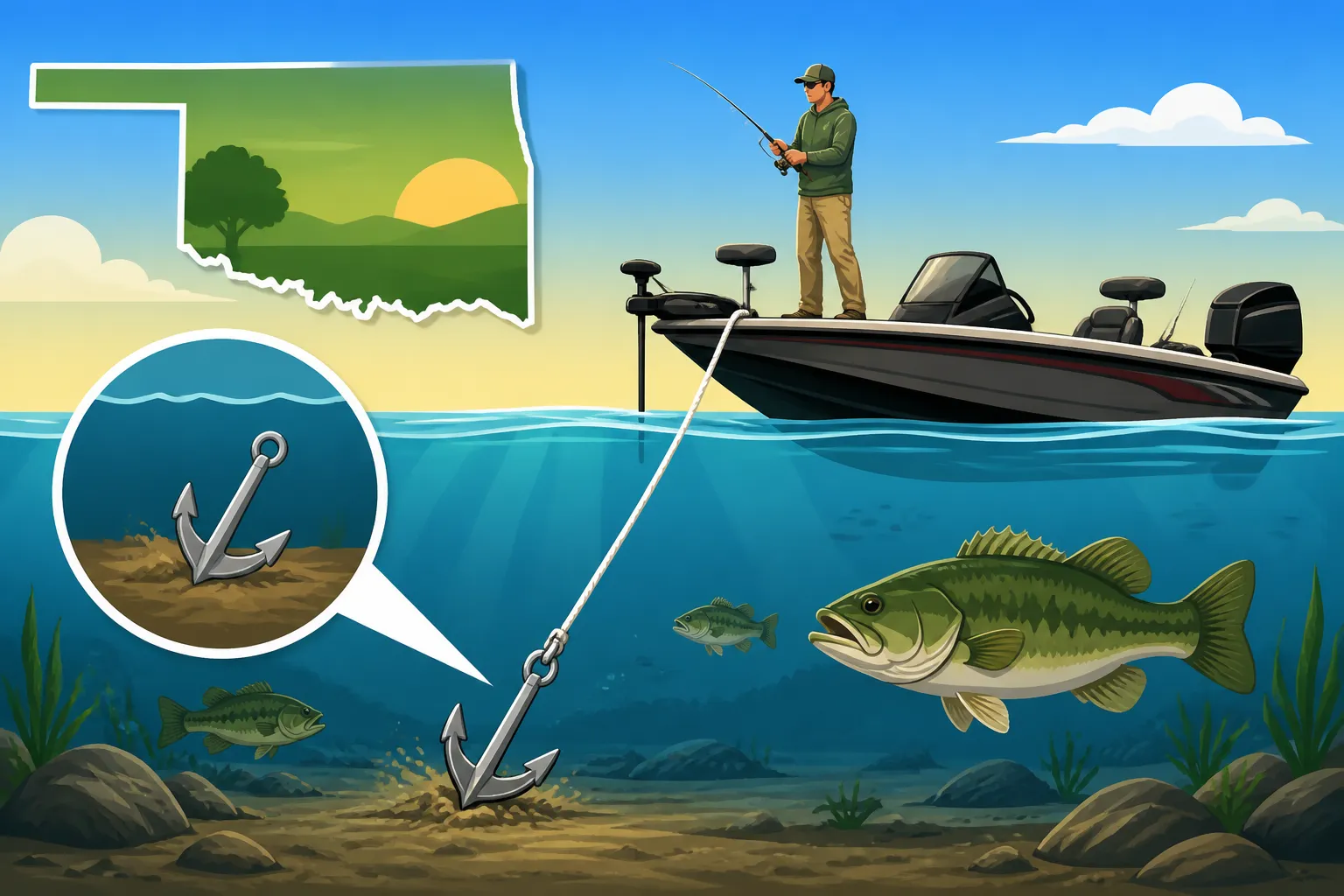
Understanding Scope: This is probably the most crucial concept in anchoring. "Scope" refers to the ratio of your anchor line's length to the depth of the water (plus any distance from the water's surface to where your anchor line attaches to the boat, if significant). The ideal scope for most fishing situations is often cited as 7:1, meaning for every 1 foot of water depth, you need 7 feet of anchor line out. A minimum of 5:1 is generally acceptable in calm conditions. Why so much line? A long scope allows the anchor to pull horizontally along the bottom, which encourages the flukes or claws to dig in and hold firmly. If you drop the anchor straight down with too little line, it will simply drag or skip along the bottom like a rock. On a breezy day on Lake Texoma in 20 feet of water, you'd want at least 100-140 feet of rope out to ensure a good hold.
-
Strategic Location and Deployment: Don't just motor over your desired fishing spot and drop anchor. You need to approach the spot from upwind or upcurrent, depending on which force is stronger. As you approach, estimate how far you'll drift or be pushed, and then drop your anchor upstream/upwind of your target area. As your boat drifts back, pay out your anchor line smoothly, letting the anchor settle to the bottom. Once you're roughly over your spot, cleat off the line and let the boat pull against the anchor. You should feel it dig in. A quick trick is to put your boat in reverse (very gently, just enough to create a little tension) to help the anchor set firmly.
-
Smooth Retrieval: Retrieving an anchor incorrectly can be a real workout and potentially dangerous. Never try to just yank the anchor straight up if it's deeply set. Instead, slowly motor your boat directly over the anchor. As your boat passes over the anchor, the pull will become vertical, breaking the anchor free from the bottom. Once it's free, you can begin to retrieve the line, hand-over-hand or using an anchor winch if you have one. Ensure you coil the rope neatly into an Best Anchor for Fishing From a Boat on Oklahoma Reservoirs – specific container or bag to prevent tangles on the next deployment.
Advanced Anchoring Strategies for Finesse Fishing
Sometimes, just holding your boat in place isn't enough. You need to position it precisely for specific casting angles or to effectively work a large piece of structure.
-
Bow vs. Stern Anchoring (and Dual Anchoring): Most anglers anchor from the bow (front) of their boat. This positions the boat to face into the wind or current, providing the most stable platform and allowing you to cast off the stern or sides. Anchoring solely from the stern is generally not recommended as it makes the boat less stable and can allow waves to break over the transom, but it can be useful for very specific casting angles if the wind is light. For ultimate stability and precise positioning, consider using dual anchoring – one anchor off the bow and one off the stern. This "locks" your boat in place, preventing any swing or drift, which is ideal for working a long brush pile or a specific rock ledge on lakes like Hudson or Arbuckle.
-
Spot-Lock Trolling Motors: This is where modern technology truly shines and has revolutionized boat positioning for many anglers. GPS-enabled trolling motors, like those from Minn Kota with their "Spot-Lock" feature or Garmin's Force trolling motor, can digitally hold your boat in place at the push of a button. Instead of dropping an anchor, the trolling motor uses its prop to precisely counteract wind and current, keeping you exactly where you want to be. While these aren't traditional anchors, they serve the same purpose with incredible precision and ease, often allowing anglers to quickly move between spots without the hassle of anchor retrieval. You can find these advanced trolling motors and accessories on platforms like Amazon. If you're considering a new setup, learning about Trolling Motor Setup for Oklahoma Striped Bass might be insightful.
-
Drift Socks/Sea Anchors for Controlled Drifting: While not anchors in the traditional sense, drift socks (sometimes called sea anchors) are invaluable for controlled drifting. These cone-shaped fabric devices are deployed from your boat and fill with water, creating drag that slows your boat's drift significantly. This allows you to cover a larger area slowly and thoroughly, presenting baits to fish that might be scattered. They are excellent for white bass, crappie, or even striped bass fishing on large, open bodies of water where the fish are spread out, and you want to maintain a slow, consistent speed, but a full anchor would be too restrictive.
Common Anchoring Mistakes and How to Avoid Them
Even seasoned anglers can make anchoring mistakes. Being aware of the most common pitfalls can save you time, frustration, and even prevent dangerous situations on the water.
Insufficient Scope and Improper Setting
This is by far the most frequent mistake. Many anglers, especially those new to boating or fishing, tend to use too little anchor line. They drop the anchor directly under the boat, or only let out a few feet of rope, expecting it to dig in. The result? The anchor drags, the boat drifts, and frustration mounts. Always remember that 5:1 or 7:1 scope ratio. It might seem like a lot of rope, but it’s essential for the anchor to work as intended.
Another error is simply throwing the anchor overboard, especially if it's chained. This can cause the line to tangle, damage the boat, or even injure someone. Always lower the anchor deliberately until it reaches the bottom. Then, slowly back off or drift with the wind/current while paying out the appropriate amount of line before allowing the boat to pull against it to ensure it sets firmly. Patience is key when setting an anchor; a few extra moments upfront save endless adjustments later.
Ignoring Bottom Composition and Water Conditions
Fishing in Oklahoma means encountering everything from deep, soft mud to jagged rock piles. Using a fluke anchor on a rocky bottom is an invitation for it to snag permanently or fail to hold. Conversely, a grapnel anchor might hold well on rock but simply slide across a soft, muddy flat. Always try to understand the bottom composition of the area you're fishing. Many modern fish finders can give you a good indication of bottom hardness.
Furthermore, ignoring strong winds or currents is a recipe for disaster. What works on a calm morning might be completely inadequate when a strong cold front blows in. Always factor in the weather conditions – existing and forecast – when choosing your anchor and deploying it. If the wind is truly howling, a single anchor might not be enough, or it might be safer to simply use a drift sock for controlled movement rather than risking an insecure hold. Planning ahead, including reviewing Best Time of Day to Fish Oklahoma Lakes in Summer and understanding how weather impacts fishing, is crucial.
Overlooking Anchor Line and Chain Maintenance
An anchor is only as good as the line and chain attached to it. Many anglers neglect these crucial components, leading to potential failures.
-
The Importance of Anchor Chain: A common oversight is not using enough, or any, anchor chain. The chain provides essential weight at the anchor's shank, forcing it to lie flat on the bottom and helping the flukes or claws dig in more effectively. Without chain, the anchor line will pull up on the anchor, reducing its holding power. A good rule of thumb is to have at least 6-10 feet of galvanized chain between your anchor and your rope. This also protects the nylon rope from abrasion on the bottom.
-
Checking Rope Condition: Regularly inspect your anchor rope for fraying, cuts, or weak spots, especially near the anchor and where it attaches to the boat. UV exposure and friction can degrade nylon rope over time. A frayed rope can snap under tension, sending your expensive anchor to the bottom forever, and leaving you drifting. Replace worn rope promptly.
-
Proper Storage: A tangled anchor line is a nightmare, costing valuable fishing time. Store your anchor and line neatly, either coiled in a dedicated anchor locker or in an Best Tackle Box Setup for a Day on the Water style bucket or bag. This keeps it out of the way, prevents tripping hazards, and ensures it's ready for smooth deployment when you need it. You can find excellent anchor rope bags on Amazon that keep everything tidy and ready for action.
By paying attention to these details, you can ensure your anchoring system is reliable, safe, and contributes to a much more productive day on the water, no matter where your Oklahoma fishing adventures take you.
Anchor Type Comparison for Oklahoma Anglers
To help you decide which anchor is best for your typical fishing scenarios in Oklahoma, here's a quick comparison:
| Anchor Type | Best Bottom Type(s) | Holding Power Rating (1-5, 5=highest) | Common Use Case in Oklahoma Lakes | Pros | Cons |
|---|---|---|---|---|---|
| Fluke (Danforth) | Sand, Mud, Silt | 4 | Eufaula, Fort Gibson (soft bottoms), general lake fishing | Excellent hold in soft bottoms, relatively lightweight, compact | Poor in rock/heavy grass, can drag if not set properly, won't reset well |
| Claw (Bruce) | Sand, Mud, Rock, Grass | 5 | Grand Lake, Texoma, Murray (all-around fishing) | Very versatile, high holding power, resets easily if dragged | Can be bulky, heavier for its size |
| Grapnel | Rock, Heavy Debris | 2-3 | Small boat/kayak in rocky areas, temporary stops in rivers | Good for snagging rocks, compact/foldable for storage | Low holding power in soft bottoms, prone to getting permanently snagged |
| River (Mushroom/Pyramid) | Mud, Silt, Current | 3 | Arkansas River, Red River (areas with strong current/soft mud) | Designed for river currents, digs into soft mud quickly | Limited use in lakes, can drag in hard bottoms |
| Stake-Out Poles | Soft Mud, Sand (shallow) | 4 (in suitable depth) | Shallow bass/crappie fishing, kayak fishing | Instant deployment, silent, no rope to manage | Only for shallow water (typically <10ft), can get stuck in hard bottoms |
This article is for general informational purposes only and does not constitute professional advice. Laws, prices and regulations vary by location and change over time. Consult a qualified professional for guidance on your specific situation.