Green Sunfish vs Bluegill: How to Tell Them Apart
Have you ever been out on an Oklahoma pond, reeling in what you think is a bluegill, only to have a nagging feeling that it looks just a little…different? You’re not alone! It's a common frustration for anglers, especially those just getting into the wonderful world of panfishing here in our beautiful state. Those smaller, feisty fish often get lumped together, but knowing the difference between a Green Sunfish and a Bluegill can actually make your fishing trips more enjoyable and even help you tailor your techniques. This guide is here to unravel the mystery, giving you clear, actionable ways to tell these two popular Oklahoma catches apart.
The Frustration of Sunfish Identification
It’s easy to feel a bit flustered when trying to distinguish between different sunfish species. They’re all generally small, often colorful, and frequently inhabit similar waters. For many, a "sunfish" is just a "sunfish," especially when you're just looking for some fun, fast action with the kids. But for those of us who love to really understand what we're pulling out of the water, that slight confusion can be a real head-scratcher.
Why Anglers Mix Them Up
One of the biggest reasons these two get mixed up is their shared habitat and similar overall appearance. Both Green Sunfish and Bluegill are abundant in Oklahoma’s ponds, lakes, and slower-moving streams. They often school together, and at first glance, a young Green Sunfish can look a lot like a Bluegill, especially when you're trying to keep a squirming fish in hand while also admiring its colors. Both have that classic panfish shape – roundish, compressed bodies, with dorsal fins that look like they're almost two separate fins joined together. Plus, their coloration can vary quite a bit depending on the water clarity, depth, and even their mood, which adds another layer of complexity to identification. It’s not like they wear nametags, right?
The Importance of Knowing Your Catch
So, why bother? Well, beyond the pure satisfaction of knowing your fish, there are a few practical reasons. For starters, understanding the species you're catching can help you refine your techniques. Green Sunfish often prefer slightly different baits or presentations than Bluegill, even if they're in the same general area. Knowing what you've hooked can also give you clues about the overall health of the fishery and what other species might be lurking nearby. Furthermore, while their bag limits are usually pretty generous for panfish, specific regulations can sometimes apply, though typically not to the extent of large game fish like bass or catfish. Still, developing that keen eye for identification is a fundamental part of becoming a more skilled and knowledgeable angler. It's all part of the outdoor education we cherish. For more on what makes a specific type of fish a good target for newer anglers, check out Best Fish Species to Target for Beginners in Oklahoma.
Green Sunfish: The Feisty Little Brawler
Ah, the Green Sunfish. These little guys are often underestimated, but they pack a punch for their size. If you've ever caught one, you know they hit a bait with surprising aggression and fight hard all the way to the bank or boat. They might not get as big as some of their sunfish cousins, but what they lack in size, they make up for in sheer determination. They are truly one of the most reliable catches for continuous action on a slow day.
Key Physical Characteristics of Green Sunfish
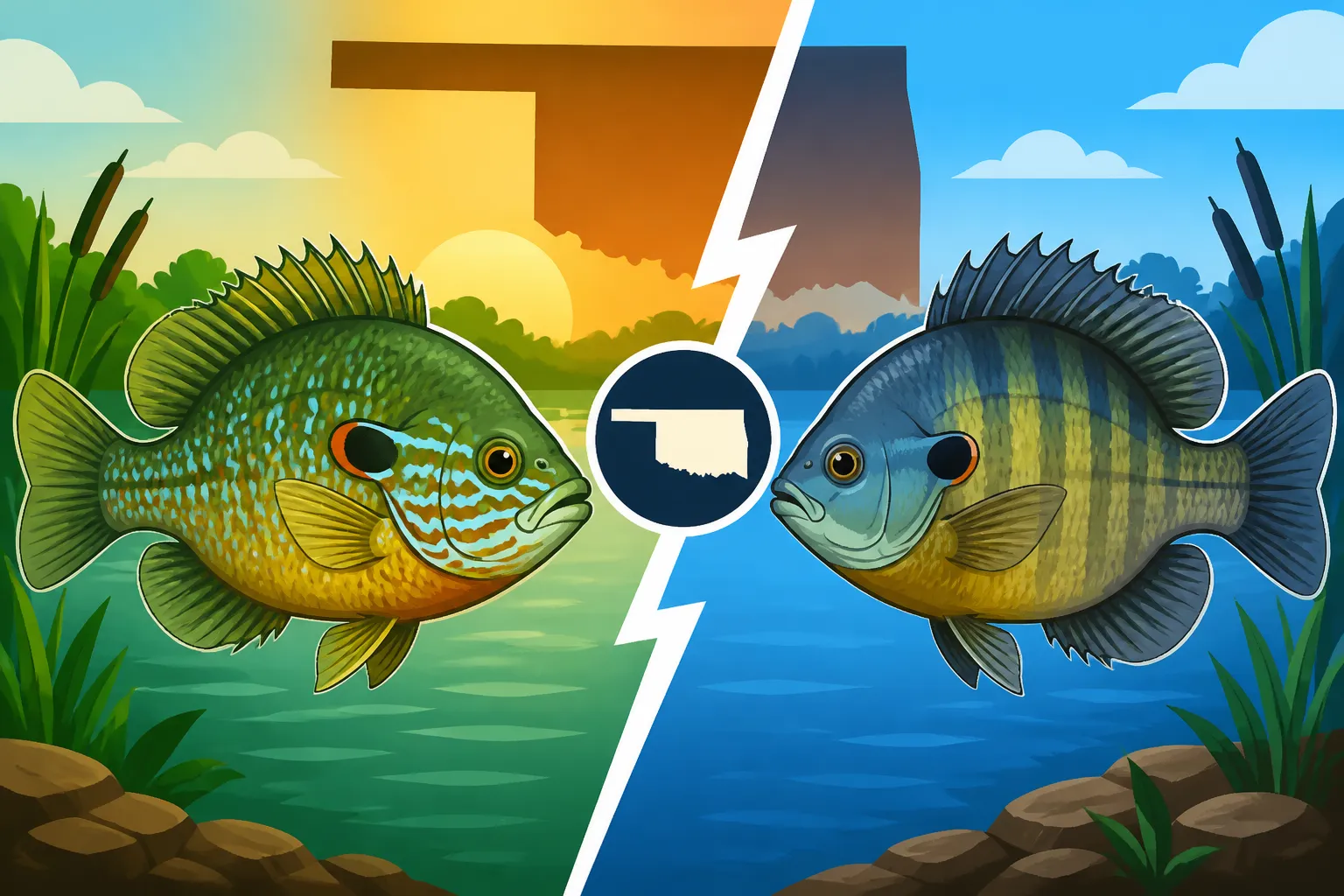
Let's get down to the nitty-gritty. The most distinguishing feature of a Green Sunfish, in my opinion, is its mouth. They have a surprisingly large mouth for a sunfish, extending back at least to the middle of the eye, often even past it. Imagine a bass in miniature form, and you’re pretty close. Their body color is typically an olive green to brownish green on the back, fading to lighter green or yellowish on the sides and a white or yellowish belly. What really sets them apart are the iridescent blue-green spots and streaks you'll often see on their cheeks and gill covers – these are like little underwater tattoos! And, crucially, look for a dark spot on the rear of the dorsal fin, often ringed with a lighter color, and a dark spot on the anal fin. Their opercular flap (that stiff "ear flap" extension on their gill cover) is usually black with a distinct light-colored, often orange or red, margin. This margin is key. For even more specific pointers, you might find Green Sunfish Identification for Oklahoma Anglers helpful.
Typical Habitat and Behavior
Green Sunfish are incredibly adaptable, which is why you can find them almost everywhere in Oklahoma. They thrive in a wide variety of habitats, from small farm ponds and slow-moving creeks to the shallower, weedy coves of larger reservoirs like Lake Eufaula or Grand Lake O' the Cherokees. They tend to prefer areas with some cover, whether it's submerged vegetation, fallen trees, rocky banks, or even old tires and debris. You'll often find them lurking around docks or under lily pads, ready to ambush anything that swims by. They're opportunistic feeders, which explains that big mouth! They'll eat insects, small minnows, crayfish, and anything else they can get their jaws around. This aggressive nature makes them a blast to catch, especially for kids. They aren't picky, which is why they are often one of the first fish a new angler pulls in.
Fishing for Green Sunfish
Fishing for Green Sunfish is straightforward and a ton of fun. Because they're so aggressive and not particularly choosy, they make excellent targets for beginners and seasoned anglers alike who just want to bend a rod. Small hooks (size 8 or 10) tipped with a piece of worm, a tiny crickets, or even a kernel of corn suspended under a bobber are deadly effective. For lure anglers, micro jigs, small spinners, or tiny crankbaits can also elicit aggressive strikes. Focus on those areas with cover: cast near brush piles, along rocky shorelines, or around submerged timber. They're often found close to the bank, so you don't always need a boat. Bank fishing from a pier or a grassy bank is often all it takes. If you’re looking for a good starter tackle box to keep all these small baits organized, Amazon has some fantastic, affordable options that are perfect for panfishing.
Bluegill: The Classic Panfish of Oklahoma
If the Green Sunfish is the brawler, the Bluegill is the beloved classic. These are arguably the most iconic panfish in Oklahoma, conjuring images of lazy summer days, bobbers dancing, and kids squealing with delight. They're known for their distinctive appearance and their tendency to school up, offering continuous action when you find a good spot.
Key Physical Characteristics of Bluegill
The Bluegill, as its name suggests, often has a lovely blue or purplish sheen on its gill plate and jaw area, especially in males during spawning season. Their body is typically a deep, compressed disc shape, almost perfectly round from the side, with a smaller mouth compared to the Green Sunfish – it rarely extends past the front of the eye. Coloration can vary widely, from dark olive green on the back to lighter, yellowish sides, often with several dark, vertical bars that are more prominent in some fish than others. They have a characteristic dark spot at the base of the soft dorsal fin. Perhaps the most defining feature is their opercular flap (the "ear flap"). It's solid black from edge to edge, with no light-colored margin, or at most, a very faint, narrow reddish hue right at the tip that is not a distinct band. This solid black flap is a major clue! We delve deeper into this specific feature in Bluegill's Blue-Black Ear Flap vs the Green Sunfish's Olive Body.
Typical Habitat and Behavior
Bluegill are found in virtually all of Oklahoma's freshwater systems, from the smallest farm ponds to massive reservoirs like Lake Texoma or Fort Gibson Lake. They prefer clear, warm waters with plenty of aquatic vegetation and submerged structure. You'll often find them in schools, especially around weeds, brush piles, or submerged timber, much like Green Sunfish, but they tend to be a bit more finicky about water quality. During the spring and early summer, you can find them "bedding" in shallow, sandy or gravelly areas, creating distinct circular depressions on the bottom where they guard their nests. This is often the best time to catch a lot of them quickly. They primarily feed on insects, insect larvae, small crustaceans, and sometimes even algae. Their smaller mouth dictates their diet more towards these smaller food items. If you want to maximize your chances of catching a lot of them, you'll want to know Best Time of Year to Catch Bedding Bluegill.
Fishing for Bluegill
Bluegill fishing is a quintessential Oklahoma experience. They are perfect for teaching beginners the joys of fishing. Small baits are key due to their smaller mouths. Worms, crickets, grasshoppers, and even small bits of bread or corn are incredibly effective. A simple hook (size 10 or 12), a split shot, and a bobber are all you need. Ultralight spinning gear or even a cane pole is ideal for feeling those delicate bites. Target areas with submerged vegetation, lily pads, docks, or brush piles. When you find a school, the action can be non-stop! It's not uncommon to catch dozens in a single session. For those who enjoy fly fishing, bluegill readily take small poppers, nymphs, and wet flies, making them a fantastic target for fly anglers as well. A small, lightweight rod and reel combo, perhaps one you picked up on Amazon, is perfect for these panfish.
Side-by-Side Comparison: Spotting the Differences
Alright, let’s get down to the brass tacks. When you've got a sunfish in your hand, how do you quickly and confidently say, "Aha! You're a Bluegill!" or "You, my friend, are a Green Sunfish!" It boils down to a few key visual cues that become second nature with practice.
Tale of the Opercular Flap (Ear)
This is perhaps the easiest and most reliable identifier. The opercular flap is that stiff, bony extension on the back of the gill cover.
- Green Sunfish: Will have a black opercular flap with a distinct, often bright, orange or red margin around the edge. Think of it as a black earring with a colorful border.
- Bluegill: Will have a solid black opercular flap. No colored margin, or if there is, it’s extremely faint and barely perceptible, definitely not a bright band. It’s a plain black earring.
This one feature alone will solve most of your sunfish identification dilemmas right there on the water. It’s usually visible even on smaller, juvenile fish.
Mouth Size and Body Shape Nuances
While the opercular flap is the superstar, the mouth and body shape are excellent supporting actors.
- Green Sunfish: Remember that "brawler" description? That's because of their large mouth. If you draw an imaginary line vertically from the front of the eye down, a Green Sunfish's mouth will extend at least to that line, and often past the middle of the eye. Their body tends to be a bit more elongated, a bit more football-shaped than the almost perfect circle of a bluegill.
- Bluegill: Their mouth is noticeably smaller, usually not extending past the front edge of the eye. They are truly the "pan" fish, with a very deep, compressed, and almost perfectly round body shape.
When you hold them side-by-side, the difference in mouth size and overall body proportion is quite striking.
Coloration and Fin Patterns
Coloration can be tricky because it varies so much, but there are still patterns to look for.
- Green Sunfish: Generally olive to brownish-green, often with iridescent blue-green spots and streaks on the face and gill covers. Look for distinct dark spots on the rear of both the dorsal and anal fins, which might be ringed with a lighter color.
- Bluegill: Often have a more pronounced blue or purplish sheen on the gill plate and jaw. Their body might show subtle dark vertical bars, especially when excited or stressed. They have a single, prominent dark spot at the base of the soft dorsal fin, but typically lack the distinct dark spot on the anal fin that a Green Sunfish usually has.
Here's a quick table to summarize these key differences:
| Feature | Green Sunfish | Bluegill |
|---|---|---|
| Opercular Flap | Black with a distinct light-colored (orange/red) margin | Solid black, no distinct margin (or very faint/none) |
| Mouth Size | Large, extends past the front of the eye | Small, usually does not extend past the front of the eye |
| Body Shape | More elongated, less deep-bodied | Deep-bodied, almost perfectly round |
| Face/Cheeks | Iridescent blue-green spots/streaks | Often bluish or purplish sheen on gill plate |
| Dorsal/Anal Fins | Dark spot on both dorsal and anal fins | Dark spot only at the base of the soft dorsal fin |
| Vertical Bars | Absent or very faint | Often present, especially in stressed or spawning fish |
Why Distinguishing Matters for Oklahoma Anglers
Beyond simply satisfying your curiosity, there are legitimate reasons why being able to tell a Green Sunfish from a Bluegill is a valuable skill for any Oklahoma angler. It's not just about showing off; it's about being a more informed and effective participant in our state's rich fishing culture.
Bag Limits and Regulations
While most sunfish species fall under general panfish regulations in Oklahoma, which are typically very generous or non-existent for daily bag and possession limits, there can be exceptions or nuances. Knowing exactly what you've caught ensures you're always compliant with current rules, particularly if you're fishing in specific lakes or ponds that might have unique management plans. Even if the immediate impact isn't about avoiding a fine, it's about respecting the resource and contributing to sustainable fishing practices. For general insights into statewide regulations, consider exploring Fishing Regulations You Need to Know in Oklahoma. It's always a good idea to refresh your memory on the basics.
Tailoring Your Approach for Better Success
Different species, even closely related ones, can have subtle preferences when it comes to bait, lures, and fishing locations.
- Green Sunfish: Because of their larger mouth and aggressive nature, Green Sunfish are more likely to hit slightly larger baits or more aggressive lures like small crankbaits or even small plastic worms designed for bass. They'll readily take crickets and worms, but their willingness to strike a varied offering makes them a fun species to experiment with.
- Bluegill: With their smaller mouths and often daintier bites, Bluegill typically respond best to smaller hooks and baits. Think tiny pieces of worm, mealworms, or specialized panfish jigs. You might miss more bites if your bait is too big.
Understanding which species you're primarily catching can help you adjust your tackle and technique on the fly, leading to more fish in your cooler or more fun on the end of your line. For specific bait recommendations, Best Bait for Crappie in Oklahoma (another panfish) or Best Bait for Bluegill in Oklahoma Ponds offers some excellent tips that often cross over for sunfish.
The Joy of Accurate Identification
Honestly, there's a deep satisfaction in knowing what you've caught. It connects you more intimately with the natural world and deepens your appreciation for the diversity of fish living in Oklahoma's waters. It turns a generic "sunfish" into a specific, identifiable creature with its own unique characteristics and behaviors. This accuracy can also be a point of pride when sharing your fishing stories or photos with fellow anglers. It makes you a more knowledgeable contributor to the fishing community and gives you a better grasp of the broader Oklahoma's 181 Fish Species: A Quick Overview. So next time you pull in a panfish, take a moment, check that opercular flap, look at the mouth, and enjoy the confidence of knowing exactly what you've got!
Disclaimer
This article is for general informational purposes only and does not constitute professional advice. Laws, prices and regulations vary by location and change over time. Consult a qualified professional for guidance on your specific situation.