How to Identify a Flathead Catfish
Few things are as frustrating as reeling in a powerful fight, only to pull it closer and realize you're not entirely sure what kind of catfish you've just landed. Oklahoma waters are teeming with different species, and while many anglers can spot a channel cat a mile away, the subtle differences between a flathead and its cousins can stump even seasoned pros. This guide will walk you through the distinct characteristics of the mighty flathead catfish, helping you confidently identify your catch and understand its unique place in our state's aquatic ecosystem.
General Characteristics of the Flathead Catfish
When you first encounter a flathead catfish, you'll immediately notice some distinct features that set it apart. Unlike the sleek, often spotted channel catfish or the broad, powerful blue catfish, flatheads have a rustic, almost ancient appearance. They're built for ambush, and their physical attributes reflect this predatory lifestyle. Understanding these general traits is your first step in accurate identification, especially when you're dealing with different sizes and color variations across various Oklahoma lakes and rivers.
Body Profile and Shape
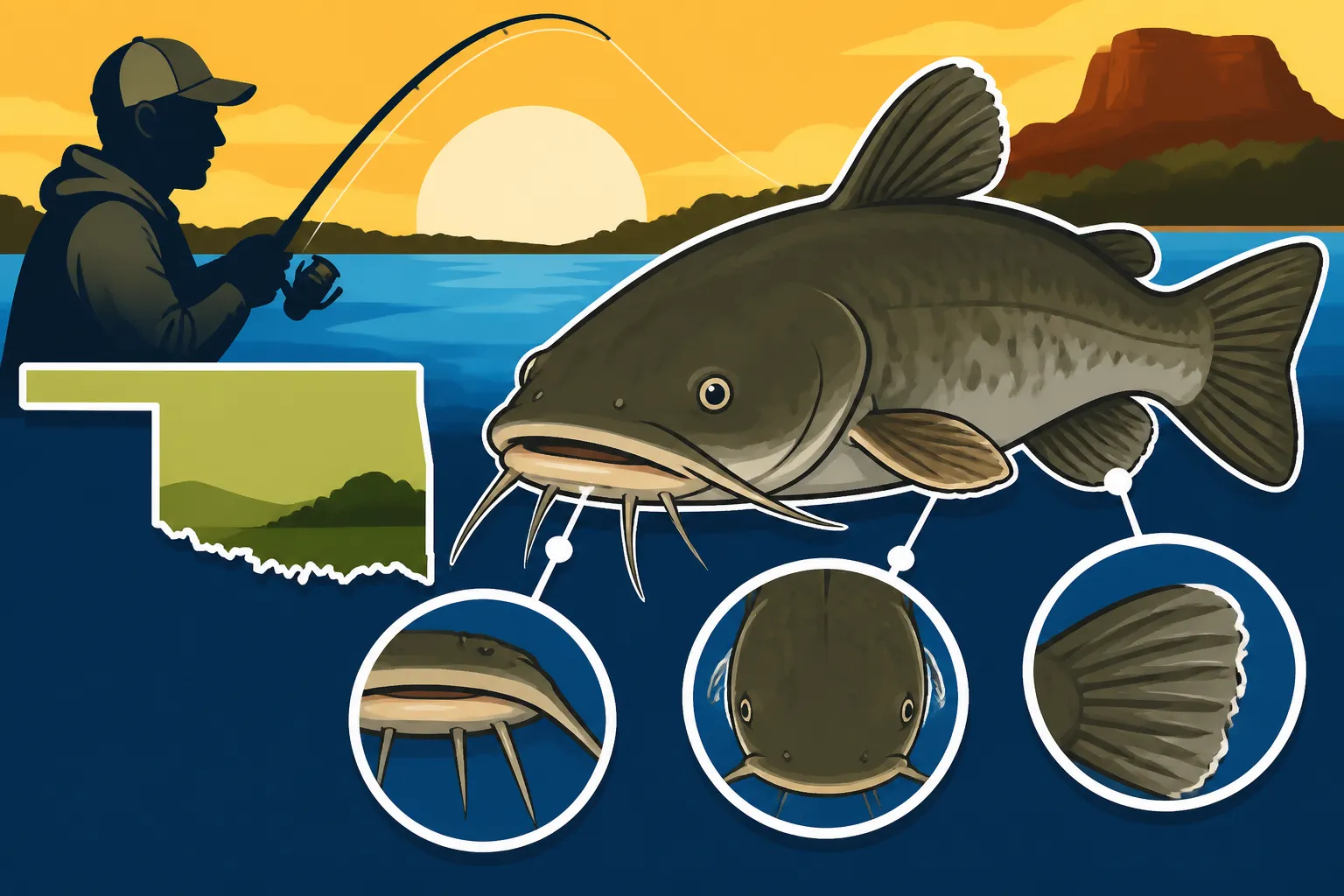
The most striking feature of a flathead catfish is, as its name suggests, its incredibly flat, broad head. This isn't just a minor difference; it's a defining characteristic. Picture a broad shovel or a flattened stone. This wide, depressed head tapers sharply towards the mouth. Their bodies are generally more robust and chunky than a channel cat, but not as streamlined and deep-bodied as a large blue catfish. They have a more cylindrical, almost "stocky" build in the midsection, which then tapers down to a moderately forked tail. If you're comparing it side-by-side with other catfish, the flathead often looks less "athletic" and more "stocky" or "powerful." The overall impression is one of brute strength and a low-slung, bottom-dwelling existence.
When you're out on a boat, perhaps enjoying the vastness of Lake Eufaula, and you hook into something that feels like a log, observe its body shape as you bring it alongside. Is its head wide and flattened, almost triangular from above? Does its body feel thick and heavy? These are strong indicators you're dealing with a flathead. Their substantial build is perfectly suited for navigating the complex underwater structure they prefer.
Coloration and Patterns
Flathead catfish display a remarkable range of colors, which can sometimes make identification a little tricky if you're solely relying on hue. Generally, they have a mottled, olive-brown to yellowish-brown body, often with darker blotches and spots that create a camouflaged pattern. Their bellies are typically a creamy white or pale yellow, a stark contrast to their darker backs and sides. This mottled pattern is particularly pronounced in younger flatheads and those caught in clearer, rocky waters, helping them blend seamlessly with their surroundings as they lie in wait for prey.
However, the specific color can vary quite a bit depending on the water clarity, bottom composition, and even the diet of the individual fish. A flathead caught from a muddy river bottom might appear much darker and more uniform brown, while one from a clearer lake with sandy or rocky substrate could be lighter with more distinct mottling. Don't be surprised if you catch two flatheads from different parts of the same lake, and they look quite different in color. The key is to look for the pattern – the irregular blotches and mottled appearance – rather than a single, consistent shade. If you're looking for a good field guide to help with these distinctions, many excellent ones are available on Amazon that show various colorations.
Average Size and Growth
Flathead catfish are truly the "brutes" of Oklahoma's catfish species, known for their impressive size and powerful fight. While you'll catch plenty of smaller ones, they have the potential to grow much larger than channel catfish, and can rival blue catfish in sheer weight. A common flathead caught by anglers might range anywhere from 5 to 20 pounds, but fish exceeding 40 pounds are not uncommon, especially in our larger reservoirs and river systems. Trophy flatheads in Oklahoma can easily push past the 60-pound mark, and even occasionally top 80 pounds, making them a truly sought-after catch for dedicated anglers.
The growth rate of flatheads depends heavily on food availability and water conditions, but they are generally long-lived fish, allowing them to attain these immense sizes over many years. When you're dealing with a truly large catfish, say over 30 inches, and it has that unmistakable flat head and mottled pattern, you can be fairly certain you've got a flathead on your hands. Remember, the Oklahoma Forked-Tail Catfish Bag Limit applies to them, and there are specific rules about how many you can keep, especially concerning very large fish. These big fish are often caught in deep holes or around significant underwater structure, requiring stout gear.
Key Distinguishing Features
Beyond the general impression, flathead catfish possess several specific anatomical features that are crucial for accurate identification. These are the "tell-tale" signs that, once you learn to recognize them, will make identifying a flathead almost instantaneous, even for a quick glance. Pay close attention to these details; they are what truly separate the flathead from its whiskered brethren.
The Flat Head and Lower Jaw
This is, without a doubt, the most defining characteristic and the source of its common name. The flathead catfish has a noticeably broad, flattened head, especially when viewed from above or the side. It's almost paddle-shaped, significantly wider than it is deep. Contrast this with the more rounded or conical heads of channel or blue catfish.
Even more critical is its lower jaw. A flathead catfish's lower jaw protrudes noticeably beyond its upper jaw. Imagine looking at it head-on: the bottom lip pushes out, giving it a somewhat "bulldog" or underbite appearance. This unique jaw structure is perfectly adapted for its predatory lifestyle, allowing it to engulf prey whole or snatch unsuspecting fish from beneath cover. If you catch a large catfish with a prominent underbite and a wide, flat noggin, you've almost certainly got a flathead. Many anglers find sturdy fish grippers on Amazon useful for handling these powerful jaws safely.
Dorsal and Adipose Fins
While less obvious than the head and jaw, the fins of a flathead also offer important clues. All catfish have a dorsal fin (on their back) and an adipose fin (a small, fleshy fin between the dorsal and tail fins). For flatheads, the dorsal fin is relatively short and stout, positioned well forward on the back.
The adipose fin, however, is particularly characteristic. It's quite distinct and separated from the tail fin by a clear gap. It looks like a little fleshy tab. Compare this to the channel catfish, which has a smaller, less prominent adipose fin, or the blue catfish, where it might also be distinct but the overall body shape is different. The adipose fin isn't fused or connected to the caudal (tail) fin in any way on a flathead, which is a consistent identifier.
The Unique Tail
Another critical identification point for flathead catfish is their tail, or caudal fin. Unlike the deeply forked tails of channel catfish and blue catfish, the flathead's tail is either slightly notched or, more commonly, square or only very shallowly forked. Some even describe it as looking almost rounded on larger specimens. The overall impression is a less hydrodynamic, more powerful, and blunt tail compared to the sharp, V-shaped fork of its cousins.
Think of it this way: if you laid a channel cat's tail and a flathead's tail side-by-side, the channel cat's would look like a perfect "Y" or "V" shape, while the flathead's would look more like a "U" or even a straight line. This difference in tail morphology is a key identifier, especially when combined with the flattened head and protruding lower jaw. Observing the tail is a quick and reliable way to confirm your identification, particularly when comparing against blue cats which also grow to large sizes. If you want to dive deeper into specific characteristics, a detailed guide like Blue Catfish vs Flathead Catfish: Key Differences can offer more nuanced comparisons.
Comparing Flatheads to Other Catfish Species
Oklahoma is a fantastic state for catfish, home to healthy populations of channel, blue, and flathead catfish. While they all share the general "catfish" moniker, they are distinct species with different habits and appearances. Mistaking one for another can happen, especially with juveniles, but knowing the key differences is essential for proper identification and adhering to specific regulations.
Flathead vs. Channel Catfish
This is perhaps the most common identification challenge for new anglers, as channel catfish are incredibly prevalent. However, once you know what to look for, distinguishing them becomes second nature.
Here’s a breakdown of the key differences:
- Head Shape: The flathead's head is broad and significantly flattened, like a paddle. Channel catfish have a more rounded or slightly conical head, not nearly as wide or flat.
- Lower Jaw: Flatheads have a pronounced underbite, with the lower jaw extending beyond the upper jaw. Channel catfish have jaws of equal length, or sometimes a slight overbite.
- Tail Shape: This is a big one! Flatheads have a square or very shallowly notched tail, often looking nearly straight or slightly rounded. Channel catfish have a deeply forked, V-shaped tail. This is a primary visual cue.
- Body Color and Pattern: Flatheads typically have a mottled, olive-brown to yellowish body with irregular darker blotches, and a pale, often yellow, belly. Younger channel catfish often have distinct black spots on their sides (which may fade as they age), and their color is more uniform, usually olive-brown to slate-gray, with a white belly.
- Body Build: Flatheads tend to be more robust, stocky, and cylindrical. Channel catfish are generally more slender and streamlined.
Think of a scenario on a leisurely afternoon at Lake Murray. You've caught a few smaller catfish. One has those classic black spots and a deeply forked tail – that's your channel cat. Then you hook something that feels heavier, and as you bring it in, you notice the big, wide, flat head and that tail that barely forks. You've just identified a flathead! For a comprehensive look at all three, check out Channel Catfish vs Blue Catfish vs Flathead Catfish in Oklahoma.
Flathead vs. Blue Catfish
Distinguishing flatheads from blue catfish can be more challenging, especially with larger specimens, as both can grow to immense sizes and inhabit similar waters. They both lack the distinct spots of juvenile channel cats. However, crucial differences exist.
Let’s compare them directly:
- Head Shape: Again, the flathead's name is its giveaway: a very wide, depressed head. Blue catfish have a more uniformly shaped head that is not nearly as wide or flat, often appearing more conical or rounded.
- Lower Jaw: The flathead's prominent underbite (lower jaw extends beyond the upper) is a defining feature. Blue catfish have jaws of equal length, or the upper jaw might slightly protrude.
- Tail Shape: This is another key differentiator. Flatheads have that square or very shallowly notched tail. Blue catfish, like channel catfish, have a distinctly and often deeply forked tail. This is one of the most reliable ways to tell a large blue cat from a large flathead.
- Anal Fin Rays: This is a more technical but highly reliable identification method. Count the rays on the anal fin (the fin on the underside of the fish, behind the vent). Flatheads have a short anal fin with a rounded edge and 14-17 rays. Blue catfish have a much longer anal fin with a straight edge and 30-35 rays. This is a definitive biological difference that can be checked if other visual cues are ambiguous.
- Body Color: While flatheads are mottled olive-brown to yellowish, blue catfish are generally slate-blue to gray on their backs and sides, fading to a white belly. They are rarely mottled.
- Body Build: Flatheads are robust and stocky. Blue catfish are often described as having a "humped" back, with a deeper body profile, especially larger ones.
Imagine you're trying to land a monster from the depths of Lake Texoma. It's huge, powerful. If it has that signature wide, flat head and a squarish tail, it's a flathead. If it has a more uniformly shaped head, a sleek gray body, and a deeply forked tail, it's likely a blue cat. Understanding these differences is not just for bragging rights; it's also important for respecting Oklahoma's Catfish Fishing Rules and Limits, which can have specific allowances for different species.
| Feature | Flathead Catfish | Channel Catfish | Blue Catfish |
|---|---|---|---|
| Head Shape | Very wide and flat, often shovel-like | More rounded or slightly conical | More uniformly shaped, conical, not wide/flat |
| Lower Jaw | Protrudes beyond upper jaw (underbite) | Jaws of equal length, or slight overbite | Jaws of equal length, or slight overbite |
| Tail (Caudal Fin) | Square or very shallowly notched, almost straight | Deeply forked, distinct V-shape | Deeply forked, distinct V-shape |
| Body Color/Pattern | Mottled olive-brown to yellowish, darker blotches | Olive-brown to slate-gray, often with black spots (especially juveniles) | Slate-blue to gray, no spots or mottling |
| Anal Fin | Short, rounded edge, 14-17 rays | Short, rounded edge, 24-29 rays | Long, straight edge, 30-35 rays |
| Typical Habitat | Rivers, main lake channels, heavy cover | Rivers, lakes, ponds, prefers moderate current | Main lake channels, large rivers, strong current |
Habitat and Behavioral Clues for Identification
Sometimes, identifying a fish isn't just about what it looks like, but also where and how you catch it. Flathead catfish have very distinct preferences when it comes to habitat and feeding behavior, which can provide additional clues to their identity, especially when you're targeting them specifically. Understanding these preferences can not only help you identify them but also improve your success in catching them.
Preferred Habitats in Oklahoma Waters
Flathead catfish are creatures of structure and current. Unlike channel catfish that might roam open flats or blue catfish that school in vast main lake basins, flatheads prefer to hunker down. In rivers, you'll find them in deep holes, around fallen trees, log jams, rock piles, and undercut banks. They love places where there's significant cover to ambush prey and retreat from strong currents. If you're fishing a major river system like the Red River or the Arkansas River, and you're pulling fish out of thick timber or deep scour holes, chances are good you'll encounter flatheads.
In Oklahoma's large reservoirs, they gravitate towards similar features: deep river channels, submerged timber, old creek beds, and major rock points or ledges. They are less likely to be found cruising open water. For example, if you're exploring the remote fishing spots on the upper end of Grand Lake, targeting areas with heavy wood cover and current, you're in prime flathead territory. They are bottom-dwellers that prefer hard structure over soft, silty bottoms. Any gear you might need for navigating these tricky spots, like heavy-duty anchors or specialized electronics to map underwater structure, can often be found on Amazon.
Feeding Habits and Behavior
Flathead catfish are primarily nocturnal predators, especially larger specimens. While they can be caught during the day, their activity peaks from dusk through dawn. This is a crucial behavioral clue. If you're out fishing for catfish at night and consistently hooking into powerful, strong-willed fish, and they exhibit the visual characteristics discussed earlier, you're likely onto a flathead pattern.
Their diet is almost exclusively live fish. Unlike channel catfish, which are opportunistic omnivores, or blue catfish, which will eat live fish but also scavenge and consume mussels, flatheads are voracious predators of live prey. They will patiently wait in ambush, tucked into heavy cover, and then strike with surprising speed. This means if you're catching them on cut bait or stink baits, they might be juveniles or simply taking an opportunistic bite, but the true trophy flatheads are often caught on large live baits like sunfish, shad, or even smaller carp. Many dedicated flathead anglers use specialized bait buckets to keep their live bait healthy, and these are readily available through retailers like Amazon. Understanding their preference for live bait further reinforces their predatory nature and helps confirm identification when a species is caught using these methods. Best Bait for Flathead Catfish at Night offers excellent tips for targeting these specific feeding habits.
Importance of Accurate Identification
You might be thinking, "What's the big deal? It's just a catfish!" But accurate identification is more than just academic; it has practical implications for responsible angling, enjoyment, and even your safety. Knowing exactly what you've caught means you can comply with regulations, handle the fish properly, and even enhance your fishing strategy for future trips.
Compliance with Fishing Regulations
Oklahoma, like many states, has specific regulations that vary by species. This is particularly true for catfish. While there might be a general statewide limit for "forked-tail catfish" that lumps channels and blues together, flatheads often have their own specific rules or are counted separately. The exact bag limits and length limits for flatheads can differ from those for channel or blue catfish, especially regarding trophy-sized fish.
Imagine you're fishing on Fort Gibson Lake, and you've had a phenomenal day. You've caught a few big fish. If you misidentify a large flathead as a blue cat or vice versa, you could inadvertently exceed the legal limit for that specific species or keep a fish that's outside the legal slot limit. This isn't just a minor mistake; it can lead to hefty fines and penalties. Game wardens are highly skilled at identifying fish, and they expect anglers to know the rules. Knowing Oklahoma's Catfish Fishing Rules and Limits thoroughly is part of being a responsible angler and helps preserve our fisheries for everyone.
Handling and Releasing Different Catfish Species
Different catfish species can also require slightly different handling techniques, especially when you plan to release them. Flathead catfish, with their powerful, broad heads and often jagged mouths, require careful handling to avoid injury to both the fish and the angler. Their underbite can make traditional lip-gripping a bit trickier than with a channel cat. Large flatheads also have incredible muscle strength, making them difficult to control once out of the water.
Knowing you've caught a flathead encourages you to use proper fish grippers, handle them firmly but gently, and ensure a quick release to maximize their survival chances. For example, a large flathead might require a more deliberate effort to revive before release compared to a smaller channel cat. Conversely, if you plan to keep the fish, knowing its species helps you understand its culinary qualities. Is Flathead Catfish Good to Eat? is a common question, and yes, many anglers find them delicious, but knowing you have a flathead allows you to prepare it properly. Always prioritize the health of the fish and your own safety.
Enhancing Your Fishing Strategy
Ultimately, the more you know about the fish you're targeting, the better angler you'll become. Accurate identification allows you to refine your techniques, bait choices, and preferred fishing spots. If you consistently identify flatheads in a particular type of cover or structure, you can replicate that success elsewhere. You'll learn that targeting those deep log jams with live bait at night is a flathead specialty, distinct from drifting open water with cut bait for blue cats.
By understanding the distinct characteristics and behaviors of flathead catfish, you're not just identifying a fish; you're unlocking a deeper understanding of the entire fishing experience. This knowledge transforms you from a casual caster into a more strategic and successful angler, capable of consistently finding and catching these powerful and elusive giants of Oklahoma's waters. It helps you decide whether to focus on Catfish Bottom Fishing Techniques or Jug Fishing for Catfish, depending on the species you're after.
Disclaimer
This article is for general informational purposes only and does not constitute professional advice. Laws, prices and regulations vary by location and change over time. Consult a qualified professional for guidance on your specific situation.